Custom of the Country
by Mark Asch
New York Film Festival 2026:
Dao
Dir. Alain Gomis, France/Senegal/Guinea-Bissau, Janus Films
Cut down from 200 hours of footage gathered from two extended-family rites staged in Guinea-Bissau and France, Dao is heady and lends itself to discussion along academic lines: postcolonial identity, ritual, patriarchy. But it wears its themes lightly, being largely content to accumulate three-plus hours of bodies in motion and people in conversation. Director Alain Gomis put his mostly nonprofessional cast through character-based rehearsals and created long-form set pieces and roughly scripted scenarios for them to improvise their way through; Dao’s larger structural concerns are simply in the air that the characters breathe, as invisible and ubiquitous as oxygen.
You might characterize Dao as a vérité documentary of fictional circumstances, though it also lays its mechanics bare, in the manner of a hybrid film. In the opening scenes, Gomis auditions a number of middle-aged French women of African descent, sitting them down in front of a white background, explaining the film to them (“You’re going to be a real fake family”), and inviting them into conversations about their lives, their upbringings and struggles, their attitudes to their relatives, and what independence means to them.
The focus soon narrows to Katy Correa, who stands out from the preliminary getting-to-know-you chats for her captivating stillness, and is soon, via the film’s liquid editing rhythms, rehearsing with her scene partners. Then, just as abruptly, she’s found in Guinea-Bissau, where her character, Gloria, was born, and to which she now returns, alongside her now European siblings, to bury her father. With Gloria is her daughter Nour (fellow newcomer D'Johé Kouadio), the child of Katy’s Arab ex-husband. Nour doesn’t speak the local Creole, but is welcomed into the family by her wizened grandmother and other relatives, who share in her excitement over her impending marriage.
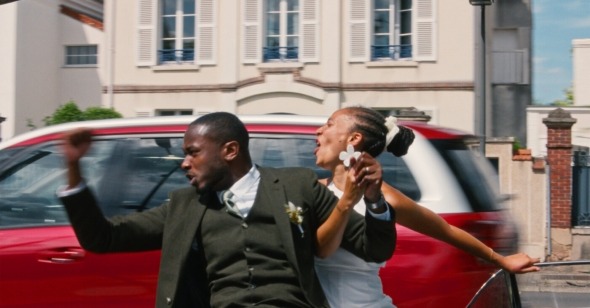
Nour’s wedding comprises the other half of the film; Gomis cuts between the twin multi-day ceremonies and celebrations throughout. The single, rather solitary Gloria is ambivalent about her daughter’s romantic inclinations—we initially see Correa and Kouadio rehearsing a conversation in which Gloria, presumably speaking from experience, tries to convince Nour to hold off on committing herself a little longer. But she can’t argue with the bond between Nour and James (Mike Etienne), which develops in rehearsals before a swift cut to the two of them zooming along in a convertible, horn honking, flag-waving bridesmaids and groomsmen trailing in a raucous convoy.
Both the funeral and the wedding are marked by chanting and dances, at once choreographed and euphoric, whether to handmade drums or the Fugees; there is feasting and drinking to excess, and there are secular rituals, such as the slicing of the wedding cake, as well as folk-religious ones involving the veneration of effigies. In such juxtapositions, pointed but not editorialized, Dao reveals itself as a docufictional companion piece to Harun Farocki’s In Comparison, which simply documents the various procedures for manufacturing bricks in the global South and North. Historical flows of capital and people are concentrated into Gomis’s human-scaled compositions: a little girl in a pink dress nodding off at a wedding reception at a French country villa, or an entire African clan wearing heat-pressed t-shirts of their late patriarch’s face as part of a mourning process that also involves butchering goats and cooking them for the entire village. The disparate elements of the film are connected by a languorous Afro-jazz score by Abdullah Ibrahim and Keïta Janota that helps to give Gomis’s long scenes a rhythmic, distended, overflowing texture.
To play multiple generations of characters, Gomis cast many members of his own family, who were given dramatic outlines on set across a shoot split between ten days in Guinea-Bissau and ten in France. (The footage was gathered by three credited cinematographers.) Gomis plants a few experienced film actors among them, including his frequent collaborator Samir Guesmi as Nour’s father and Gloria’s ex; late in the film, the mother and father of the bride share a prickly, rueful conversation about gender roles and expectations, their reflections on the limits of their assimilation clouding their hopes for their daughter.
If you didn’t know which of Correa and Guesmi has been acting in films since the 1980s, you wouldn’t be able to tell. Gloria is a daughter at the funeral and a mother at the wedding; in Africa she is among the ones who left, in Europe she is an immigrant. Correa’s stoic gaze matches her liminal status; her aura of wounded skepticism makes her seem both outsider and insider, observer and participant, and this does much to draw out the dual perspective of Gomis’s film, which is both analytic and experiential.
One preoccupation that emerges through Gloria is a dissatisfaction with codes of masculine behavior on either side of the diaspora. She observes the gendered division of grief work in Guinea-Bissau, which involves the women of the clan sleeping on the floor and serving men as they drink (Zambian Welsh filmmaker Rungano Nyoni examined the darkest implications of this binary in 2024’s On Becoming a Guinea Fowl, a study of abuse and its enabling). At the wedding, her brothers get into heated, liquor-lubricated disagreements over outdated sexual norms, while a family black sheep raises eyebrows when he arrives late with a heavily pregnant white girlfriend. More than any inciting incident, fights seem to break out when someone peacockishly impedes another’s personal space to demand an apology or offer ostentatious forgiveness for a slight neither party can actually remember (no one is ever mad until well after the shoving starts).
This is a film in which a kids’ soccer game is overtaken by progressively older boys and men—but also one in which Gloria ends up on the pitch as well, the whole wedding party cheering her on as she takes a penalty kick. In its tonal range, Dao has sufficient vitality to live up to its opening epigraph, which defines the title as “a perpetual and circular movement which flows in everything and unites the world.” Another recent film set in Guinea-Bissau, Pedro Pinho’s I Only Rest in the Storm, also sketched an outline of European and African cultures in conversation through its elaborately worked-out background action and long running time. But while that film was more thesis-driven, centering its loose-hanging drama around an oblivious Westerner, Dao is simply an open world. Gomis’s camera wanders through it, at once electrified and relaxed.