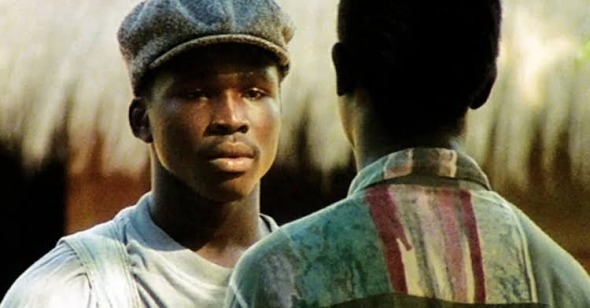
Nature Boys
Dakan
By Kelli Weston
Though a smattering of films throughout the 1970s, mostly from Senegal and Tunisia, featured minor queer characters, Dakan, which should arrive as late as 1997, enjoys distinction as the first African film to explore same-sex intimacy. For some time, Dakan commanded a respectable, if mixed international profile, including a feted premiere in Directors’ Fortnight at Cannes, the same edition where Wong Kar-wai’s Happy Together competed, and a far less warm reception at 1999’s FESPACO (The Panafrican Film and Television Festival of Ouagadougou), where its Guinean writer-director (and sometime actor) Mohamed Camara had to change hotels every day and dip out of screenings early to avoid violence. Not that the film's laurels, accrued on the festival circuit, did anything to rescue the standing of Camara, who has not made a feature since.
In Mandinka—better known by its colonial exonym “Mandingo” to describe a people (and their language) stretched across Gambia, Guinea-Bissau, Guinea, Mali, and regions of Senegal—“dakan” translates to “destiny.” This is a curious word to characterize what most in the aforementioned countries have been convinced is not even “natural.” Mali was the rare case that criminalized same-sex relations for the first time in 2024, and only in Guinea-Bissau is homosexuality legal. What is natural rarely requires such aggressive regulation.
Camara’s film comes to much the same conclusions. High schoolers Sory (Aboubacar Touré) and Manga (played by the director’s brother Mamady Mory Camara) kiss and cling to each other with quotidian ease. When we find them, their romance is not new and unexpectedly accepted by their schoolmates. Both Manga’s single mother (Koumba Diakite) and Sory’s businessman father (played by the filmmaker himself) appear aware of their sons’ illicit attachment, albeit frustrated by their persistence, until they can bear their defiance no longer. The boys are separated. Sometime later Manga gets engaged to a white woman (Cécile Bois), a pairing more tolerable to his mother, and Sory has a child with a village woman. But they cannot shake each other.
Dakan is an unusual production, even by today’s standards. Our lovers have a measurable touch of what feels like anachronism: the very first scene of the film is almost comically classical—two adolescents making out in a red convertible—but no such scene between men yet existed in African cinema. (For that matter, Western cinema, certainly at the height of the AIDS crisis, was not much better, with its propensity for either unrequited or largely chaste affairs.) The past 30 years hardly boasts a glut of queer African cinema, amid admirable strides like Senegal’s Karmen Geï (2001), South Africa’s The Wound (2017), and Kenya’s 2018 smash success Rafiki. But Dakan eclipses even some of its worthiest successors—at home and abroad—by giving its heroes a happy, not merely optimistic, ending. What makes Dakan such a striking artifact is that the place where we might otherwise fix Manga and Sory in time is marked instead by gaping absence.
Camara, who is straight, had already established his propensity to experiment or test the bounds of narrative convention, with a marked affection for outsiders. In his Denko (1993), a woman—obliged by the albino healer she rescues from drowning—cures her blind son (again Camara, who began as an actor) by having sex with him. While incest and later child suicide, in his 1995 short Minka, betray a curiosity in the murkier, shadowy dimensions of human possibility, Dakan, a soulful portrait of two young men helplessly drawn together, may trace its origins to a more nuclear experience.
Camara was born in 1959, a year after Guinea secured its independence from France. He came of age as indigenous cinema bloomed across the continent in the wake of the Laval Decree, which had previously restricted African filmmakers from making anti-colonial movies. Ousmane Sembène, Souleymane Cissé, and Djibril Diop Mambéty were surely models and, later, peers; in fact, it was Mambéty who reportedly approached Camara after a screening of Dakan and predicted, “You can be sure that your career is over, but in a hundred years, people will still talk about you.” (It should perhaps be noted that certain scholars have located strands of queerness in Mambéty’s own films, including 1973’s Touki Bouki—or “Journey of the Hyena”—due to the animal’s gendered ambiguity and the sexual subversion the creature represents in Wolof folktales.) African films about queerness invariably announce the wound left by European intrusion. Now we know that many pre-colonial African societies, by no means uniform, embraced diverse sexualities.
Camara would see this up close for himself—after a fashion—planting the seed for his influential film. While shooting Denko in Burkina Faso, the filmmaker observed two teenage boys kissing in a nearby courtyard. Even more curious, he watched as they washed the back of a woman in a public bathroom. Sensing his surprise, the locals explained, “They are girls.” At a Howard University post-screening discussion in 1999, Camara explained, “In [Guinea] people’s view, a male homosexual is someone who is very feminine and imitates women…when there is a party or a social gathering it is the homosexuals who come to make the party come alive.” According to the director, they are usually integrated in their respective communities, but principally as “entertainers” (in this way, we see acute parallels to the West and its own habit of accepting queerness primarily as spectacle). “But the minute you say,” he continued, “that a homosexual is a man who makes love with another man or a woman who makes love with another woman…there is a certain level of confusion in people’s understanding about the situation.”
Far from the performance gender requires across most cultures—generally subject to withering scrutiny on all sides—the first post-colonial generation recoiled from engaging with homosexuality on serious terms, in the face of widespread sexual exploitation and myths about Black hypersexuality. Some Africans believed sodomy was introduced by Arab slave traders and Europeans. This makes it “un-African” and yet also satisfies the actual colonial myths that still cling to the continent. Under patriarchal conditions of sex as an exercise in dominance—something done to women—we begin to see how sex between women is not considered sex at all (the presumed absence of a phallus or penetration) and how sex between men preserves certain reductive gendered implications. Moreover, in the way that Black women are excluded from the category of womanhood, historians have often deemed the far more tragic crisis that Black men cannot fully access the spoils of patriarchy. Thus, the rejection of “femininity” (the dominated) carries an urgency that must feel like an escape from death, or else, a status one suspects they occupy anyway.
Camara translates, with remarkable clarity, all these warring tensions and the humanity behind them; that is, the borders to which we are so woefully beholden. “If God were fair, he’d let me bear your child,” Manga tells Sory, revealing those ineffable strivings that exist purely in the body—the irresistible urge to become whole with another—conveyed, inadequate as language can be, in the only grammar available to them. But their relationship is not free from the shadow of power. Class corrodes their connection from the beginning. Sory is rich (the red convertible is his) and, on occasion, withholding, not unlike his implacable father. Manga lives with his mother in a smaller, much plainer house than his boyfriend’s, and this scarcity surfaces for him emotionally, too, as paranoia and insecurity, when he accuses Sory of flirting with other boys.
Their parents’ respective methods of “purification” reveal much about their class division, too. Manga’s mother, not unlike the desperate mother of Denko, stages a countryside “spiritual” intervention to heal him, as if queerness were contagion. She consults the metaphysical, although curiously enough, their Indigenous rituals demand an earthly return to nature (Manga’s mother covers herself in wet clay and lies in a bed of soil at a cemetery). Meanwhile Sory’s father expedites him into the world of business—an embrace of modernism and capital—though not before he betrays himself: “Everyone will be…terrified by the two of you,” he tells his son. It is crucial that he should name terror—rather than, say, hate or disgust—which suggests he instinctively grasps that the boys mount a dangerous, tribal repudiation. Cloaked in shadows, their silhouettes crouched in doorways, Manga and Sory do not carry their own shame so much as the cloud of a long forgotten history. The late Guinean singer Sory Kandia Kouyaté’s “Toutou Diarra,” a Mande anthem devoted to ancient warriors and Bambara royalty, scores the film, as if to mark Sory and Manga’s story as the oldest one of all.