Nutcracker, Nutcracker
By Mark Asch
Mad Bills to Pay
Dir. Joel Alfonso Vargas, U.S., Oscilloscope Laboratories
If you live in Crotona Park East and don’t have a car, then one way to get to Johnny’s Reef, a fried seafood place at the southern tip of City Island that’s packed all summer long with Bronxites celebrating graduations or capping off beach days, is to take the 5 train from Freeman Street a few stops to Pelham Parkway/Williamsbridge Road, where you can catch the Bx12 bus and take it to Bruckner Boulevard (US 95), across the Hutchinson River from Pelham Bay Park. From there you’ll take another bus, the Bx29, the only public transit on City Island, via Orchard Beach. It takes a little more than an hour each way, but if track work or traffic holds you up, the Bx29 only runs every 15 minutes during peak times, so you’ll want to budget in some extra waiting time just in case, and if you’re coming back at night, the 5 train doesn’t run south of East 180th St after 9:00 p.m.
So, then: If a 19-year-old from Crotona Park East cannot regularly show up on time to his minimum-wage job at Johnny’s Reef, how immature do you consider him to be? This question, in a sense, is the subject of Mad Bills to Pay, the debut feature by Bronx native Joel Alfonso Vargas, an instant-classic New York Movie and a lively, sophisticated study of the interrelated imperatives of masculinity and money, grounded in the specifics of a Dominican family in an unaffordable city.
The 19-year-old struggling to hold down a job at Johnny’s Reef is Rico (Juan Collado), who begins the film with a less reliable but more entrepreneurial gig, selling nutcrackers—head-splitting home-mixed blends of sugary fruit drinks and hard alcohol—on Orchard Beach, forcing his cooler through the sand and shouting out his wares: Pikachu Lemonhead, Laguna Beach, $10 for one, $15 for two, $25 for three. He lives with his mother. Andrea (Yohanna Florentino), a healthcare worker who keeps demanding hours, and his 16-year-old sister, Sally (Nathaly Navarro), in a house whose walls are mostly bare save for black electrical cords snaking every which way. Early in the film, Sally is grounded for attending a party, but the screaming mother-daughter fight is shortly resolved, in an ensuing scene, into a tender celebration of Andrea’s birthday—mom is newly 40, with no man in her life, and the suggestive math suggests one reason for her and Sally’s tense relationship.
Having been the one to drag his sister home from the party, and joined his mother in ganging up on Sally for her racy taste in clothes and dangerous taste in company, Rico is equally, aggressively protective of his sister's sexual innocence, though he knows the score for different reasons. Soon after, Rico finally picks up the phone call he’s been ducking all morning and duly relays the news to his mother and sister: He’s going to be a father. “It’s Destiny,” he says. “Destiny who?” asks Sally.
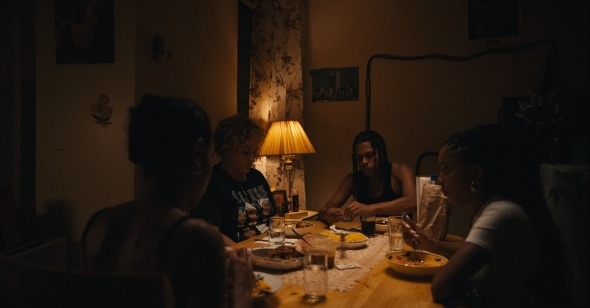
Specifically, Rico has knocked up 16-year-old Destiny Quinones (Destiny Checo), who, having been kicked out of her own house, shows up at Andrea’s in an oversized bootleg Aaliyah t-shirt and moves into Rico’s bedroom, squeezing in past the open drawers and stacks of shoeboxes (there’s no evident room for a crib). Rico chatted her up on the beach, and incredulous Sally knows her from school, where Destiny sits near the wall in the cafeteria. Meek and sullen, shrinking herself to be as small as possible at dinner with her new family, Destiny was surely vulnerable to Rico’s attention, and, at least initially, she’s swept up by his bravado as an impending dad.
Rico’s father being absent, he is initially effusive about stepping into manhood; his hard-sell charm, honed hawking bootleg cocktails on the beach, serves him as he officiously swaps out Destiny’s breakfast cereal for something less sugary, and hand-waves away her concerns with assurances that he’ll take care of everything. Destiny, so entirely lacking in self-confidence, is eventually forced to grow up simply through her disappointment and frustration in Rico, who, it becomes clear, cannot tell the difference between a dream and a plan. He’ll get a car, they’ll get their own place; she doesn’t need to worry about anything, they have time to figure it all out. As with his repeated proclamations that the baby will surely be a boy, he defers all specifics with magical thinking.
When soft-spoken Destiny expresses that she might want to get an abortion, Rico simply shoots her down with a “Bro, seriously?” It’s emasculating, her suggestion that he’s not ready for this; as it’s emasculating when it turns out that his and Destiny’s mothers are resilient, competent, and better at handling the practicalities of planning than he is. Another big fight is sparked by his insistence that he doesn’t want his baby to be vaccinated, to the shock of Destiny and the horror of Andrea, who’s in and out of scrubs the whole movie. (Asked how the child will be able to go to school, Rico invokes charter schools, noting that they can also fire their teachers much easier.) He offers no justification, well-sourced or otherwise, for his anti-vax beliefs, which are incoherent but make a certain kind of emotional sense: there’s no dignity, it seems, in doing what you’re told, in simply submitting to the instructions of the experts who know better than you. Vargas shot the film in 2023, but one wonders if Rico was one of the many young Hispanic men in the Bronx who swung to Trump in 2024 because they identified with his oppositional brazenness and got a vicarious charge of agency from it, a brief glimpse of a life lived with real scope.
Collado has raggedy braids, sharp features, and a soft body; he gives Rico a pouty devilry and a half-faded, half-cranky weariness. He’s both immature and prematurely aged, and his options are foreclosing rapidly. His new responsibilities mean it’s time to “man down,” as an acquaintance advises him—not “man up.” His reward at the end of a day mopping toilets at Johnny’s Reef is a small drink at the bar at work, which, with a punishing commute looming and a family waiting, soon turns into another drink, and another. Rico is right, to a certain extent, to resist the indignities of labor under late capitalism at a time when upward social mobility seems ever more a mirage, but he’s also a staggering drunk. Having gathered his rosebuds and passed out in his own doorway with his keys in the lock, Rico on one occasion has to be roused the following morning by his mother, who has eaten far more shit, not least from him, for far longer, but will not be late to her own job. For all the good that’s done her.
Vargas wisely makes no effort to disentangle individual and systemic causes for Rico’s troubles, a distinction that flummoxes Andrea and Destiny, too, especially after Rico is arrested for fare evasion. He’s also roughed up, along with the pregnant and visibly teenaged Destiny, by an aggro cop—ACAB, it goes without saying, but that doesn’t mean your baby mama won’t blame you for making them feel worried and vulnerable, especially if you knew you had outstanding warrants for selling alcohol. Vargas’s deadpan filmmaking rhythm in this scene—a cause-and-effect cut pattern that takes us from a cooly observant long shot of the turnstile jump to a slapstick medium of the arrest—is, as in others, funny in how it unfolds with a logic so ruthless we might even call it carceral.
Shimmering with local color, and attentive to the all-cash accounting of outerboro life, Mad Bills to Pay would seem to slot easily enough into a New York neorealist mode—a genre that encompasses the Photo League poetry of The Little Fugitive, say, and the handheld shake of Laws of Gravity, and at its best (as in those films) takes on a documentary urgency befitting the city's overwhelming humanity. But Vargas's formal choices resist the reflexive assumption that its characters' humble circumstances should be conveyed by an unassuming style. The film is a city symphony, albeit out of tune. The first shot is of the Paradise movie palace on Grand Concourse, a 20th century monument to working-class entertainment that was accessible yet elevated—it was one of the Loew’s Art Deco “Wonder Theaters”—but one that closed in the 1990s after a long surrender to demographic change and economic decline. The atmosphere is humid, with natural light filtered red-orange through ratty blinds, and artificial light shimmering outside a bodega. You never forget where you are—or lose track of the larger forces shaping it. Eyebrow-raising pillow shots include a Bronx Community College ad on the side of a bus, the single word “Education” vague but insistent like a magic password, and the armed forces recruitment center on Fordham Road.
Vargas shot the movie in 16 days, expanding on a prizewinning proof-of-concept short also starring Collardo. To cover as many scenes as he did, he took inspiration from Pedro Costa’s locked-off camera and similarly collaborative rehearsal process with nonprofessional actors. His cast is far more voluble than Costa’s regulars, and his palette, achieved with cinematographer Rufai Ajala, swaps Costa’s deep blacks for a vivid array of blues—the rich blues of sea and sky, the almost Kleinish synthetic blue of Rico’s wheeled cooler and the tables at Johnny's Reef, the icy and artificial light blue of a Blue Hawaii nutcracker. He and Ajala shoot in single takes, with the camera usually in the corner of a room.
Especially during screaming fights, the surveillant camera gives Navarro something to play to—she makes outrageous, almost fourth wall–breaking imploring or incredulous faces as her mom drops the hammer on her or Rico pulls something. Sally is the youngest and most camera-conscious character, so it makes sense that the actress playing her is a bit of a scene-stealer. There’s still some ego and self-consciousness in the way that she presents herself to the world—she’s the only one in the movie with pride left to spare, but just give it time. With its title's unconvincing casual posture toward overwhelming financial obligations, Mad Bills to Pay is a coming-of-age narrative which shows that coming of age sometimes means making pragmatic accommodations to cyclical poverty.