They Live
By Michael Koresky
New York Film Festival 2026:
Paper Tiger
Dir. James Gray, U.S., NEON
“The kind of movie they don’t make anymore.” This phrase is so frequently heard now that it’s worth parsing it a bit. First, what “kind of” movie are we talking about? Is it a film that stands outside of genre traditions, sociocultural trends, or industrial realities? It might refer to, say, Paul Thomas Anderson’s One Battle After Another, the western-influenced, politically minded, rough-and-tumble, non-superheroic saga so ecstatically received last fall, made with the sort of risk-taking budget rarely given to personal visions unbeholden to market testing. Or it might apply to the mid-size, character-driven “programmer,” often without A-listers, which used to provide a solid foundation for a studio’s annual output, like, perhaps, Clint Eastwood’s gripping Juror #2, unceremoniously dumped by Warner Bros. into a handful of theaters with little fanfare before hitting streaming.
Which brings us to the second question: who are “they”? Clearly, this is meant to apply to those phantomlike legends known as “studio heads.” Once feared and venerated, now profit-obsessed stooges and glorified pencil pushers, the studio heads in the age of shameless monopoly are the ones responsible for the lack of entertainment geared towards what we might call “adults,” and which used to be the industry’s mid-size bread and butter. With studios mostly devoted to churning out a tiresome, endless succession of attempted tentpoles, the “they” who might even make such movies has often shifted away from the major studios: affordable, star-driven movies are now the province of independent production and distribution companies like NEON and A24, living somewhere at the nexus of altruistic and aspirational.
Finally, what do we mean by “anymore”? People reading this review have undoubtedly heard this phrase used so many times, and for so long, that it’s started to feel less timebound than just a free-floating 21st-century truism that we’re in some eternal epilogue of cinema history. Yet if the list of “the kind of movies they don’t make anymore” has become so extensive as to include A Star Is Born, The Fablemans, The Brutalist, The Mastermind, Blitz, Blue Moon—all titles I recall hearing this phrase connected to or which I maybe applied to myself—and so many more, then clearly these are the kinds of films someone does still make and will continue to make in some form. But to adequately understand the “anymore” we also need to diagnose the moment and what’s no longer central to film culture. Throughout this decade, films that have gained cultural currency that do not feature teenage spider-web slingers or faces being pummeled into oblivion (horror’s current de rigueur gross-out tactic) have been decidedly of the moment; from Get Out to Everything Everywhere All at Once, from Weapons to The Drama, most of the most talked-about movies of the past decade, however varying the quality, feel like they have already written their trend pieces in advance and are readymade to start online “discourse.”
To their endless credit, the movies of James Gray never have an easily marketable or exploitable hook, and thus are unlikely to set social media on fire. Gray has been making movies that “they don’t make anymore” for so long that he’s helped the phrase lose its meaning while also giving credence to it by being the consistent exception. His movies are sturdily crafted dramas that viewers of a certain age—perhaps born before the turn of the millennium—might have grown up watching: geographically specific, authentic to their milieu and time in history, inquisitive about human nature, fascinated by how familial and social customs are reflective of larger historical factors. In other words, these are movies about people: if James Gray’s not the “they,” he must be the “us.”
Gray’s Armageddon Time, to these eyes one of the great films of this decade for turning its barely concealed Trump-era anger into a despairing, “how did we get here?” mourning in America, seems to emerge only from its own, expertly tilled soil; The Lost City of Z may have been based on a nonfiction best-seller, but the movie forgoes traditional adventure beats in favor of an internalized, pragmatic depiction of human obsession; Two Lovers finds the grandeur in a modern-day New York love triangle not by giving into operatic histrionics but instead burrowing into the subtle social customs of a Russian-Jewish New York enclave that grant its characters their specific, sometimes oddball identity.
There’s no James Gray formula—his work is too habituated to the unpredictable vicissitudes of trying to live as a moral person in this world to fit an easy template. But there does seem to be a method, one returned to time and again, one born of integrity, artfully deployed within generic parameters. Gray’s new film Paper Tiger stays true to his traditions—autobiographical authenticity, middle-class aspiration, evil lurking around the edges. Here we see a portrayal of an everyday American striver, a family man constantly worried about his loved ones’ futures, caught unawares when brought into unwitting and naive close contact with a violent criminal underworld. As with so many of Gray’s films, there’s both fragile tenderness and simmering terror, all couched in the foreboding sense that our material, domestic comforts could be snatched away in a single moment. Paper Tiger is Gray’s deftest and most moving film yet about how the assumptions Americans are fed about our ability to transcend class and economic standing are more quicksand than bedrock.
Another way Paper Tiger feels outside of trends is in its propulsive elegance: there’s an economical storytelling here more reminiscent of classical Hollywood than exposition-heavy movies made in the TV streaming age. Gray prefers to get at his ideas subtextually, filtered through character behavior and cause and effect. This isn’t “vibe cinema”—themes that may have been lingered upon and heavy-handed by other filmmakers simply become part of the conceit, and viewers aren’t spoon-fed narrative turns in advance. Foreboding is part of movement and milieu. This is, after all, a movie concerned with moral rot that centers around pollution—of the environment, of the soul, of the future. Gray doesn’t mean to hide or bury what he’s trying to communicate about the precarity of American middle-class life: he opens with an image of the World Trade towers poking up like cornstalks in the distance among an expanse of swaying tall grass on New York’s outskirts. We’ll later return to this field, under soaring overhead planes disembarking from LaGuardia Airport, only now it will be sprayed with blood.
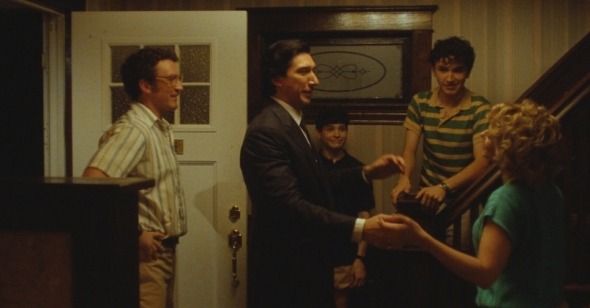
Returning to the mid-1980s Queens of Gray’s youth, the film comes out of the gate as a warm, lived-in portrait of domesticity, briefly burrowing in with husband and wife Irwin (Miles Teller) and Hester Pearl (Scarlett Johansson) and their good-natured teenage sons Scott and Ben (Gavin Goudey, Roman Engel), before darkness encroaches. Exquisitely shot in widescreen by Joaquin Baca-Asay with a thoughtful, pleasing intimacy that almost imperceptibly tilts from nostalgic to menacing, Paper Tiger exists, crucially, in a pre-digital world, when American life, even in New York City, felt local and any awareness of the doom hovering around our peripheries had to come from the boundary dissolving of physical encounters. Irwin’s older brother Gary (Adam Driver), a former police officer whose work connected him to the shadier side of humanity, functions as the catalyst for the tight-knit Pearl clan’s exposure to the elements. One night, after seducing his brother and his family with a surprise, home-catered spread from Peter Luger, Gary pitches his engineer brother on a sure-fire scheme, assisting a group of Russian “businessmen” on a real estate venture down by the Gowanus Canal in Brooklyn. It’s easy money, Gary swears, and a hot ticket to help Irwin and Hester establish a firm foundation for the boys’ future. As soon as they meet the shadowy Russians (very obviously the mafia), it becomes eminently clear that all will not be so simple: even in their earliest interactions, the supposed professional relationship shatters, as Irwin’s attempts to introduce ethical standards and regulations on the Russians’ illegal actions—which include dumping toxic waste from the canal—only stoke their suspicion and kneejerk propensity for violent retribution.
The specificities of these criminal machinations are mere engine fuel for what’s more critical to Gray’s vision: an exploration of love—between brothers, between husband and wife, between parent and child—and the sacrifices inherent in realizing the fullness of the bond that love creates. Gary, finely inhabited by Driver with his customary combination of physical confidence and interiorized anxiety (despite his swagger, Gary embodies a kind of constant guilt, like he’s always second-guessing himself), acts out of care and concern for his brother, despite his wayward, ne’er-do-well tactics. The inexperienced, essentially decent Irwin, brought to nerve-wracked life by a never-better Teller, is interested less in a ticket to the big time than a way to ensure his family’s financial stability. At the same time, Gray gives Hester her own private hell, a sudden and alarming medical diagnosis that, amidst the escalating nightmare, she keeps painfully to herself. Having Hester harbor her own malignant secret effectively underlines the growing distance between Irwin and Hester, while also deepening the film’s preoccupation with free-floating contagion. The subplot also grants Johansson a meatier role, which she gnaws into with gusto and sensitivity. For all its focus on fraternal pride and masculine honor, the images that might stick most from Paper Tiger are those of Johansson’s face, with its tremulous self-concealment.
If Paper Tiger feels and moves like the “kind of movie they don’t make anymore,” then maybe it’s finally because genre is used as neither misdirection nor deconstruction, but as a vessel to explore essential truths, ambitiously and unironically. These characters, richly drawn and sincerely played, move through a space that is entirely their own, within the poignant, passing moment in time Gray had fashioned for them. Gary’s own pathway ends in a simultaneous act of self-negation and self-actualization; Irwin’s climaxes with a realization of eternal tenderness, reflected back through a window; Hester’s culminates in an image of dematerialization that’s almost unutterably moving. Each of them, their lives so intertwined, now cut off from one another, vanishing—from this Earth or from this movie—in his or her own solitary revelation.