Passing Through
Dan Schindel on the Multiplane Camera and Snow White and the Seven Dwarfs
Cinema reconstitutes space, time, and the senses in ways that have come to seem natural to the human mind. This extends from an artificial matte painting to a green screen backdrop to the cut itself, an inherently visual incongruity. This is doubly true for animation, wherein the entire image is an artist-generated caricature of reality. As early filmmakers were building the grammar of live action, animators were figuring out the principles of cartooning that would make its imitation of life affecting to viewers. In both mediums, one important step in this evolution was understanding cinema’s three-dimensionality, comprehending how a camera’s ability to move and zoom could break beyond the artistic delineations of painting and still photography. For animation, this breakthrough came in the form of the multiplane camera, a newly invented piece of equipment that was a huge part of why 1937’s Snow White and the Seven Dwarfs astounded audiences and proved the viability of feature-length animated pictures.
It’s easy to forget (especially in the current digital era) that animation, for most of its history, entailed photographing drawn elements with a camera. This poses a dilemma in resolving the disconnect between the two-dimensional nature of the cartoon elements and the camera’s optical capabilities. There were ways to work around this. A clip of Mickey Mouse strolling through the woods can create depth by drawing Mickey smaller as he walks further away or larger as he draws closer. By only partially drawing him, he can be made to disappear behind trees, even though they’re part of the same single painting used as the scene’s backdrop. The background painting can scroll behind the transparent cels on which Mickey is drawn, simulating a pan.
But if the camera were to zoom in or out, the illusion would be ruined. The entire image would grow larger or smaller at once, which the eye would register as false. If you were in a forest and walked forward, the trees nearer you would expand rapidly in your vision, bushes in the middle distance would grow more slowly, and the greenery farther away wouldn’t look all that different. It’s for this reason that cartoons mostly avoided such techniques for their first 40 years or so. In the 1933 Walt Disney short Three Little Pigs, you can see how the view switches from wide outdoor shots to mid-shots within the three pigs’ cottages by using background paintings with elements drawn larger in comparison to the characters. Though there are many beautiful and impressive theatrical shorts from this era, the technological constraints are obvious. There was a limit to the visual scope of these films, a ceiling on their ambitions. The multiplane camera broke that barrier, in a way not unlike how the introduction of perspective techniques during the Renaissance changed Western painting.
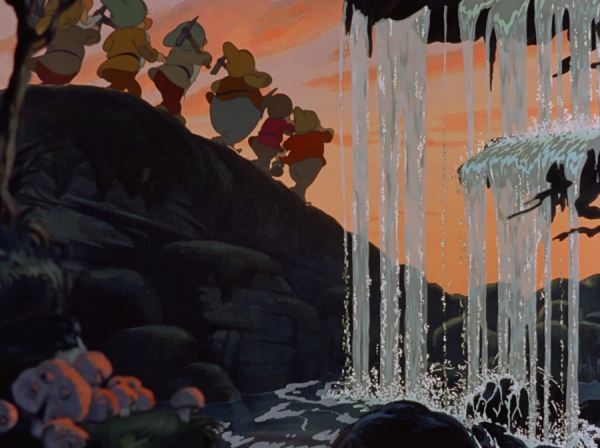
I’ve seen one of Walt Disney Productions’ three surviving original multiplane cameras at the company’s studio in Burbank. Calling it a mere “camera” undersells how imposing the rig is: a 12-foot-tall lattice of poles, gears, lamps, and glass, with the camera itself surmounting it, pointing down at a series of panes into which artwork can be slotted. The different planes can be adjusted, independently pulling toward or away from the camera and each other. By layering different elements of a scene onto different planes, these movements can perform a variety of camera moves outside the confines of two dimensions. One plane can contain the far background of a shot, another a layer of effects (such as shimmering water), another the bits of foreground, and another the cels bearing characters. These planes can all move toward the camera at different speeds (or not move) to create a zoom that operates as a convincing simulacrum of what it would look like in reality.
Before Snow White, Disney tested the multiplane camera with the elegant 1937 Silly Symphonies short The Old Mill. It opens with a long push-in on the old mill and closes on a long pull out. The new possibilities afforded by the multiplane setup are immediately apparent. The first shot has a spider in its web in the foreground, and as the camera zooms in, the focus on it fuzzes until it dissipates from view. In a series of dissolves, a “single shot” can go from a wide view of the mill and the landscape around it to a close-up of a bird’s nest in the mill’s grindstone. It’s a stark contrast with the aforementioned Three Little Pigs, which opens with a still shot of one of the pigs working on his house—a fairly typical introduction for an animated short of the time.
Snow White has a similar introduction, but on a much greater scale, with a grand view of a castle that narrows in on a single window. Already the studio’s animators are flexing with what they can do now; in that opening shot, at the same time the camera zooms, the clouds behind the castle drift across the sky, deepening the tableau’s parallax. Over the course of the film’s unprecedented three-year production, artists like Art Babbitt, Grim Natwick, Gustaf Tenggren, and others with less-awesome names dramatically expanded animation’s vocabulary. Throughout the film, the animators flaunt these new techniques, such as extreme close-ups with zooms, like when the Evil Queen holds up the potion that will turn her into a crone, her face reflected in the glass. When she drinks the potion and transforms, the foreground scrolls to the left while the background scrolls to the right, making the room appear to spin around her. In this scene, the camera facilitates an expression of cinematic subjectivity not previously possible in animation.
Disney’s multiplane camera was not the first. German director Lotte Reiniger utilized a similar setup for The Adventures of Prince Achmed (1926), the oldest surviving animated feature. Reiniger worked in silhouette animation, and her use of overlapping layers drew from the conventions of shadow puppet theater. (Like the Disney camera later, she shot her panes of glass from the top down.) Contemporary with Walt Disney Productions’ golden age, rival studios like Fleischer and Iwerks (the latter run by Walt Disney’s collaborator turned disgruntled rival) developed their own versions before the Mouse House. The Fleischer “stereoptical camera” utilized small sets into which the animation cels were placed, resulting in the distinct combination of cartoon characters and “live action” in shorts like 1936’s Popeye the Sailor Meets Sindbad the Sailor. Meanwhile, the camera devised by Ub Iwerks after he separated from Disney posed the different planes in front of a kind of dolly track. (Frustratingly, while it is well-known that Iwerks built the rig with parts from a Chevrolet, no source I could find described exactly what parts were used and how.) When Bill Garrity was tasked with building a multiplane camera for Disney, orienting the device to operate vertically rather than horizontally proved key for the efficiency of the process.
The history of these tools and the concurrent development of new animation techniques demonstrate how closely artistic concerns and technical logistics are married in filmmaking. The multiplane camera is also an effective synecdoche for the system Walt Disney molded his studio into. The studio put out films with such a refined level of detail in their drawings and nuance in their gestures by embracing an almost Fordist industrial process. It incorporated departments of writers, artists, and technicians operating in tandem on a scale that would dwarf that of any competitors. Traditional animation is an agonizingly painstaking process. Many hours of previsualization, drawing and redrawing, and careful arrangement set up a photograph that captures a fraction of a moment, before the shot is slightly adjusted to create the next frame, over and over. The multiplane camera might be operated by as many as eight men at a time, turning the labor of hundreds of other people—background artists, key animators, in-betweeners, inkers, colorists—into hundreds of thousands of frames, which in sequence become a film like Snow White when projected.
This industrial process of animation extended beyond the drawings. Walt Disney Productions had a whole department mixing its paints in-house. Writing was handled by brain trusts of disparate executives and animators, each contributing story and scene ideas piecemeal. Cash rewards were offered to anyone who pitched a gag that ended up being used in a finished film, often enough that the “gag rate” was even standardized at $2.50 (accounting for inflation, that’s over $50 today) by the early ’30s. The studio benefited from a network effect of drawing audiences through high-quality work, putting a better-than-industry-standard share of the money it made into paying its workers (20% of the profits from shorts were funneled into employees’ bonuses), attracting more skilled workers through such incentives, and utilizing those skills to create even higher-quality work. Many accounts of the time paint an idealized picture of the studio, more like a family than a workplace—appropriate, given Walt Disney’s famously Utopian vision. This was not to last.
The downside of Disney’s industrial efficiency was that it could blur individuals into an undifferentiated mass. This was to Walt Disney’s tremendous benefit; he was a great producer but an even better impresario, and it wasn’t long before the studio’s films were synonymous with him in more ways than just their opening logos and titles. The boss was the one accepting Oscars, appearing in trailers, and talking to newspapers and magazines, which hailed him as a genius. One particular sticking point was the lack of mention in credits—Snow White lists Babbitt and other leads on the production, but many, many more animators go unacknowledged.
Disney was also zealous in ensuring he was the face of the company. Neal Gabler’s biography notes that he was disgruntled with a Time article on the studio which he thought “made it seem that he was irrelevant.” (Originally scheduled in early December 1941, that article was punted as a cover story, for obvious reasons.) In some ways, he treated his workers as extensions of himself, a machine that existed to realize his visions rather than a collective of people who were each artists in their own right. This tendency went back to the silent era. For a time, Ub Iwerks was Disney’s most steadfast collaborator, co-creating Mickey Mouse. Overworked and under-credited, he had a falling out with Disney and quit in 1930 to found his own studio. (They would mend their relationship and Iwerks would return to the studio about a decade later.)
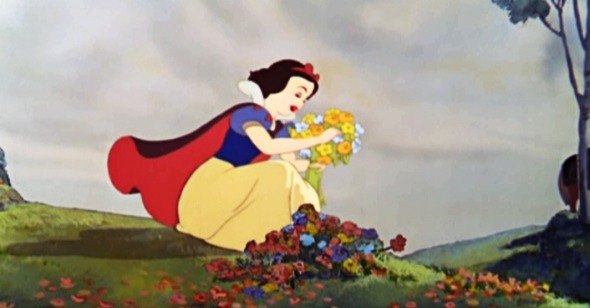
A standout example of this attitude is the studio’s sharp segregation in the work it permitted male and female employees to do. Women were vital to Disney’s golden age, but they long went ignored in official narratives because they were relegated to tasks that were considered menial. Official missives to job-seeking women stated it plainly: “Women do not do any of the creative work in connection with preparing the cartoons for the screen, as that work is performed entirely by young men.” The studio’s definition of “creative work” did not include inking (tracing the linework of a character from an animator’s drawing to a transparent cell) or painting (filling in the inkwork with the right colors), and thus this department was staffed entirely with women. But the ink and paint department workers were the ones who figured out how to properly rouge Snow White’s cheeks, how to highlight her hair so it would remain distinct. They had to both figure out the proper mixing of the gouache paints to achieve the right look that would pop in Technicolor and also keep those colors consistent across many thousands of cels.
Snow White set in motion a chain of events that would shatter the studio’s superficial idyll. The production pushed the staff to its breaking point, with many logging dozens or scores of hours of unpaid overtime each week. The added complexity of setting up and photographing shots that came with the use of the multiplane camera contributed to the extended production time. Workers were assuaged with promises of huge bonuses once the film was finished. But though Snow White became one of the highest-grossing releases of all time, the profits were instead put toward a lavish new campus for the studio. The bonus-sharing standard was nixed. Pay disparities became drastic, ranging from $250 a week for established artists to $20 a week for new ones.
Still, Disney’s artists continued to refine the use of the multiplane camera. Pinocchio (1940) has a tracking shot through a bustling town that’s an order of magnitude more complex than anything in Snow White. Fantasia (1940) follows a procession of the faithful during its “Ave Maria” segment. The parallax in Bambi (1942) is rapturous, authentically creating a thick forest with overlapping layers of trees moving in meticulous choreography with the camera. But none of these films came close to Snow White’s box office draw, and the studio’s financial situation worsened.
In 1941, during the production of Dumbo and amid Hollywood’s rising tide of labor solidarity, unionization efforts spread throughout the animation industry. Babbitt and others joined the Screen Cartoonist’s Guild, whereupon a furious Walt Disney fired them. This precipitated a massive strike against the company, which in turn spurred further firings and poisoned all goodwill between the animators who joined the picket line and those who crossed it (“finks”). The strike would ultimately result in Disney forging a contract with the SCG and setting standards for better pay, 40-hour workweeks, and proper screen credit, among other improvements. Still, the battle laid bare the extent of Walt Disney’s paternalistic disconnect from the workers under him.
While many fired animators were rehired, the studio limped away with its workforce halved from what it was before the strike. Dandelion-like, disgruntled artists spread throughout the industry, joining other studios or forming their own. Walt Kelly avoided taking a side during the strike by going on a leave of absence, but the ill feelings were enough to drive him toward work in comic books instead—he would go on to create the seminal newspaper strip Pogo. John Hubley and others were poached for the newly founded United Productions of America, which would help American animation free itself from the stylistic stranglehold Disney had established. Babbitt and others joined Leon Schlesinger Productions, the forerunner of Warner Bros. Cartoons.
Over the decades, technological advances have smoothed over many of the more labor-intensive aspects of animation. Many inkers found themselves out of work after Iwerks figured out how to use xerography to directly copy drawings to cels in the early ’60s. Walt Disney Productions would continue to use the multiplane camera in its films until it was itself supplanted in the late ’80s by the CAPS system, which could replicate the multiplane effect with computers. With CAPS, animators could work with hundreds of layers instead of a dozen, enabling complex three-dimensional imagery like the flying sequences in Rescuers Down Under (1990) and the iconic swooping ballroom dance shot in Beauty and the Beast (1991).
At the same time, animation continues to be thought of as a process with control concentrated in the hands of a few rather than a collaboration of artists. Animation—not just in cartoons, but also the broader field of computer-generated imagery, which at this point encompasses essentially every big-budget production—has historically faced problems with overwork and underpayment amid a generally precarious environment. Famously, the special effects house Rhythm & Hues had to file for bankruptcy mere months after the release of Life of Pi, which had grossed over $600 million on the strength of the spectacle R&H had helped make. Disney remakes its older films in live action, aping the work of countless animators (sometimes following things shot for shot) without any credit to them.
There is an increasing awareness of the need for solidarity among animation labor. But a new threat has emerged in the form of AI-generated content, which has raised concerns about animators being replaced with prompts getting plugged into generative models (which were trained in the first place on the work of these animators). The industry’s executives continue to take these artists for granted. In 2025, social media saw a fad of people using AI filters to transform photographs into different animation styles. One of the filters replicates the classic Disney look. Nearly a century ago, Walt Disney exploited his animators to make “his” masterpiece, with the multiplane camera both facilitating this production and obscuring the effort of a collective behind a monolithic device. Today, using a phone or laptop and algorithms scraping for information with no comprehension of soul, anyone can prompt the generation of “their” version of Snow White. Technology continues to offer new possibilities while alienating us even further from labor.