Act Your Age
by Kelley Dong
New York Film Festival 2026:
The Day She Returns
Dir. Hong Sang-soo, South Korea, Cinema Guild
Hong Sang-soo’s 34th feature The Day She Returns continues a robust period of autofiction for the filmmaker about aging artists who are more concerned with being true to themselves than being liked. The latter preoccupation often incapacitated the protagonists of Hong’s past films, who whimpered their way into bars and beds to assuage their fear of failure or, even worse, mediocrity. Hong’s contemplative turn from street smarts to aged wisdom now depicts seeking approval as a distraction from more urgent mid- and late-career artistic concerns. The pared-down structure and staging of The Day She Returns give it the appearance of a small aside in a chapter already defined by efficiency. But the film's brevity is the result of careful precision. It is among the director’s best meditations on the artistic process, with an emotional gravity that passes through like a breeze.
Three interviews take place between three young journalists and Jeong-su (Song), a middle-aged actress ending a 12-year hiatus with a role in an independent film. The Gen-Z journalists have little to no knowledge of Jeong-su's catalog or cinema in general, so their lines of questioning careen a little too quickly into the matter of Jeong-su's divorce from two years ago. Jeong-su expresses more interest in probing the minds of the interviewers. Why do they want to talk to her? Is it just because she's famous? What do they think of love, of the future?
The Day She Returns winks at the English title of Hong’s 2011 film The Day He Arrives, which follows a male film professor caught in endless permutations of barhopping and pursuing a woman who looks like another woman he once loved. Perhaps, like myself, the director sees the earlier film as his first successful attempt at constructing a hall of mirrors without any obvious exits or entrances. The structure of The Day She Returns retains its predecessor’s rhyming, but Song has gone from being a figure orbiting men to a central one. And the resignation to the idea that we are condemned to barrel through the same mistakes each day has softened into a sober-minded meditation on a truth chiseled slowly by time and uncovered in increments. It is a moving change from a director whose filmography currently resembles the Ozu approach to artistic growth by returning to and refining previous films.
Jeong-su’s comeback vehicle is by a director of ambiguous repute—all we perceive of him is an off-screen voice offering rides and meals to the young women. The quality of the film, which she claims has an excellent script, and of Jeong-su's performance may be overshadowed by the novelty of her casting. Despite the redundancy of each interview (everyone wants a word of advice for young people), Jeong-su instills her responses with zealous but strategic maneuvers to protect herself, to promote the film, and to offer what she believes to be a good performance. Her experimentation with the elasticity of the truth pokes holes into each conversation as she creates pockets—deviations into the philosophical, questions about the interviewer's love life, an extended explanation of intermittent fasting—into which she might disappear.
Just as he integrated the political activities and theatrical career of actor Kwon Hae-hyo into the plot of last year's By the Stream, Hong sews together elements of his own life with that of Song to create Jeong-su. Like Jeong-su, Song is a prolific television actress and a single mother to a daughter. The character’s foray into independent cinema invokes Song’s collaborations with Hong: Woman on the Beach (2006), On the Beach at Night Alone (2011), and Walk Up (2022). Both the actress and the director have had their fair share of scandals. Song's late husband was murdered by a hitman hired by his cousin in 2017. It has been more than a decade since the extramarital affair between Hong and actress Kim Min-hee on the set of Right Now, Wrong Then (2015) came to light, but its enduring effect on public perception of the two very reasonably remains on the director's mind. The fact that Jeong-su's divorce is already two years in the past has an obvious metatextual connection, but it also serves as a grand metaphor for what one can never accurately describe no matter how many times one tries, especially if the public's interpretation is far beyond one's control.
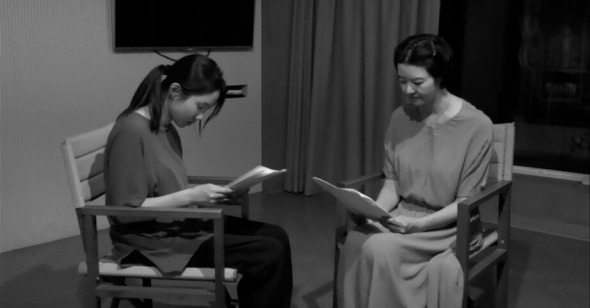
Save for some vaping breaks in the parking lot and a few walks down the street, the film mostly consists of two-shots which place scene partners in profile and Jeong-su's face in full view. At times she appears to yield to a difficult question, then she retreats and turns the question back to the journalist. She snaps with sarcasm, then shares an anecdote about her ex-husband with tears in her eyes. And after insisting to each interviewer that she isn't much of a drinker, she always gives in to ordering a mug of beer with a big smile. The delayed arrival of alcohol plays a trick on the trained expectation that it would unlock a lower depth of vulnerability, as drunkenness has been wont to do in Hong’s films. But as the mugs come and go, Jeong-su grows increasingly opaque as she becomes more adept at using the drink as a prop and preparing for her next take.
After the interviews, she attends an acting class where she is asked to recall and reenact the interviews as a scene. She finds her memories have faded. What she does remember seems altogether too much, both too revealing and too obscure. It is easier to perform passion for an audience and on behalf of a director. But the command that Jeong-su is given over her own experience draws out an uncertainty that renders her hours-old proclamations about this new chapter in her life porous and complicated. The resulting performance is revelatory because it is totally devoid of charisma. Song enters this final portion with more weight on the shoulders and a dimmer light in her eyes. Her shift in body language is what makes most legible the lesson of this mysterious parable: a truer self makes for a better artist, and it begins with the surrender of the bells and whistles.
Claire Denis once described women as being the true axis of time in Hong's films. I’ve maintained some ambivalence towards this view, admittedly out of fidelity to Korean feminists who decried films like On the Occasion of Remembering the Turning Gate (2002) for enshrining a strain of self-deprecating Korean masculinity, bolstered by alcohol and art world hierarchies. (For more on that subject, I redirect everyone to Park Chan-ok's Jealousy Is My Middle Name [2003] and Kim Cho-hee's Lucky Chan-sil [2019]—respectively, Hong’s former assistant director and his former producer.) A clock is important, but it is an object nonetheless. So it is a welcome surprise that The Day She Returns formally concretizes what Hong has gotten right about women before in such masterpieces as The Power of Kangwon Province (1998) and Nobody's Daughter Hae-won (2013). Women are made peripheral by men who fail up, but what they do to survive in a man's world will be executed with grit and aplomb. Even when no one is watching, even in dreams. Crucially, The Day She Returns takes a step further than portraiture. By focusing on the interviews, the structure grounds Jeong-su’s personhood in her own words to describe her desires and goals—being a good mother, being an excellent actress, losing weight, being in a relationship that doesn't feel routine, being happy—and not in terms of who or what she's up against.
I am reminded of the television films Bergman made about actors—The Rite (1969), The Magic Flute (1975), After the Rehearsal (1984)—and how acting’s pleasures derive from a very controlled but intuitive leakage of vulnerability, glimpses of the person behind the mask. Therefore a skillful actor risks forgetting how to be themselves, ironically because they know too well what being oneself looks and feels like. Hong likewise constructs The Day She Returns around the trance the actor falls into and awakens from in order to be someone else, and what it means to merge that other being with oneself. I can’t help but also think of Autumn Sonata (1978), which Bergman made in the aftermath of being charged with tax evasion and his final theatrical release. Similarly stripped down, it is a vulnerable admission to being embarrassed of the human behind the public persona and the artistic mastery. But unlike Bergman and even unlike himself, this time Hong does not conjure a memory, a dream, or the cinema to fill the gaps in our understanding of the present. Instead, he stays committed to today’s banal schedule, with all its unsettling lapses into the unknown. No cuts, no naps, and not enough beer. Only awkward silences and deep breaths before the next repetition.