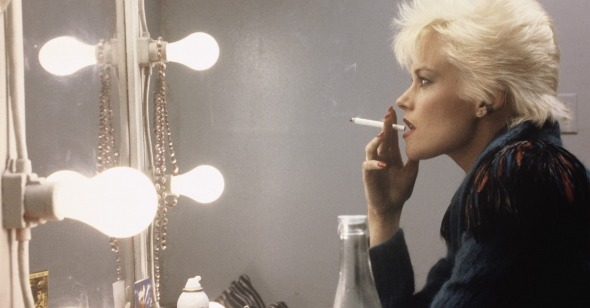
Still a Thrill
Vadim Rizov on Body Double
Body Double screens at Museum of the Moving Image on June 12, 2026, as opening night of De Palma: Summer of Suspense.
“It’s a good script. It’s not gonna save the world. I mean, it doesn’t have eighty-five messages pasted on it. But it shows a side of Los Angeles, and it’s gonna be entertaining.”
As indicated by that not particularly overwhelmed evaluation from Joe Napolitano, Brian De Palma’s’s first AD from Blow Out to The Untouchables, deeming Body Double (1984) one of his peaks is largely a retroactive estimation. That quote opens Susan Dworkin’s book-length making-of chronicle from the time, Double De Palma: A Film Study with Brian De Palma, which captures in granular detail both the workings of a mid-size studio ’80s crew and how De Palma made use of it. As she documents, his penchant for improvisation and incorporating suggestions made for a more flexible vision than suggested by his aesthetically airtight camera drifts, meticulous storyboarding, and rigorous formalism.
Blow Out’s box office failure had taught De Palma a lesson: “I have a certain corrosive vision of society, which seems to not be very commercial,” he told Dworkin. “I try to not let my vision corrode the movies to the extent that they become so dark that nobody wants to see them. I did that in Blow Out, and nobody really cared.” Thus, Body Double marked a “lateral move” (his words) into the realm of technical self-refinement while revisiting the genre that brought De Palma the commercial success of Dressed to Kill. The film had another, equally pragmatic motivation: after going over budget on Carrie, Blow Out, and Scarface, both De Palma and his agent Marty Bauer felt, in the latter's words, that "it would be advisable that for his next picture, he should make a movie that did not have a substantial possibility of” doing so again. One way of getting there was to not cast any stars; per Columbia exec Craig Baumgarten, “We agreed that there would not be three more people to come and see this movie if it had a big star. Brian De Palma is the star of this movie.”
Like Body Double’s reputation, its star emerged retroactively—Melanie Griffith, given free rein to riff—but Baumgarten’s evaluation was ultimately correct: Body Double is defined by De Palma’s patented, hypnotically narcotized camera motion. The film’s controversies were almost predetermined by its central driller-killer murder scene, which doubles down on Scarface’s X-rating-courting violence, and rumors that the movie would feature actual penetration. Griffith’s character was heavily informed by input from Annette Haven, an adult performer who vehemently rejected the label “porn” and who auditioned for the part, but there’s no credence to those rumors, which Columbia swiftly investigated to make sure they weren’t paying for actual pornography.
Body Double began as a 13-page treatment that De Palma intended to produce, only taking on the role of director after his twice-as-expensive project Fire—with John Travolta as a self-destructive rock star modeled on Jim Morrison—fell apart. In the meantime, the treatment had been expanded by screenwriter Robert J. Avrech and then went back through De Palma, who continued revising throughout the shoot. The fundamentally simple premise—an actor, Jake Scully (Craig Wasson), plunges into his own personal Vertigo—was shaped by elements from both De Palma’s cinephilia and life: Scully’s separation from his fiancée echoed the director’s recent divorce, and he used a trauma from his past for an early anecdote explaining Jack’s claustrophobia, rooted in the experience of when, as a child, he was trapped behind a refrigerator while playing with his brothers.
Jack tells this story in an acting class while being broken down by an impatient teacher (likewise rooted in experiences De Palma had), and is then seemingly befriended by fellow struggling actor Sam Bouchard (Gregg Henry). Learning that freshly single Jack is in need of a sublet, Sam offers to hook him up with a Hollywood Hills plant-sitting gig. The UFO-looking hyper-modernist pad comes with a long-lens telescope that, at Sam’s prodding, Jake uses to voyeuristically spy on the nightly dance-and-masturbation routine of Gloria Revelle (Deborah Shelton) across the canyon. That telescope echoes the film camera Robert De Niro uses to spy on his neighbors in De Palma’s 1970 film Hi, Mom!, which was itself based in De Palma’s childhood experience of (correctly) suspecting his father of infidelity, following him with a camera and catching him in the act.
Gloria is murdered, and her Vertigo double turns out to be porn star Holly Body (Melanie Griffith) as Hollywood Hills glamour cedes to home-video sleaze; anxiety about the rise of VHS and its potentially devastating effects for theatrical revenue percolates underneath the plot. Body Double’s other metatextual elements include a not-so-subtle indictment of baked-in entertainment industry racism: when Jake witnesses Gloria being murdered by a flagrantly made-up stranger, it’s easier for him to believe in a rogue Indian running around Hollywood than any slightly more plausible explanation. This subtext is given unintended support by the (unsavory pun) Red herring’s savage white dog, cast after De Palma saw him in the Sam Fuller movie of the same name. (It’s actually two dogs—one for snarling and barking, the other for jumping. Which one was the Fuller alum is unknown.)
De Palma’s films are punctuated by unexpected lurches into comedy, and Dworkin’s book clarifies how that comes about; there are multiple descriptions of Wasson and co-star Melanie Griffith cracking each other up with their riffs. In another section, De Palma acts the other end of a telephone conversation with Shelton, but his “gravelly deadpan cues” don’t produce the required anguish, so Wasson takes over:
“Remember how when we first got together, every time it was boom boom boom, and now it’s every third time or every fourth time? Well, I’ve met somebody new and it’s boom boom boom every time again.”
Brian laughed hysterically, turning crimson. Deborah rolled her enormous blue eyes toward the sea. “I’m trying to get the anguish and he’s laughing.”
A modest production whose budget adjusted for inflation would now come in around $30 million, Body Double nonetheless benefitted from the kind of large crew that could jump into action to accommodate last-minute requests. The original ending took place in a graveyard, but how it worked didn’t satisfy De Palma, who signaled his intent to come up with a new one. When location scout Eric Schwab passed an aqueduct, De Palma decided on that new setting four days before shooting. Relocating the ending there required shooting both outside (with a cost for diverting the water for five hours of $18,000) and doubling the aqueduct inside, including making a hole on the stage that would later be repaired at a cost of $22,000. For Napolitano, this wasn’t an existential change on the scale of De Palma figuring out the ending of Blow Out at the last second—necessitating, among other things, procuring fireworks and 60 extras—but it’s nonetheless startling to learn that such a highly controlled ending was literally constructed in four days.
Prior to Body Double’s release, De Palma had been hype-baiting the press for months: “The media’s gonna go nuts. I’m gonna do all the things they’ve been critiquing me for!” he told the Philadelphia Inquirer’s Rick Lyman. To Lynn Hirschberg in Esquire: “If they want an X, they'll get a real X!” The press repaid the favor: Body Double was denounced seven months before it was released, in the Los Angeles Times by then-regular contributor Joyce Sunila Holt, who wrote, “De Palma can’t wait to show us the depths of his contempt for women … De Palma will pose and strut for reporters, winking his superiority to his material and dragging poor Alfred Hitchcock in as an accomplice.” Body Double was the last erotic thriller he’d make until Femme Fatale (2002) and its tepid critical reception and financial failure were among the factors that convinced him not to take on Fatal Attraction, saying in 1987, “I don’t think you can make movies any longer where you put women in peril that way”—and so, he didn’t. The film inevitably looks tamer than it did upon first release, which only helps its oneiric drift sink in. Camera motion in and of itself is the project beyond all else; per De Palma’s explanation for the 360-swirls around Wasson and Shelton when they kiss, “Every revolution is a revelation.”