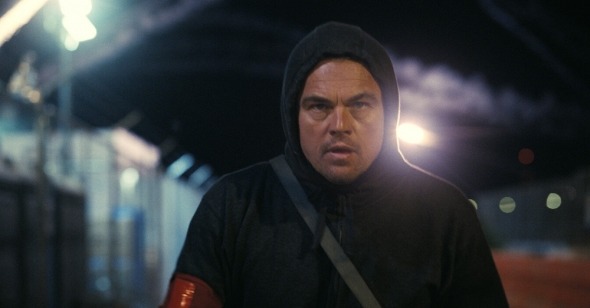
It’s hard to remember a year when there was such consensus over the top ranked film. Across awards bodies, mainstream publications, and even cinephile rags like this one, Paul Thomas Anderson’s One Battle After Another came raging out of Warner Bros.’ janky gates, steamrolling all comers with its full-throttle, Pynchon-cribbed “This is America” bravado. Who are we to argue? From our original review by Violet Lucca to Eric Hynes’s blurb below, we haven’t hidden our enthusiasm, and we’ve been PTA admirers from way back. It’s the fourth film of his to appear on our ten best lists but the first to hit number one, following There Will Be Blood (#2), The Master (#6), and Phantom Thread (#7). (All three would also end up on our decade best symposium, as well.) Why did this particular PTA handily make it to the top? We can’t say there wasn’t a lot of competition. Debate its efficacy as a political object all you want—the jazzy boost it gave us during this very, very bleak time cannot be discounted. We wonder how the film will look five years from now. If we’re lucky, it will seem like a relic. Or maybe this is where we live now.
We may be dog tired, but cinema still has teeth. Just as exciting was seeing longtime RS crush object Jafar Panahi reach his widest audience, Jia Zhangke making a summative statement on his century so far, Richard Linklater continuing to prove his casual vitality, and Rungano Nyoni asserting that she’s a singular new voice on the international scene.
As usual, the year’s best films were determined by polling our major contributors from the last year. Their individual ranked lists were tallied by awarding the top film ten points, the second film nine points, and so on.
[Capsules written by Julien Allen, Lovia Gyarkye, Jawni Han, Eric Hynes, Michael Koresky, Chloe Lizotte, Vikram Murthi, Jeff Reichert, Chris Wisniewski, and Farihah Zaman.]
1. One Battle After Another
Being that it’s already the most festooned film of the year, One Battle After Another isn’t exactly in need of defending. Yet its level of achievement might be underestimated. No one seems to question how spectacular it is to behold or experience, how exquisitely it’s edited and scored, or how uniformly inspired are its performances, how it’s somehow both the most thrilling and the funniest film of the year. Why these would ever be secondary concerns is beyond me, but that they seem to be for some speaks to our era’s degraded appreciation (or diminished understanding) of deep-dyed cinema, and relatedly, of a tendency to instrumentalize films for one’s personal, political, or cultural agenda. But as with any intellectually rigorous work of art, One Battle anticipates these agendas, and furthermore depicts and personifies various of them. It centers Leonardo DiCaprio’s white male Bob, a paranoid pothead decades removed from effective revolutionary engagement, while making clear, at every turn, how comparatively privileged he is (and his political convictions are) in relation to associated women and people of color who’ve so much more at stake and live in far greater danger. Yet rather than lampoon Bob, the script assumes we can absorb complexity and depicts an ultimately likeable dad who’s sweetly obliged by Benicio del Toro’s Sergio St. Carlos (a name seemingly stolen from the mind of del Toro’s other 2025 director, Wes Anderson), a community leader for whom political engagement isn’t a choice or identity but rather a daily, grinding necessity. Surely this isn’t the first work of art we’ve encountered in which the protagonist is, by design, neither the story’s most compelling character nor its moral or political center. For all its magisterial moviemaking, One Battle lets the audience do its own rack focusing. Background is foreground, politics are also personal, entertainment can bear great weight, and lo, we are quite capable of caring about creating a more just world and laughing at ourselves at the same time. —Eric Hynes
2. It Was Just an Accident
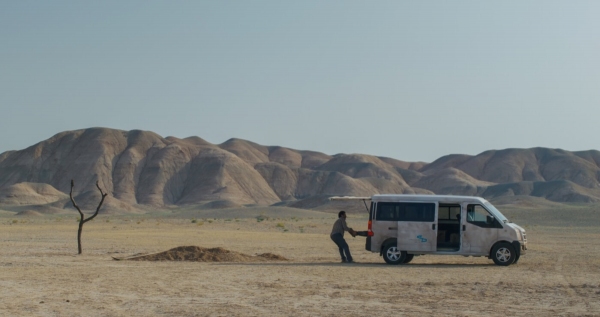
The sweetly vaudevillian title of Jafar Panahi’s Palme d’or–winning It Was Just an Accident both embodies the film’s light, playful elegance and utterly belies the weight of its emotional and intellectual heft in exploring the consequences of living under an oppressive regime. Panahi is all too familiar with such consequences after a decade-plus of making work in secret, in defiance of the Iranian government’s ban on his creative expression. The film follows Vahid, a mechanic who believes the man who came to him for an urgent car repair after hitting a dog happens to be his one-time state-sanctioned tormentor. Panahi is so nimble in transcending the conventions of any one genre or form that this film, in which former political prisoners recount, in visceral detail, the causes of their still-visible trauma, also carries the absurdist trappings of farce, the pulse-quickening tension of a thriller, and a twisted Brementown-band road adventure as one friend after another joins up to help Vahid identify whom he has captured and consider the retribution he deserves. Panahi films people not as symbols of resistance but as participants in a shifting, tenuous reality where dread and joy, violence and tenderness, coexist without hierarchy. The film is a reminder that the work of life is more often about tolerating uncertainty, of how gossamer thin, how elusive, justice is—and how rare is resolution. —Farihah Zaman

3. Caught by the Tides
Jean Renoir allegedly said, “A director makes only one movie in his life. Then he breaks it up and makes it again.” In Caught by the Tides, made under China’s tight COVID protocols, Jia Zhangke complicates this maxim by asking what it means to make the same film when everything around him has changed. In this tour de force exploration of his oeuvre, Jia weaves footage accumulated across 23 years, including outtakes from Unknown Pleasures (2002), Still Life (2006), and Ash Is Purest White (2018), into a kaleidoscopic epic that contends with Chinese modernity in flux, as well as his and longtime collaborator Zhao Tao’s artistic maturation. The dizzying mix of various shooting formats—DV, 35mm, digital cameras, and iPhone—also tracks the evolution of filmmaking technology during this time. Its story, which follows Qiao Qiao (Zhao) in pursuit of a lover who has left her to seek more lucrative opportunities elsewhere, returns to many of the director’s pet narrative motives. But Jia is not one to dwell on the past to deny the present. Instead, he revisits his own body of work to make sense of the current moment and ultimately to look ahead, much like Qiao Qiao, who, at the finale, bids farewell to her old flame and joins a cluster of joggers. Caught by the Tides is at once a sanctuary for historical memories and ways of life on the verge of dissipation, and a profound meditation on life during the pandemic. —Jawni Han
4. Afternoons of Solitude
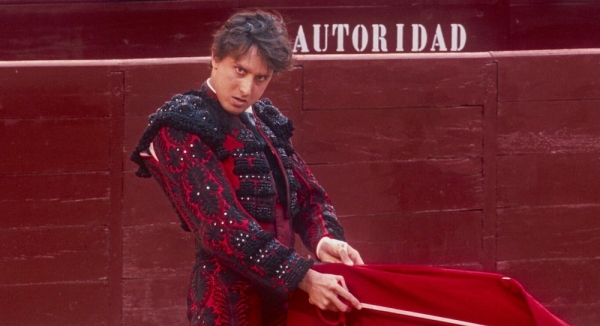
In the closing chapter of a corrida, the exhausted, wounded bull appears to approach something like a trancelike state. Egged on, or, perhaps we might say, directed by the movements of the matador’s bright red muleta, it charges, circles, charges again, in and around the gaudily dressed figure at the center of the conflict, the torero who will soon take its life with his sword. Albert Serra is a filmmaker canny enough to know a good metaphor when he sees one, and it’s impossible not to locate a rumination on the cinema lurking in the margins of his hypnotic, stripped down nonfiction portrait of Peruvian matador Andrés Roca Rey. He completes this work with miraculously few elements—a camera mounted on the back of a seat in a sprinter van ferrying Roca Rey and his crew to and from matches; sharp telephoto shooting of the matador in the ring that has a predisposition to tip into abstraction; a handful of traditional “behind-the-scenes” sequences pre- and post-match—and most hilariously Roca Rey getting lifted up and crammed into his glittering traje de luces as if he were conforming his body in preparation for a drag brunch. (“As if”—Serra is winkingly curious about how this male-dominated sport is a locus for a different strand of homosocial performance.) Context be damned, Serra quite admirably commits to the bit—he cycles through this restrained palette again and again over the course of just over two hours, actively withholding reams of information about Roca Rey, about the state of bullfighting, about the audience for these bloody spectacles, whom we never get to see. Yet, the magic of Afternoons of Solitude lies in how skillfully the film points our attentions elsewhere, to different sets of concerns—motion, light, the bounds of his frame, and, yes, terrible violence and death he refuses to blink from. Is Serra playing matador while his viewers occupy the place of the bull? Or is Serra himself the animal, ensorcelled, weakened and murdered again and again by the powers of his chosen medium? Likely a bit of both, and in this odd, unexpected film, possible meanings stretch far beyond the bounds of the various plazas de toros where its action takes place. —Jeff Reichert
5. The Secret Agent
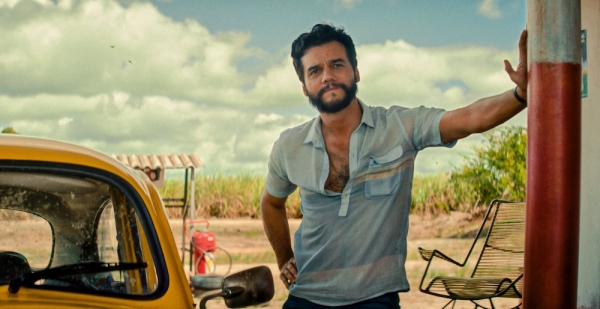
Despite its nabbing Best Director and Actor prizes at Cannes and receiving near-universal critical acclaim upon its American release, Kleber Mendonça Filho’s The Secret Agent hardly qualifies as a revelation. Anyone familiar with Neighboring Sounds, Aquarius, or Bacarau knew long ago that Mendonça is one of our great film artists—an inventive visual storyteller who marries stylistic panache, trenchant political critique, and a keenly observed sense of place. These qualities abound in The Secret Agent, a shaggy dog man-on-the-run narrative set in the late 1970s during Brazil’s military dictatorship. Despite the film’s title, our protagonist (a soulful Wagner Moura) is neither revolutionary nor freedom fighter, just a world-weary professor who has lost his wife and sought refuge from a bounty on his head issued…over a patent. But, as it was in 1977, so it is today: capitalist graft and political corruption make inseparable bedfellows. In its unassuming and disarmingly casual way, this period noir thriller digresses, meanders, and, finally, expands out to become a meditation on history, violence, fathers and sons, the transformation of physical spaces, and, yes, the movies. Propelled by an embarrassment of compelling performances (Tania Maria, playing a grandmother figure to a ragtag group of refugees, could steal a movie from anyone other than Moura), The Secret Agent never loses sight of its human core, which makes it all the more heartbreaking. There may not have been a more quietly devastating scene this year than the one that finds Moura’s professor joining his fellow refugees for an evening of drinks that turns into an airing and sharing of aspirations for escape to a better life. Except, of course, for its shockingly understated climax, at once mercifully withholding and bone-chillingly cruel. This cinematic excavation of inherited trauma lingers in the mind and weighs heavily on the heart. —Chris Wisniewski
6. Blue Moon
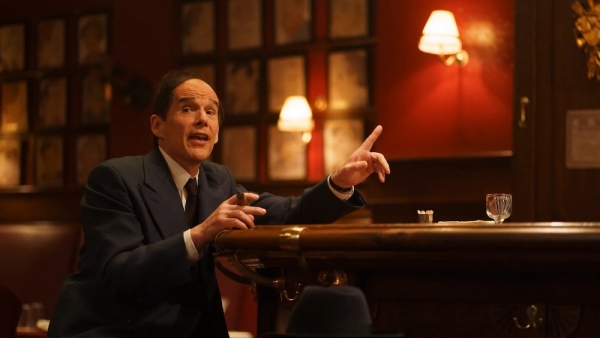
Richard Linklater’s two hangout biographical portraits from 2025 capture artists at critical points in their careers. Nouvelle Vague charts the path of Jean-Luc Godard just as his professional life is about to explode, while Blue Moon finds lyricist Lorenz Hart (an impeccable Ethan Hawke) peering over the brink of cultural irrelevance. Within the warm confines of Sardi’s, a Broadway institution for rising and fallen stars alike, Linklater and writer Robert Kaplow generate a lattice of relationships all stemming from Hart’s gregarious, inebriated presence on the opening night of Oklahoma!, the imminent massive hit from former creative partner Richard Rodgers (Andrew Scott) and his new collaborator, Oscar Hammerstein. Hawke renders Hart a compelling case in desperation: though he can’t conceal his disdain for his friend’s sellout smash, Hart’s anti-populist attitude won’t impede his obsequious need for approval from his commercially minded friend. Hart’s restrained social recklessness is Blue Moon’s narrative anchor, yet Linklater’s expert direction, personified by his ensemble blocking and melancholic compositions, bottles up a feeling rarely portrayed on film: the mixture of admiration and discomfort of listening to a brilliant, troubled man monologue at length—a feeling partly embodied by Scott, who nails Rodgers’s respectful unease toward his despairing friend. All of Linklater’s films dating back to Slacker demonstrate the unique dynamism of language with unparalleled mastery. Hawke brings Hart’s loquacious sensibility to life by infusing Kaplow’s script with embittered panache, but Linklater’s casually precise mise-en-scène turns a cosmically inconsequential night into a subtle emotional maelstrom because he emphasizes listening in the free-flow of communication. Linklater’s relaxed filmmaking style creates the false impression of easy digestibility, but he makes sure we linger on Hart’s words even as they threaten to betray his status and grace. If anything, his sin is making art look too easy. —Vikram Murthi
7. Peter Hujar's Day
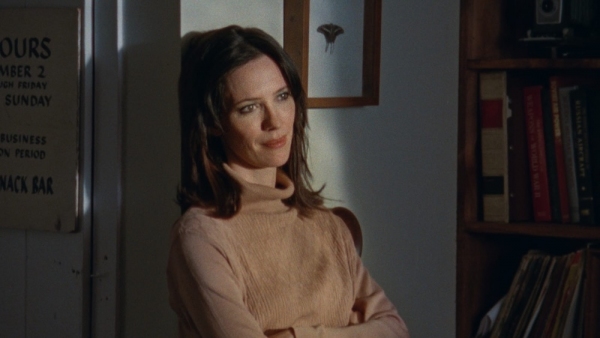
The first line of dialogue is “I got up,” and the last is “I went back to bed and fell asleep.” The remarkable thing about Peter Hujar’s Day—both the 2025 film by Ira Sachs and the transcribed 1974 interview by Linda Rosenkrantz it’s based on—is that the many, many words in the 75 minutes between don’t really matter so much. I mean this in the best possible way: this is a talky film in which the details of its enclosed universe (the name-dropped art world luminaries, the neuroses of working as a freelance artist) ultimately register less than the past they evoke and its attendant feeling of existing as a gay man in pre-AIDS New York. Sachs’s boldly inconspicuous latest doesn’t “bring us back” to the moment of its conception so much as summon ideas, memories, and hopes, wondering about (while never telling us) what this particular photographer’s world was and what his legacy means now, nearly 40 years after he died of complications from AIDS. Ben Whishaw is technically perfect, of course, poring over every word as though unearthed from some long-buried sea scroll, but Rebecca Hall is even more dazzling, a listener of compassion and wisdom whose reactive performance all but creates the film’s meaning: the drive, the need, for love and for understanding another—the inner life fashioned by external details. Sachs’s unceasing adventuresome nature is increasingly rare for our country’s independent auteurs in this unforgiving distribution landscape (thank goodness for Janus), and his film feels like a throwback: not to the 1970s New York art scene but to the kind of low-budget queer narrative experimentation that characterized the late eighties and early nineties—a stretch of time that probably had a lot to do with why so many of us care about this medium in the first place. —Michael Koresky
8. Cloud
“What is up with this guy?” is a thought likely to cross your mind while watching a Kiyoshi Kurosawa movie. In Cloud, the first such guy is ice-cold, impenetrable Yoshii (Masaki Suda), an internet reseller scamming his way to massive profits. Therapy machines, collectible anime dolls—what he’s selling doesn’t matter as long as the price seems right, which he sets based on “impulse and instinct,” gambling with the customer’s own deep-seated need for a dopamine rush. In retrospect, the resellers and career men Yoshii meets along the way all speak in terms of risk, gambling, stability—the precarity of building a life and being a man. But, as is always the case with Kurosawa, it’s not clear where the narrative is going (or if it can go there) until it’s too late. And when it is too late—when Yoshii’s spurned buyers come together on the dark web to hunt him down—Cloud suddenly becomes a kickass shootout action movie. (And would it be a Kurosawa movie if there weren’t a set piece in a warehouse—where we keep the dingy clutter of the subconscious?) What lingers is the intensity of the anger Yoshii’s pursuers feel toward him, numbing them to violence, to self-destruction. Techno-capitalism, as Cloud stages it, destroys humanity through desensitization. Never has the sight of an online grid of identical products for sale, blinking “sold!” one by one, been infused with such a mounting sense of dread. —Chloe Lizotte
9. Misericordia
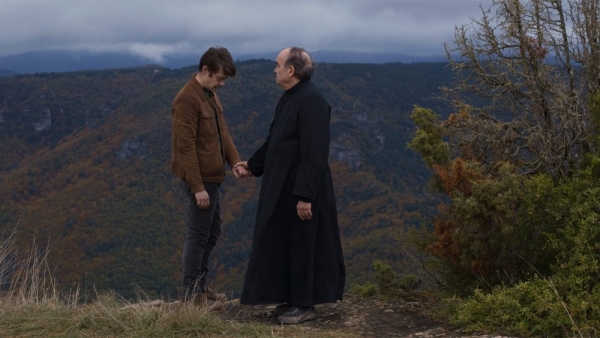
Death and Desire, the ever-present leading men of Alain Guiraudie’s cinema, find mutual attraction in his transcendent morality tale Misericordia. The setting is a still-born, south-by-southwest French village whose parishioners have been robbed of their daily bread by the death of their baker. They will hum in hesitant communion around his returning apprentice Jérémie (Félix Kysyl), a protagonist who remains a stranger throughout—to them and us—but holds them in his grip. He shacks up with the femme du boulanger and provokes escalating erotic pandemonium, like a whey-faced Terence Stamp. The one tangible in Misericordia is the beauty and tranquility of the nearby forest, the site of bucolic mushroom collecting, bloody violence, and investigation. Miséricorde is a commonplace theocratic term in French meaning mercy, and it falls to the abbot (Jacques Develay) to deliver the film’s unforgettable act of compassion: providing the murderous Jérémie with the most solid alibi imaginable, in a sequence bursting with self-sacrifice and love which moves audiences to tears of laughter. Vacillating through genres, as life does—social drama; noir; suspense; satire; farce—Guiraudie audaciously rejects the single-mindedness of most modern drama, and leans into and sublimates the great mystery of desire. Motives are cloaked in darkness, and our discombobulation is a perverse cinephilic comfort. By framing its intrigue as a return to a past we never quite discover, the film exhibits a curious melancholic nostalgia for the bland and weird, and finally promotes the uncontrollable and the inexplicable: cinema as one bafflement after another. —Julien Allen
10. On Becoming a Guinea Fowl
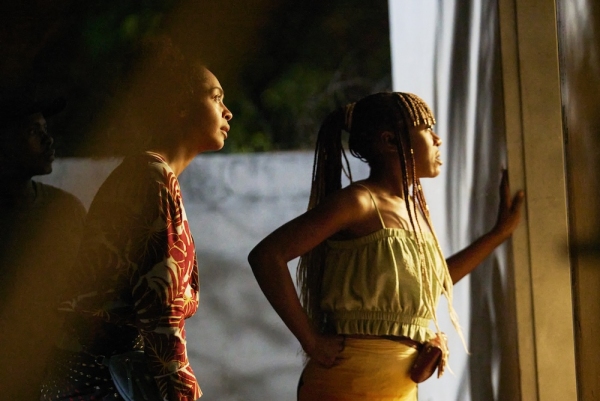
When Shula (Susan Chardy), the protagonist of Rungano Nyoni’s extraordinary feature On Becoming a Guinea Fowl, encounters her uncle’s body in the middle of the road, she is driving home from a costume party and blasting the Lijadu Sisters from her car speakers. Her outfit is comical: a black full-body inflatable jumpsuit with heeled boots and a bejeweled mask. To inspect the corpse, lying prone under Lusaka’s night sky, Shula must waddle instead of walk. This kind of moment, in which the absurd meets the melancholic, is a fixture of Nyoni’s sly film about a family undone by the death of its most troubling member. On Becoming a Guinea Fowl is a surrealist feat and a surreptitious emotional experiment. Nyoni fills the movie’s tragic frame with unexpected instances of humor, pockets of rage, and stretches of deep discomfort. The Zambian-Welsh director, who made a confident cinematic debut with I Am Not a Witch, shapes her sophomore project around the secrets held, buried, and later exhumed by generations of women in Shula’s family. Deftly shifting between wildly different tones, Nyoni accomplishes an impressive and vertiginous highwire act. —Lovia Gyarkye