The Thick of It
by Gavin Smith
The Secret Agent
Dir. Kleber Mendonça Filho, Brazil, Neon
It’s February 1977, and The Omen is freaking them out in the Boa Vista movie theater. Across town, you can thrill to sight of Charles Grodin stomped into the ground in Dino De Laurentiis’s King Kong update. Meanwhile Tiburón, aka Jaws, is still packing them in over a year after its release and, as it happens, a human leg has just been discovered in the stomach of a local beach shark during an autopsy. Incriminating evidence of dirty deeds done dirt cheap, the leg’s switcheroo disposal, dumped into the sea by the local cops, is seemingly the source of the tabloid urban legend of the “Hairy Leg,” terrorizing the amorous denizens of one of the city’s shadier parks in nocturnal rampages. In this “period of great mischief,” as the film announces, nearly 12 years into Brazil’s military dictatorship, it’s business as usual in the coastal city of Recife, unless you can spot the telltale signs. According to the city’s police chief, the death toll of this year’s Carnival is 91 and counting, and by the end of The Secret Agent we can add at least four more.
There’s no question that writer-director Kleber Mendonça Filho’s new film is in part a movie lover’s dream of time-traveling back to his cinephile roots within a fictional framework. It’s a spiritual sequel to his previous film, Pictures of Ghosts, a not-exactly nostalgic meditation on Mendonça’s hometown, to formative experiences that gave rise to his cinephilia, and the decline and fall of beloved movie theaters, amid troubling sociocultural shifts. (One of The Secret Agent’s key supporting characters, film projectionist Alexandre, played by Carlos Diogenes, is modeled in tribute on one of the unassuming “stars” of Pictures of Ghosts, Art Palácio projectionist Alexandre Moura.) The Secret Agent honors the music and movies and places in the heart of the bygone era in which its plot unfolds, and their atmosphere, texture, and aura go a long way to defining the affective immediacy and ambience of the film’s imaginative world. The Secret Agent is a thriller to be sure, but while it delivers the requisite underlying suspense, it also disperses its genre imperatives, hot-wiring this man-on-the-run vehicle to veer off in unpredictable digressions.
The Secret Agent’s protagonist, who goes by the name Marcelo (Wagner Moura), is a reserved, melancholy figure, still mourning the death of his wife—and by extension the dictatorship’s pervasive corruption (where even a movie theater employee can be bribed to finger a coworker). Moura, in a performance of great restraint, fully inhabits his character’s placid, watchful demeanor and never falls into the trap of reaching for big moments, even when Marcelo bewilderedly learns that paid assassins are coming for him. This guy drives a yellow Volkswagen Beetle—what’s he done to become a target?
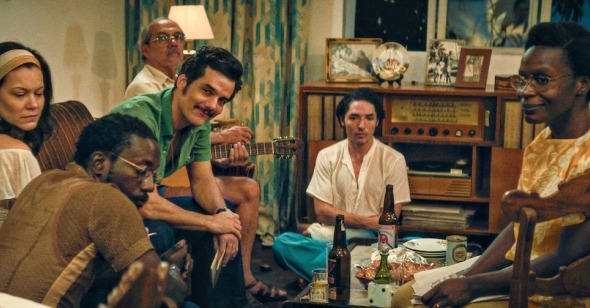
The film opens with a slow-burn Sergio Leone-esque encounter at a gas station in the middle of nowhere featuring two highway cops soliciting a contribution to “the police community fund” and a corpse covered by a tarpaulin, given one last glimpse as Chicago’s “If You Leave Me Now” rises on the soundtrack. Marcelo arrives in Recife, where he is given sanctuary in a political refugee safe house run by no-nonsense septuagenarian Dona Sebastiana (Tânia Maria, a scene-stealing nonprofessional if ever there was one). Here he is welcomed into a makeshift community of people who, like him, are awaiting documents that will enable them to flee the country. In Marcelo’s case, we will eventually gather, he’s leaving because his work as head of a technology research group at a public-funded university has been commandeered and effectively privatized by powerful business interests represented by Ghirotti (Luciano Chirolli), soon to become president of electric utilities giant Elotrobras. Marcelo’s clash with Ghirotti’s ruthless power play concludes with a punch up in a restaurant, making the scientist persona non grata. Intending to get rid of a loose end, or out of sheer malice, it is Ghirotti (possibly based on Brazilian politician and power broker Antônio Carlos Peixoto de Magalhães) who engages the services of a pair of professional killers.
Amidst Recife’s vibrant street life and the tumult of Carnival, Marcelo lucks into a job as a clerk at a public registration archive, where he embarks on a quest for his dead mother’s documents, part of an ongoing effort to retrieve what he can of his past—above all through reunion with his nine-year-old son, Fernando (Enzo Nunes) who lives with his grandfather Alexandre and dreams of seeing Jaws. (Mendonça was nine in 1977.) Marcelo also stumbles into the unlikely good graces of Euclides (Robério Diógenes), the city’s genially crooked police chief. In a breathless stroke of dumb luck, Euclides reconnects with a former military comrade, Agusto (Roney Villela), who explains that he’s in Recife to kill someone—but never identifies the name of his target.
One of the main ways in which The Secret Agent upends its suspense thriller framework is in the deployment of an audacious time-shifting structure. While its pivot to the past and an extended flashback supplying Marcelo’s backstory and his tangling with Ghirotti are not so unusual, the film also springs into the future, where in the present day two student researchers are transcribing cassette tape recordings of Marcelo. The source of these recordings is later revealed when Marcelo is interviewed about his situation in the backroom of the Boa Vista by Elza (Maria Fernanda Cândido), a resistance leader in Recife.
The Secret Agent builds to a dynamic action sequence in which a subcontracted gunman tracks Marcelo down to the document archive. At this juncture, Mendonça certainly brings the goods in thriller terms—but it’s by proxy. Throughout the film he’s steadily surrounded the relationship of Marcelo and Fernando with a constellation of father-son relationships—Ghirotti and his odious sidekick son (seen only in flashback), assassin Augusto and his adopted son and partner in crime Bobbi (Gabriel Leone), Euclides and his godson Arlindo (Italo Martins)—which are activated in The Secret Agent’s climax to stunning effect. But this climax is only notional: the film’s culmination is yet to come, and it’s at an almost 50-year remove from the main body of the film’s narrative. In another leap into the present day, one of the researchers shares with the now grown-up Fernando (also played by Moura) definitive information about the fate of a father he barely knew—a fate that is signally never depicted despite it being what’s at stake from the get-go. Cutting short The Secret Agent’s climactic action in media res and omitting the cathartic action that a conventional thriller conclusion would supply, Mendonça delivers a low-key payoff that’s poignant and bitter. He’s found a graceful and ingenious way to have his cake and eat it.