Puppet Regime
Greg Cwik on the digital effects in RoboCop 2
In RoboCop 2 (1990), a messianic drug lord, biblically named Cain (Tom Noonan), is inundating the streets of Old Detroit—or the dilapidated, sordid mess, rife with violence, that is left of it—with an intensely addicting, brain-rotting drug called “nuke.” The sanguineous fluid injected into the neck offers “paradise”—one made in America. RoboCop (Peter Weller), the cyborg with the ineradicable soul, wants to stop him. But Omni Consumer Products, or OCP, which owns the cops and will soon own the whole city, is trying, and succeeding, to push cops out of the picture by sowing discord and spurring a police strike. They want Old Detroit to burn. The Old Man (Dan O’Herlihy), with his pallid hair belying the black of his heart, is waiting for his crack team of scientists to make Cain into a new RoboCop, imaginatively named RoboCop 2: scarier and more loyal to the company—more dangerous to the city it’s/he’s purportedly intended to protect—than Alex Murphy. Who better to provide the brain and soul of a law-enforcing, killing machine than a sociopathic drug lord with a God complex?
Paul Verhoeven's 1987 RoboCop was a sardonic lampoon of Reagan-era greed, gaudiness, and America's predilection for the amoral use of technology; a sincere rumination on identity and what it is that makes a human human; and, of course, a kick-ass action flick both rooted in, and a rebuff of, ’80s macho man action. It did not need a sequel, especially without Verhoeven and writers Michael Miner and Edward Neumeier. But it was inevitable that the studio would want to put one out after the original's $50 million-plus box office on a relatively humble budget. The sequel, from The Empire Strikes Back director Irvin Kershner, is undoubtedly inferior in most measures and not well-liked by critics or moviegoers—it is, as penned by Frank Miller, pulpy, lurid, and, in Kershner’s hands, Looney Tunes–silly, complete with slapstick sound effects. Yet RoboCop 2 remains fascinating for several reasons, one being the trashy and provocative continuation of the original's existential ruminations on what makes a man a man in an era of machinery, and, most significantly, the unprecedented marriage of traditional and groundbreaking special effects.
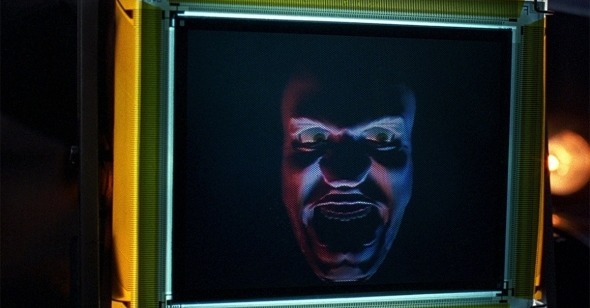
In 1985, Young Sherlock Holmes featured the first photo-realistic CG character animated in a live-action background, courtesy of Lucasfilm, a stained-glass window medieval knight come to life, totaling ten seconds of screen time, RoboCop 2’s “digital” Cain face represented, to that point, the boldest leap forward, and brought the technology—its possibilities and its corruptive powers—to a wide, mainstream audience. Cain's digital face, an ugly, malformed bastard of a human visage, is purposefully glitchy in a way redolent of Max Headroom. Our first glimpse of it is after a braggadocious slaughter of his former heavies and one child, when the screen slides out of the metal-armored “head” of the infernal RoboCop 2; set before a background the color of a light-polluted sky—or, as William Gibson might say, television tuned to a dead channel—it proceeds to gawk lecherously at his former squeeze. Moments later, he grows irate, seemingly arbitrarily, the virulent tantrum of an addict in need, and squelches her head with his industrial claw, ignobly dropping her limp carcass on the floor and, everyone now dead, stomping off for more nuke. The war machine on drugs.
Trey Stokes was the puppeteer for Cain’s/RoboCop 2’s digital face. Stokes, who had two years earlier done VFX on the remake of genre film master Chuck Russell’s technically skilled remake of The Blob, helped advance the medium of CG animation with Mike the Talking Head, a character used for semi-improvised live theater. They utilized a new program called Perform to turn the actor’s face into the live-animated Mike, modeled after host Mike Gribble. The process involved 256,000 points of data and myriad polygons to create shadows. The mouth had to be synced up for each phoneme.
Then they got the job of a lifetime. “The Talking Head team,” Stokes called it, for Cain/RoboCop 2 comprised Greg Ercolano, who did the data for Cain’s death face, Ken Cope, and J. Walt Adamczyk. Cope modeled, and Greg and J. Walt wrote code, while Sally Syberg and Anne Adams produced. They worked off renowned animator and effects supervisor Phil Tippett’s assiduous storyboard plans for the stop-motion, a persnickety process that both helped the animators and made things harder. Stokes and company got a crash course in how CG worked, but [he] couldn’t do any of it. [He] learned to call an exclamation point a ‘bang,’ but that was pretty much it.” The three-axis roll-cage controller manipulated by hand (bringing to mind the Nintendo Power Glove) was synced up to the three axes of Cain's face's rotation. In the middle was a toggle to control the expressive mouth, and for lip syncing, the joystick made “O,” “EE,” “AH,” and “EH” movements using the left hand. The face itself used very few polygons so it could move more smoothly, since Cain only has a face, not a fully formed human-ish head. And because he growls rather than speaks, they were able to bypass some of the more frustrating work involving visual animation and audio recording.
While working on a tight deadline and frugal budget, Stokes said that the crew realized they “shouldn’t approach this like animation, but as performance,” the appeal of a real-time system. According to Stokes, it took five seconds to create a five-second animation. “But ten seconds only took…five more seconds!... [They] let the recording run while [he] tried variations of each shot and even improvised some stuff. That way, Phil [Tippett] could choose a section of performance that worked best, with lots of extra head and tail frames so he could slip the timings however he needed.”
RoboCop 2 offers slightly childish but still intriguing J. G. Ballardian ideas on tech and modernity and humanity's role in the devices and systems it has engendered, whether of noble or nefarious intent. Ballard's notions of the relationship between people and technology, of the effect of advancing science on the human condition, tremble with carnality; he likens our relationship with science and technology to sex, and our attempts to elucidate and explain this relationship to pornography. He sees erotic potential in the inanimate, objects of desire that arouse parts of us intoned only in our solitary moments (or loudly and shamelessly on the internet).
Consider now another argument about the pornography of technology in cinema: David Foster Wallace’s famous claim that Terminator 2 and its ilk are FX porn, a term used disparagingly. RoboCop 2 is FX porn in the Wallace way, some of the best we've ever had, if you dig porn, as well as Ballard—prescient, in both regards, to Terminator 2. Cain/RoboCop 2 rejects his former lover, choosing drugs and murder and the tremendous power of being a machine instead, more attracted to the machine than a hot woman, while Murphy's tragic longing for his wife remains untainted, even though his machine parts have made him physically impotent, however pure of heart and soul. Murphy is the antipode of the characters in Ballard’s Crash, in which the mingling of the mechanical and the human body is lascivious; Murphy is denied love by the machine merged with his body. In many was a junky piece of high-concept, hyperviolent escapism, the film also taps into our very real existential concerns, both modern and timeless, by showing off the destruction of men by machine and machine by men.
OCP sees in the ruin of Old Detroit many sad, easily manipulated, and ultimately disposable denizens they can play, push around, take advantage of; they know that these people want safety, and will support any false promise of it. And they will not be missed when the truth crushes them. Civilized life, Ballard posited, is rooted in myriad illusions and falsities, duplicitous machinations—the unethical use of machines, for example—of con men deceiving whomever they must in their pursuit of power. The tragedy of civilization, and the many tiny and tectonic melancholies caused by it, is that we can see the truth about these charlatans, distributors of pain, and we convince ourselves that it's all a product of our collective imagination.
The benevolence of technology is the modern illusion, because tech is dangerous when used by the wrong men, who always have the means to exert such power. RoboCop represents the evils of new technologies heralded as our savior—with methods used only by corrupt humans. Alex Murphy, on the other hand, represents the very real possibility of humanity's triumph over this perfidy. In both films, Murphy overcomes the strong influence of tech and the whims of its creators and the men who control it all. “I rebel,” Camus wrote, “therefore I exist.” In his battle to do what is right, fighting the powers that be, and the self-interested system that’s created the cruel gadget, Murphy finds meaning for human existence. RoboCop 2, then, is technology's innate potential for evil, and Cain the willing collaboration of men—the damage a man with power will do. It is Murphy who wins in the end, a victory for human decency and rebellion against authority, and probably always will. An enemy we can never beat, and to whom we can never surrender.
*****
While stop-motion is a redoubtable, ageless technology, the groundbreaking effects for Cain’s face show us the acceleration of cooler and scarier technology and its attempted replication of humanity. These eyes, the smile, the scowl—all features not then associated with computers—set the stage for the digital human emulation that is now a defining technique of 21st-century Hollywood, from de-aging to the sacrilegious reincarnations of dead actors, and even pervades our quotidian lives (see face-morphing filters on Instagram). In RoboCop 2, we see Alex Murphy'sreal human face (a puppet, but still believable) exposed, clearly traumatized, in agony as his inchoate mess of a body squirms on the asphalt after Cain has him unceremoniously dismembered by his gang of goons, juxtaposed with Cain's pseudo-human digital face. Practical effects vs “digital,” man vs machine.
In the original film, Tippett got the gig of bringing to life—or ersatz life—the ED 209, a bulky, hulking, clumsy contraption armed to the proverbial teeth, an OCP invention designed for urban pacification, which will make OCP’s executives a lot of cash. The film looks so good thanks in no small part to cinematographer Jost Vocano, who used unusual lighting rigs (which Mark Erwin would swap out for more traditional lighting in the sequel, necessitating an alteration in RoboCop's body color), and Rob Bottin, who would win an Oscar for Verhoeven's Total Recall, and here handled the splattery gore effects with aplomb. But it's Tippett's work that remains most impressive, especially considering the low budget for effects. He consequently had to eschew his own groundbreaking work with Go motion, a style of animation that involves, among other techniques, petroleum jelly smeared on the lens and “bumping” the puppet, ideas stemming from Russian animator Ladislas Starevich's innovative work in the 1920s. Instead, Tippett deftly employed old-fashioned techniques, drawing influence from Ray Harryhausen, progenitor of Dynamation, using rear-screen-composited stop-motion, in which the puppet is animated against a background plate that is advanced a couple of frames at a time.
This technique is efficient, but has drawbacks, such as how the actors cannot cross in front of the puppet, limiting the compositions and depth, and the director's choices of set-ups have to work with the effects, making the puppets and props the focal point of the shot. Consider the introduction of the ED 209: the gargantuan enforcer marches toward the executives sitting around the conference table. The robot moves authoritatively in the foreground, its massive mechanical leg stomping forward at the bottom left of the screen, while the humans are in the background, scrambling backwards in their seats. It's seamless. Verhoeven knows how to direct special effects. (For his skills with CGI-heavy filmmaking, see Hollow Man.)
And yet Tippett later said that the stop-motion in the spectacular climax of the sequel remains the most intricate ever achieved. Watching a berserk behemoth and our human-robot hero grapple and exchange outlandish gunfire and smash each other through ceilings and walls and streets as cops and pedestrians drop in bullet-ravaged heaps (the film, despite its theme of humanity, has little respect for human life), it's hard to disagree. Stokes also opined that stop-motion reached its apogee here and will never be topped: “The stop-motion that Tippett Studio did in RoboCop 2,” he said, “is astounding. In my opinion, Cain is the pinnacle of stop motion as a realistic VFX technique.”
For the grand RoboCop/Cain fisticuffs climax, ridiculous and awesome, old and new technology collide. The Talking Head team would perform and record the puppetry for Cain’s face, then take the shots to another room, where a 35mm movie camera was aimed at a hi-res monitor, shrouded by a black cloth. Each frame was rendered at full resolution on the monitor, about a second per frame; they would then ship the footage to Tippett, who transferred it to Laserdisc and then onto a Sony Watchman that fed into the stop-motion puppet. For close-ups, the life-sized Cain had a regular TV screen built into it, bringing to mind ideas on the use of the boob tube to provoke paranoia and perpetuate disunity.
Murphy’s stalwart vestigial soul resists the allure of technology’s evil applications and that distinctly American amorality. He has an indestructible sense of right and wrong and retains human empathy. Cain the monster-man uses tech to augment his desire for rampant, rampaging destruction, his unending fusillade of bullets shredding everything the camera sees. He causes chaos, which is what we want him to do, glorious, grandiose chaos, as long as he loses at the end. Murphy defeats Cain by removing and smashing his brain—big clenched-fist clubbing, silly and gross, chunks flying, pulverizing it into a pink, goopy, chunky mess of deranged consciousness, the final destruction of a mind poisoned by American-made nuke and lost long ago. The technology is nothing without the man behind it.