The Art of Selling Out
Vikram Murthi on The Target Shoots First and the Hi8 camcorder
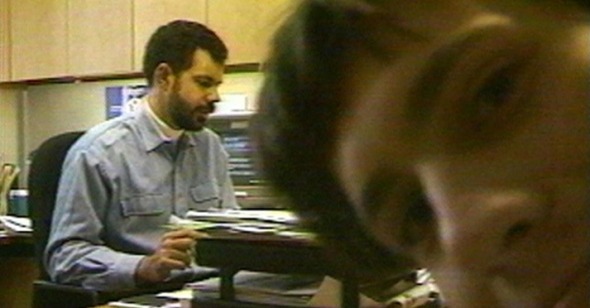
Chris Wilcha was the exact right age to see the world through the viewfinder of a Sony Hi8 camcorder. He received the camera as a college graduation gift from his parents in May of 1992, three years after Sony introduced the 8mm videocassette format to compete with Super VHS. Its increased picture quality and compact size made it perfect for amateur filmmakers like Wilcha, who brought his camera into the offices of Columbia House, America’s most prominent record club, every single day for two years. He was 22 years old when he started as an assistant product manager in the marketing department; he left the company as a full-fledged product manager to attend CalArts film school. The 200 hours of footage he shot became the bones of his thesis film The Target Shoots First (1999), a first-person documentary whose short festival run occurred right around the time that mail-order music clubs began their slow descent into extinction.
Wilcha’s film never received a theatrical release. Instead, it was licensed to TV networks like HBO and the Sundance Channel in the early 2000s before slipping into relative obscurity. Target would eventually find its way on the Internet, where its charmingly unrefined style helped it fit in with the plethora of amateur video diaries, but it crucially exists within and beyond its particular early-to-mid-’90s moment: a time when a booming economy could facilitate existential crises around personal integrity, when filmmaking became even more democratized, when technology was a source of optimism, even as it began its inevitable encroachment towards the permanent collapse of public and private spaces.
Target chronicles Wilcha’s tenure at Columbia House, where he’s hired in no small part because of his age. His familiarity with Generation X taste makes him an asset to the company’s fortysomething staffers, who are trying to catch up to a cultural marketplace significantly altered by Nirvana’s unforeseen mainstream success. (The film largely takes place between the lead-up to the release of Nirvana’s final record, In Utero, in the fall of ’93 through Kurt Cobain's suicide in the spring of ’94.) He becomes Columbia House’s “resident alternative consultant,” tasked with everything from editing Beavis & Butt-head–related copy to explaining to the woman in charge of merchandising that Bad Brains is a rock band and not a rap group.
Wilcha constantly tapes while he's on the job. He films inane company meetings and interviews with coworkers. He documents a Columbia Records factory tour, a San Diego music industry convention with David Hasselhoff in attendance, and an Aerosmith autograph signing. (“Such a deal!” Steven Tyler exclaims when asked about his thoughts on record clubs.) Wilcha particularly excels at recording the idle stretches of downtime built into any nine-to-five job, like puttering around an office or goof-off sessions with his cohorts. Taken as a whole, Target casually captures a snapshot of Clinton-era white-collar corporate environments. Contemporary viewers too young to remember the period will likely be stunned by the sheer tonnage of paper every room contains, or that a company was ever flush enough to hire such an enormous staff to produce a sales catalog.
No one at Columbia House seems to mind Wilcha’s camera in their face; in fact, many are charmed by its presence. The consumer-grade camcorder was still a specialized object in the early ’90s, so it wasn’t exactly commonplace for someone to carry around a video camera into an office setting without an explicit agenda. Much like in James McBride’s landmark metafiction David Holzman's Diary (1967)—where the eponymous character brings his 16mm Éclair everywhere on the streets of Manhattan, allowing him to have impromptu conversations with strangers enamored by the sheer novelty of a man with a camera—Wilcha’s camera provides him with remarkable access within his Boomer-dominated workplace. Wilcha and McBride’s films spring from the cinéma vérité tradition, in which new technology, specifically portable cameras with improved sound, not only generated new filmmaking techniques but also more intimate expressions of truth. In Wilcha’s case, “truth” meant the banal realities of office culture that implicate so many people, like the particulars of offboarding paperwork and elementary school-style fire drills.
*****
Target admirably resists neat categorization, which might explain some of its limited commercial prospects upon completion. In interviews, Wilcha has described his thesis film as “The Office before The Office.” That characterization makes sense as an elevator pitch in that Wilcha edits the film with punchlines in mind, but its origins are more filmic and rigorous than its unpretentious style suggests.
Target owes considerable debts to the work of Ross McElwee, who helped pioneer the autobiographical documentary with films like Sherman’s March (1986) and Time Indefinite (1993). Wilcha developed Target while studying under experimental filmmakers like Thom Andersen and James Benning, with the latter suggesting that he construct the film in 60 one-minute sequences. He drew superficial comparisons to Michael Moore during Target’s brief festival run, most likely because of his wry voiceover and the film’s quasi-fact-finding approach.
But Wilcha’s film never feels like a Roger & Me-ish exposé. Instead, it more closely resembles a memoir, embracing elements of the personal essay film that emphasize mundane absurdism as a means of social commentary. It’s easy to draw a line from Target to the creative nonfiction work of John Wilson, and it presages the lo-fi aesthetics of the early mumblecore films set in white middle-class environments. In an age when people post personal video diaries on Instagram and TikTok, Target no longer feels quite so anomalous.
In retrospect, HI8—analog video’s last stand—was the only form that could reflect Target’s emotional core, which is one of the final, honest Gen X statements about “selling out.” Sony introduced its first digital camcorder in 1995, and MiniDV became the standard format for con- and prosumers by the late ’90s, with the larger film industry quickly following suit. The film’s primary throughline involves Wilcha’s anxiety about working for a mass market corporation as a punk rock acolyte, whose principles embrace a strong opposition towards working in corporate America. Columbia House’s success was premised on negative option billing, which places the burden on the consumer to actively decline their offerings lest they be charged. Internet subscription services now freely deploy this tactic, even while the FTC has made it more difficult to conceal these policies from consumers. “Punk rock has always been about saying ‘No’ to exactly the kinds of commercial systems that exploit bands like corporate record clubs,” Wilcha correctly muses in voiceover, referencing his employer’s casually deceptive business practices.
Wilcha serves as the de facto liaison between “creative services”—the in-house staff of twentysomething copywriters and graphic designers who produce Columbia House’s sales catalogs, with whom he has more in common—and the more “adult” marketing department where he works. In an effort to collapse this divide, he helps spearhead a relaunch of the company’s alternative club catalog alongside a group of like-minded coworkers from both departments. Together, Wilcha’s team successfully shapes the previously dry brochure into a SPIN-like music magazine. On the catalog’s pages, they disclose hidden costs and company sales tactics, sneak in music criticism, and even include their names and photos in defiance of Columbia House tradition to use hacky pseudonyms, for instance a collection manager named “John Savant.”
The previously impersonal-by-design sales tool suddenly feels handmade and knowingly self-aware. Wilcha accomplishes this by imposing, rather than concealing, his team’s personal taste all while eliminating distinctions between departments. His “radical” efforts elicit the ire of upper management, who hire an expensive outside ad agency to “support” Wilcha’s team by ultimately taking credit for their success. (In one galling scene, a long-haired ad exec who resembles a “cool” youth minister condescendingly explains Gen X’s obsession with credibility to management.) Despite the success of the alternative catalog, the company eventually eliminates its personality and, per Wilcha, “things return to just being for sale.”
Even before Columbia House exercises its power, Wilcha’s pride in the catalog sours when he realizes the obvious: for all of the catalog’s so-called subversiveness, he ultimately just provided a way for Columbia House to profit from his generation. Letters pour into the office from teenaged and college-aged kids enthusiastically responding to their feeble rebellion. “We not only convinced the kids that consuming was cool, we made it seem like an act of defiance,” he concludes.
*****
In 2026, it’s probably easy to roll your eyes at this existential handwringing. Wilcha would be part of the last wave of kids who would ever be able to afford a semi-bohemian life on the island of Manhattan—in fact, Wilcha himself said that he could barely afford to live there when he returned to the city after film school—so I can’t really blame anyone who might scoff at his affected unease about taking a corporate gig to pay his meager rent, or find his desire to live a life free of any compromise to be unrealistic.
In Flipside (2023), Wilcha’s autobiographical semi-sequel to Target, he reflects on how he used his camera to distance himself from his Columbia House job in his first feature. He gently pokes fun at his pretensions as someone convinced that he wasn’t selling out but rather “sneaking in,” and incorporates previously unseen footage of him interviewing coworkers about their relationship to work and identity, which he describes as an attempt to be “some kind of grunge Studs Terkel.” At one point, Wilcha features a tape of his early-twentysomething self earnestly addressing his camera about his desire to live a professionally meaningful life despite capitalism’s chokehold on society. (“This is painful for me to watch,” the older Wilcha admits in voiceover.)
“Looking back, I realized I was asking these questions because I couldn’t figure out how anyone makes a living doing work that is meaningful,” Wilcha says in Flipside, a film that largely chronicles his two-decade journey from being a young, ambitious documentarian to accepting his unplanned profession as a freelance commercial director. Using Wilcha’s desire to document his fledgling hometown record store as a jumping-off point, Flipside itemizes his numerous unfinished projects about subjects as varied as the White Stripes to a garage sale–obsessed psychotherapist, all of which fell apart because of a lack of resources or were scuttled by the subjects themselves. Wilcha was forced time and again to put potential features aside to take well-paying, oft-anemic commercial gigs to support his family. Advertising, the job that made him so uneasy in his mid-twenties, is now how he makes a living.
Instead of depicting these incomplete works as ill-fated loose ends, however, Wilcha and editor Joe Beshenkovsky tie the digressive strands together into a portrait of a life that, for all of its frustrations and disappointments, is defined by an abiding love of creative processes. The format of Wilcha’s camera may be constantly evolving, a development that Flipside thoroughly captures, but the director’s disarming perspective remains constant. The flat, low-res quality of Wilcha’s Hi8 image—along with his inchoate, yet energetic cinematography in Target—reflects the candor of his youthful searching. Meanwhile, the crisp digital photography and his seasoned eye demonstrated in the present-day footage from Flipside reveals middle-aged resignation and ambivalence, along with some hard-earned wisdom.
*****
Wilcha’s apprehension about being complicit in a corporate scheme was borne out by 21st-century social and technological “progress.” Record clubs may have died out, but Columbia House’s fat-cat business practices have thrived under streaming services like Spotify, which has all but eliminated the middle-class artist by passing on the metastasized next-gen version of “8 CDs for a penny” to consumers. Wilcha’s identity crisis in Target, brought on by his thoughtful curiosity and catechistic sensibility, strikes me as neither embarrassing nor naïve. Identifying the ills of consumption may be quaint, but that doesn’t make its passive normalization any less unsettling. It’s hardly juvenile to meditate upon the value of labor in the face of capitalism’s demand for moral concessions, even if it means using a video camera to rationalize it.
For all of Target’s ’90s cultural context, it somehow lives in a generationally liminal state. Wilcha taped, edited, and released his film in a pre-surveillance world, where photography was neither entirely democratic nor an inherent cause for concern. (Any comparable business nowadays would put the kibosh on Wilcha’s directionless recording purely for liability concerns.) Wilcha’s coworkers likely had little idea that his footage would ever see the light of day; their lack of self-consciousness on camera arguably dates Target just as much as its Gen X angst. A decade after Wilcha leaves Columbia House for grad school, YouTube would emerge and the era of endless performance would ensue.
Somewhat ironically, YouTube is currently where Target resides. Wilcha admits its limited availability can be attributed to his own underestimation of the film; he saw it as a grad school project whose surprising popularity on the festival circuit was a fluke. Once the TV licensing deals expired and physical media waned, nobody was ever motivated to provide it with a home. (He’s reportedly working to restore it now.) When Target is viewed on YouTube, its nostalgia factor multiples—the analog image and handheld camerawork only amplify its archaic, home movie-esque aesthetics. Yet its critique of capitalism and email-job concerns contribute to Target’s contemporary feel, despite its worn image.
For a short period, I edited Downtime Magazine, the online publishing arm of my friend’s apparel company Jambys, which specializes in unisex loungewear. I was allowed to commission 800 to 1200–word recommendation pieces about streaming titles from freelance writers with minimal oversight; these articles were often read in promotional email blasts sent to subscribers, presumably while they wore or bought the company’s clothes, which reportedly charmed the company’s investors. It was a way of getting me and my colleagues paid a decent rate for culture writing sans the burden of topicality in a diminished media environment, and it worked for a while before financial realities reared their ugly head.
I went into Downtime with complete awareness of the publication’s supplementary nature; there was no confusion that it existed in service of selling elevated athleisure. I’m proud of the pieces I commissioned and the money I helped redirect, but it still made me think about the spectrum of concessions and forfeitures required to produce good work under the best of circumstances. Shifting economic realities have made “selling out” an unfortunate inevitability, but I’ve always resented my generation’s flippant dismissal of the anxiety. What are arts publications but a compendium of corporate propaganda with some original writing to space them out? How much shady bullshit have we accidentally or purposefully swallowed in the aim of quality?
When I interviewed Wilcha in 2023, he communicated gratitude for his commercial career, but he also expressed misgivings about some of the gigs he’s taken, and bemoaned the all-too-familiar feast-or-famine fear that arises from freelance life. In short, he’s still questioning everything, still moving through an imperfect world with concern, in the same way he was when he was lugging around his camera around the office as a kid. The personal and generational insecurity in Target couldn’t have been depicted on anything but videotape, but the age-old questions it probes, namely “Are we what we create or whom we serve?”, thrives under the technology from any era, even if the question might one day permanently be moot.