Recombinatory Hallucinations
Sam Bodrojan on Guy Maddin’s Generative Cinema Project
AI cinema is the future. At least, that’s what shareholders keep telling me.
Every other week, we are confronted by a new frontier in high-fidelity fake images. These are often accompanied by breathless claims that cinema has finally been democratized, that Hollywood will become vestigial, that digital reality shall soon dissipate in a sea of perfectly personalized forgeries. This often stands in direct contrast to examples shown of this technology in action, which remain uncanny, homogeneous, and only persuasive when obscured. When the Berlinale featured Cao Yiwen’s What’s Next? (a film composed entirely out of generated imagery), much of the controversy deflated upon the revelation that it looked like this. Can anybody recall what Tilly Norwood actually looks like?
In the face of constant pro-AI propaganda, it is tempting to fall back on flimsy sentimentality. The romantic critic’s impulse is to wax poetic on some ineffably “human” quality to art, that some neurological phenomenon distinguishes a person’s creative imitations from those of a computer. The fearful theorist may argue that imaginary video destroys the necessary metatext of cinema itself. These claims, however, are meek jabs in a philosophical boxing match we never should have weighed in for. Viewed honestly, AI video is the promise of infinite audiovisual material centrally controlled by a corporation, maximizing profit derived from content platforms. The explicit and single-minded goal of every single video generation tool is to be a parasite that minimizes overhead.
You may notice there are some notable ellipses in that statement. These AI videos are still movies that require labor and resources; the “cloud” is, in reality, a collection of buildings constructed in impoverished areas which use massive amounts of power and render the surrounding communities ecologically uninhabitable. The product is reliant upon extant, non-AI footage as well as manual configuring from testers and programmers. Furthermore, though these AI companies may not have the stated goal of “art without humans,” they certainly want to decimate the industry of human art. Even if a Large Language Model AI (LLM) could hypothetically produce unique work that suggests an unscripted perspective informed by past experience, the current models are explicitly incentivized not to do so. Being built around inelegant, brute-force linear regression models means that they are constantly striving for a median, deliberately unauthored approximation. These machines work on what amounts to intricate predictive flowcharts; despite resembling rudimentary neural pathways, they are trained out of “hallucinations”—i.e., invented material that does not fall within a strict standard deviation—which would lead to inaccuracy. Generative video is thus, definitionally, not a perpetual cinema machine, nor will it ever be without fundamental changes to its principal design. Such a machine does exist, however.
The brainchild of Guy Maddin and brothers Evan and Galen Johnson, Seances is a multimedia project that spanned four years, three location-specific performance art installations, a feature film, and a website. Inspired by more than two dozen lost and unrealized films from across history, the collective set about “resurrecting” them via filmed stagings. These occurred at Centre Pompidou in France in 2012 and Centre PHI in Montreal in 2013. One short film was made each day, using a rotating cast of actors. Some, like Adèle Haenel, only participated for one day. Others, like Udo Kier, play several characters across different films. Clara Furey plays one character, “Margot,” yet appears in at least five seances. The sets were open to the public, and visitors were invited to spectate on production. As for the footage itself, the material found a home in two places. The first was a feature film, The Forbidden Room, which premiered at Sundance in 2015 and received theatrical distribution later that year. The second was a website, seances.nfb.ca.
As the site loads, a black text box invites the user to “Touch and hold to conjure.” A title and film description float in disjointed parallax against a smoky background. The title changes at irregular intervals every five to ten seconds. These titles are ostentatious and goofy: how could you resist “Grieve the Wailing Deductibles” or “Before the Perverted Bachelor?” Yet there’s a slight delay between clicking on a title and the website loading the film. In this time, perhaps the length has changed, or a word in the flowery description has been swapped out. Then the film begins.
Every title, it turns out, is the name of a unique, algorithmically generated short, assembled following a labyrinthine set of rules and conventions. Each one, called a Séance, is structured like a Matryoshka doll, where a portion of one lost film transitions part-way through into another, ostensibly unrelated film, and then another, and then another, before reversing course. (Think of it like the climax to Inception, but for repertory cinema nerds.) At the deepest layer of each generated piece is a “Chewy Centre”—a dreamlike fragment picked exclusively from scrapped scenes and otherwise uncompleted seances. The resulting collages are your typical Maddin/Johnson fare, though perhaps more narratively free-associative.
Each runs around the length of a single reel, and they play in old modes: German Expressionism, screwball comedy, high melodrama. The filmmakers elide traditional plot, transforming lovingly emulated riffs on early cinema into Rorschach tests. There are multiple pre-selected moments in each seance where the algorithm can shift to a new source film—everything from a character falling asleep to an x-ray of a pelvis. Sometimes the code triggers a transition, while other times these moments pass without incident. Each layer is not a complete film—it is a randomly selected portion of a film, often with large swathes hacked away. Certain moments, referred to in the project bible as “Infection Points,” are changed across all films to form some semiotic continuity. This might be a repeated object or word or overlaid image. Other alternative cuts of individual films are substituted in at random. Other times, spontaneous connective tissue can form by accident. Two disparate films featuring the same actor suddenly feel linked; a Freudian nightmare elsewhere gives a mother’s embrace newfound meaning. The possible permutations number in the hundreds of millions, and each one offers a unique kaleidoscopic vision of the work as a whole.
The twist is that no seance can be viewed twice. As soon as a film finishes (you cannot pause or rewind), that title is taken out of the selection pool permanently, and added to a long list of “re-lost” films. Thus, Maddin and Co. built the world’s first perpetual movie maker, a constant cycle of regeneration and demolition.
Because of the project’s relative obscurity and enigmatic programming, it is impossible to clearly envision the ‘true’ renditions of each lost film. Little information is available about its production on the internet. Wikipedia has both an incorrect and incomplete list of resurrected films. Occasionally, tangentially related stock footage appears datamoshed (i.e. glitchy and digitally corrupted) atop the movie. Interstitials are swapped and shots are speed-ramped.
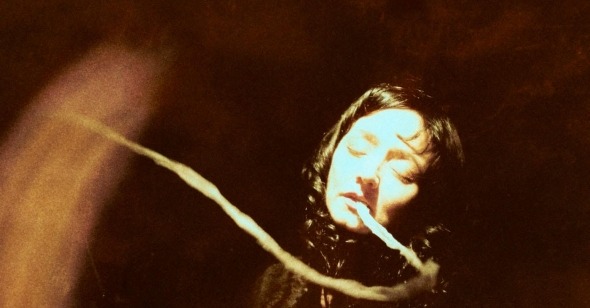
No matter what iteration an audience encounters, Seances is unmistakably the work of its directors. Like the two decades of Maddin films before it, the project alternates between sleazy and quaint, full of vaudeville spectacle and ribaldry. Though shot on digital, Maddin and Co. painstakingly simulate nitrate quirks and celluloid post-processing textures. The aforementioned data-moshing and speed-ramping were all meticulously created by hand. The most astonishing effect is what Maddin refers to as the “ectoplasm” effect, where images bubble and warp as if in the early stages of being burnt. The rear-projection and rudimentary tinting feel like century-old images, yet few films back then could match the Chaucerian debauchery or soap opera soundstage maximalism. Even amidst the digital doctoring, the costuming and set design keep the whole affair so tactile. Perhaps these are only surface pleasures; yet that descriptor would be insufficient for such an inimitable aesthetic force.
The authorial voice becomes clearer upon closer comparison between the listed films. Sometimes, Maddin and the Johnsons do a loose but straight adaptation of surviving material, decorated with connective tissue that smooths the transition between other seances. Other times, the trio intentionally disregard publicly available synopses for the lost films in favor of outlandish, invented premises that better mesh with the psychoanalytic farce that drives the project. The restagings were not acts of preservation. They were full-blooded continuations of the creative process.
Any attempt to “solve” Seances proves futile. It is tempting to treat The Forbidden Room as gospel, because it is the only static version of Seances. The 2015 feature follows that same nesting structure, uses the same source material, has a coherent wrapper, and is generally more deliberate than the Kuleshov madness of the website. Outside the context of its making, it feels like a “normal,” albeit episodic, motion picture. Yet The Forbidden Room features only 15 to 25% of the material that the Seances website uses to construct its shorts. Only upon viewing clips from Seances can the audience discern that what seemed like one story in The Forbidden Room was in fact two spliced together, or what seemed at first to be a lost Naruse was in fact an unfinished Lubitsch. Seances is more than a work of art; it is an infectious recombinatory hallucination.
Seances is, at every step, a collaborative artistic effort. These shorts marked the beginning of Maddin’s continued partnership with Evan and Galen Johnson, who have become equal voices on his films. Long-time Maddin cowriter Bob Kotyk also pitched in. They drew inspiration from William Cook’s wacky omnibus Plotto and mined dialogue from The Inn of the Guardian Angel, a play built out of old obituaries and fanzines by none other than John Ashbery. The project’s precursor, an installation piece called Hauntings, followed a similar conceit except that Maddin had a horde of fresh filmmakers producing the individual lost films à la the Warhol factory. In interviews, Maddin and the Johnsons take special care to mention not just the cast and crew but also the website designers, treated as artists who contributed essential insight to the finished contraption. The algorithm is simply the last part of the film, left unfinished until you press the button. Here is collective passion made manifest, an artistic practice that is radically hopeful about the medium’s present and future.
Seances is a project of infinite, algorithmically constructed cinema, built explicitly upon the creative work of others. It is also a communally authored project funded by multiple federal art endowments. Unlike the “promise” of AI, this is not the anonymous work of a corporation’s predictive audiovisual approximation. It does not seek to obfuscate its influences. It does not wish to supplant the fragments out of which it builds itself. It is easy to dismiss Seances, like Méliès’ moon, as little more than a parlor trick. But if there is a future in generative cinema, it doesn’t look like Will Smith eating spaghetti. It looks like this.
Special thanks to Guy Maddin, Evan Johnson, and Galen Johnson, who offered me loads of supplementary material via a few very generous emails.
Update: As of December 31st, 2025. It appears that the Seance project has been taken down by the National Film Board of Canada. This is perhaps a fitting end to a prototype for a different, more miraculous cinematic future. But poetic rhetoric does not make the loss of millions of unmade, unresurrected films any less tragic.