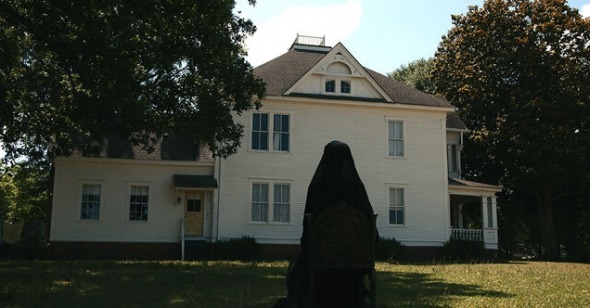
First Night: The Woman in the Yard
Twelve years ago, for the closing night of our ninth edition of this annual Halloween column, I wrote about Jennifer Kent’s The Babadook. That film’s concept felt fresh and frightening, even novel in 2014: a monster in the house as a physical manifestation of grief and trauma. Kent’s storytelling dynamism and visual invention ensured that the film’s central ideas—the impossibility of repressing the memories that eat away at us, and the necessity of confronting them head-on, even if they can never be entirely vanquished—came across as robustly metaphorical. The film would prove influential: so many horror movies in its wake have doubled down on the idea that the genre is inherently strongest—even most legible—as an exploration of psychological damage that it’s become a cliché at this point; the derisive “torture porn” moniker of the aughts has been replaced by “trauma porn” in the late teens and early 2020s.
The range in quality is wide—from Midsommar to the Smile films to the Australian horror renaissance kicked off with Talk to Me to Mike Flanagan’s tearjerking TV terrors—but what generally unites these films is that the characters tend to start off as deeply wounded, haunted by some shame or loss that will become the motivating factor (hidden or not) in their journey towards either redemption or rock-bottom despair. Many horror movies have employed similar kinds of psychological readings, but they were once more anomalous: sure, we’ve had The Seventh Victim (a film about depression, highly unusual for 1940s American cinema) and The Haunting (which stays faithful to its Shirley Jackson source material by delving into the ambiguous emotional impairment of its main characters), but most of our classic horror movies have been about innocents thrust into unimaginable situations: Rosemary’s Baby, The Exorcist, The Texas Chainsaw Massacre, The Omen, Poltergeist, Get Out. If The Blair Witch Project were made today, would Heather also be confronting the memory of her abusive father, seen in ponderous flashbacks? Horror has always had “teachable” moments, though they’re more along the lines of “don’t go into the woods without a compass” or “steer clear of motel showers.” It’s probably no surprise that the ascendance of grief horror—in which characters aren’t simply scrambling to survive but are implicitly trying to overcome something from their past—has coincided with the mainstreaming of the “self-care” industry. How can we trust our disreputable entertainment if it’s not a steppingstone on the way to wellness?
Moviegoers in general and horror lovers in particular seemed to have overdosed on grief horror by the time Jaume Collet-Serra’s The Woman in the Yard was released last year. Largely dismissed, if not disparaged, the film was something different for its director, an ace genre craftsman whose former descents into horror were classical, hearty, fast-paced, and in the case of Orphan, compellingly unsavory. Collet-Serra’s fans may have been surprised, even disappointed that with Woman in the Yard he preferred to take an emotionally and narratively claustrophobic, character-based approach. The film, with a script that writer Sam Stefanek has called deeply personal, undoubtedly fits more cleanly into this au courant form of grief horror, yet by ignoring it for its alleged 21st-century genre sins, viewers passed on a film with an elegant, pared-down design and a genuinely upsetting interior landscape that, for this viewer at least, was persuasively horrific and, finally, deeply moving.
Much of the film’s power comes from Danielle Deadwyler’s fully invested performance as Ramona, the recently widowed mother of a teenage boy, Taylor (Peyton Jackson), and a prepubescent girl, Annie (Estella Kahiha). The three live in a remote farmhouse, which we come to learn Ramona was already feeling isolated and disillusioned in before the car accident that claimed her husband David’s life. Far from civilization and neighbors and, as the film begins, without electricity due to delinquent payments, the family is barely getting by, stumbling over each other with resentment and confusion, while Ramona, her leg still in a cast, hobbles reluctantly through whatever domestic and maternal responsibilities she can manage.
Deadwyler is a naturally sympathetic, beautifully transparent actor, so watching her descend into apathy is truly alarming; it quickly becomes clear that she’s not merely agonizing over her husband’s death but is severely depressed and hardly functioning. Soon enough, Taylor notices a figure perched on a bench in their front yard facing the house at an ominously polite distance, completely enshrouded in black tatters. The children somehow immediately clock this mystery person as a woman, although it would be impossible to know this due to the distance and the clothing—either an improbability or a psychic trick of the film. In finally gaining the courage to approach this sinister cloaked entity, Ramona asks it to leave their property. Staring back at her, the wraith (played by an excellent, unsettlingly composed Okwui Okpokwasili, her face barely visible behind the muslin veil) calmly states “Today’s the day,” and extends a pair of bloody hands.
Indeed, The Woman in the Yard will take place over the creeping expanse of one day, from sun-dappled, wide-open terror (the first shock cut is to curtains being opened) to the inky darkness of night. Within its circumscribed time frame and single location, Collet-Serra comes up with an array of unforced yet dramatic camera angles and positions that give this tightly enclosed world, shot in effectively destabilizing widescreen, a sense of variation and geometric pleasure. While burdened by the occasional car-crash flashback (done in subjective, slo-mo flourish, par for the course in 21st-century grief horror... The Babadook, Smile 2, even all the way back to The Descent), the limitations imposed by the narrative serve this film well, allowing the viewer to home in on the details and emotional resonances of Stefanek’s script. The fear that the cloaked figure elicits has less to do with “horror imagery” per se than with what it means for the characters. Shrouded and in black, the woman is a classical figure of mourning—in other words, an image of how a widow is “supposed” to behave, to hide herself away like the totaled car that still sits, covered in its own shroud in their yard.
Is the woman a Babadook, a literalization of grief? Or is she more simply, more eerily, a double? (The movie could have been titled Other Mommy.) This sort of mirroring becomes the fulcrum of the film: there’s even a joke about it, with a shot of a movie marquee showing Barbra Streisand’s The Mirror Has Two Faces, and there’s a barely noticeable trick mirror shot early in the film for the eagle-eyed. While such obvious psychological illustration (let’s call it explanatory ambiguity) might have painted other filmmakers into a corner, Collet-Serra’s restraint and Deadwyler’s wrenching dedication create a work of persuasively expressionistic, Southern Gothic-tinged horror.
The Woman in the Yard certainly isn’t above citing other horror landmarks. There are The Shining jokes aplenty, from Taylor’s bored bouncing off the walls with a rubber ball, to Annie’s inability to write her R’s facing forward, instantly echoing the backwards “R” in Danny’s RedRum scrawl (another mirror allusion). There’s more than a whiff of Rear Window suspense in watching Ramona, trying to protect herself and her loved ones while housebound and encased in a broken leg. And as the woman moves imperceptibly closer to the house, we may think of M. R. James’s uncanny “The Mezzotint,” a story of a haunted painting that alters only when you don’t look at it. (It’s a proper reference point, as Ramona is herself a painter—which we’re reminded of in the rather extraordinary final tracking shot.) All of this helps extricate The Woman in the Yard from the recesses of grief horror: I perceived more of an allegiance to the classics here, like Henry James’s doppelgänger masterwork “The Jolly Corner” or any number of Shirley Jackson’s studies of people immobilized by inextricable personal fears. Collet-Serra’s film doesn’t feel like it’s part of the grief horror trend but rather a prime example of why it made sense in the first place. —Michael Koresky