Nasty Habits
By Gavin Smith
The Devils
Dir. Ken Russell, U.K., Warner Bros. Clockwork
Aldous Huxley knew a thing or two about show trials. As a Los Angeles resident, he had a front-row seat for HUAC’s postwar anti-communist witch-hunt. This pathetic chapter in postwar American history, as well as Stalin’s three-decade purge of supposed counter-revolutionary heretics, seep into the events recounted in his The Devils of Loudun, which was published in 1952, at the height of the Red Scare.
Ken Russell pronounced The Devils, a faithful distillation of Huxley’s extensively researched and entirely fascinating nonfiction work, to be a political film. Released in 1971, eight years after Huxley’s death, it accordingly fell afoul of the censors, cut down first in the UK, and then, for good measure, a little more in the U.S. Doubly trimmed and never released on home video, The Devils’ availability for theatrical exhibition was curiously erratic. (I successfully booked an immaculate DigiBeta for three shows for a Russell retrospective in 2010 and a year or so later was told that it was unavailable due to “rights issues.”) Conspiracy theories swirled that someone high up at Warner Bros. had waged a long campaign to suppress the film. Then Russell’s original cut, featuring the never-seen “Rape of Christ” sequence, was reassembled by film critic Mark Kermode (a devout Catholic who in all seriousness regards The Exorcist as the greatest film of all time). A bootleg, lifted from the British TV transmission of this cut, was available for purchase on Amazon for a while. A full restoration finally seemed imminent, and the unexpurgated version of The Devils made its way from this year's Cannes Classics to a U.S. premiere at the New York Film Festival, and on to a U.S. re-release, 15 years after Russell's death.
At the core of Huxley’s book is an account (seemingly written in a 17th-century literary pastiche) of a mass outbreak of demonic possession in a French Ursuline convent in the city of Loudun in 1634, and its use by various sworn enemies to settle petty and not-so-petty scores with the city's de facto spiritual leader, a charismatic, politically intransigent, and morally compromised priest, Urbain Grandier. In the course of her multiple exorcisms, the Mother Superior Jeanne des Anges denounces Grandier (for personal reasons) as the sorcerer inflicting these demonic spirits on her and her sisters. A farcical, six-month long circus of public exorcisms culminates in a rigged trial and Grandier’s condemnation. He is sentenced to torture in order to extract a confession (unsuccessfully) and despite the protests from the town's protestant minority, is burned at the stake before a braying audience of thousands. Turns out witch trials are a boon for the tourist trade.
Sure, Arthur Miller was not far behind Huxley, but The Crucible makes its all-fall-down allegorical point by sweeping up its assortment of luckless, less-than-virtuous accused, accusers with their personal grudges and emotional grievances, and earnest but ultimately helpless religious authorities and hurling them into an unstoppable whirlwind of destruction. The Devils of Loudun is a less schematic proposition. It interweaves documented historical facts with a thoroughgoing theological exegesis, an examination of the pre-Enlightenment psyche and worldview, and a sober evaluation of the gross ecclesiastical malfeasance of the exorcisms performed in this case, with their circular logic and guilty-until-proven-innocent modus operandi. (He also takes up the possibility of the paranormal, touching upon telepathy, ESP, and telekinesis—this is, after all, the man who, two years later, as an early advocate of LSD, wrote one of the Sixties counterculture’s foundational texts, The Doors of Perception.)
Russell, the oft-labelled enfant terrible of British cinema, is anything but sober. Where Huxley's treatment is meticulous and calmly factual, Russell tackles the material in his customary style, which got up to speed in The Music Lovers (1970) and would be sustained in all but one (Savage Messiah) of the seven films he directed in an astonishing run in the 1970s, when British cinema was all but moribund: an irreverent disregard for good taste, outrageous iconoclasm, and an over-the-top gusto that matched the hysterical excesses of his subjects. Don’t doubt it, this is a filmmaker who had no use for the literary stateliness of so-called heritage cinema, as Oliver Reed and Alan Bates’s nude wrestling scene in Russell’s D. H. Lawrence adaptation Women in Love (1969) attests.
There’s plenty of evidence in The Devils that Russell was the staunch Catholic convert he professed to be, and so it's perhaps no surprise that he seizes upon the religious controversy at the core of The Devils and by extension the wider political context of 17th-century France. He opens with a typically outlandish shot: an ambiguously gendered, near-nude figure rises into view on a theater stage in a tableau vivant recreation of Botticelli’s Birth of Venus; after a mock coronation, this figure takes part in the performance of a dissolute masque. This is not just any performer however—it’s King Louis XIII (Graham Armitage), shamelessly depicted by Russell as the effeminate homosexual he was rumored to be. (Louis XIII did in fact dabble in composing and designing costumes for masques and ballets.)
For this decadent performance, the only audience member that matters amongst the throng of courtiers is an unimpressed Cardinal Richelieu (Christopher Logue), the power behind the throne. With the young king’s assent, Richelieu is pursuing an agenda to establish absolute monarchy in France, with church and state working together to impose the crown's authority over the entire country by forcing the provincial power bases of the nobility into submission—while ensuring the troublesome Huguenot protestant minority are kept in check. When one of Richelieu’s officials, Baron de Laubardemont (Dudley Sutton), arrives to weaken Loudun’s independence by demolishing its fortifications, he comes up against the defiance of the commanding Grandier (Oliver Reed) and is forced to back down. And so the latter unwittingly becomes enmeshed in a royal power play, making enemies in high places. His downfall is just a matter of time—and setting about engineering it, de Laubardemont finds ready accomplices in Grandier’s local enemies—among them the vengeful magistrate whose daughter he has impregnated during her private Latin lessons and then spurned, and his resentful, priggish Canon Mignon (Murray Melvin), the magistrate’s cousin.
The Devils takes place in a city ravaged by bubonic plague—an addition of Russell's (the plague had run its course several years before the events of the story) that’s indicative of his reflexive instinct to revel in the agony and ecstasy of corporal extremity and gruesome abjection. Hence, he gives us Grandier both going through the motions as he sprinkles holy water on a mass grave of plague victims and then passionately ministering to a dying woman in her final excruciating death throes (after seeing off a chemist and a surgeon and their quack treatments, thereby making two more enemies). Leading this plague victim’s distraught daughter Madeleine (Gemma Jones) in prayer and later taking her confession, in which she admits she’s fallen in love with him, the libertine cleric takes her as his latest paramour, only to find authentic love stirring in him. He secretly takes her as his wife in a theologically questionable private nuptial mass, covertly observed by Mignon. As the forces arrayed against him close in, the love of this devout, virtuous woman puts Grandier on the path to moral and spiritual redemption. As he says to Mignon earlier, “I have a great need to be united with God.” Be careful what you wish for.
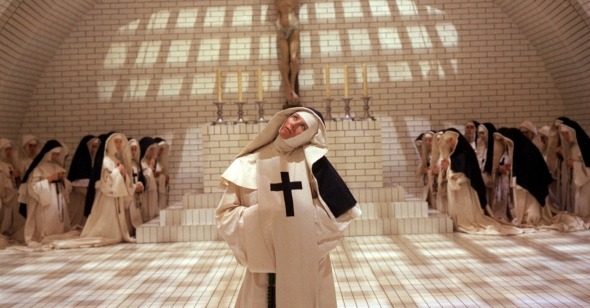
What have been regarded as the most problematic/sacrilegious/ludicrous (take your pick) scenes in The Devils are those set in the Ursuline convent. These squarely attribute the nuns’ supposed demonic possession to mass hysteria—“chronic sexual excitement” in Huxley’s words. For a start, the unsuspecting Grandier has a devoted fanbase with the sisters, who avidly try to catch sight of him as he leads the funeral procession for the city’s governor in the film’s second scene, swooning like so many overwrought Beatles fans (“He’s the most beautiful man in the world!” one nun exclaims). Far exceeding them, their disturbed hunchbacked Mother Superior Jeanne (Vanessa Redgrave) harbors a maniacal erotic fixation on Grandier of frightening intensity, tormented by blasphemous visions of the priest: in the first he walks on water and then rejects her desperate advances while she is mocked by all around her; in the second he’s a crucified Christ, descending from the cross where his wounds are licked by Jeanne. Russell deftly establishes a hothouse atmosphere of sexual longing and frustration (Grandier-mania), firmly setting the stage for what is to come.
Devastated to learn of his secret marriage and that, to add insult to injury, he has declined to be appointed as the convent’s confessor, Sister Jeanne accuses him of visiting her in her bed in the form of an incubus. When professional exorcist Barré (Michael Gothard) arrives to provide a ready ear, she semi-denounces Grandier and loses her shit—literally since a forced enema is considered a handy procedure for flushing out Satan’s minions. Under the increasingly fanatical (and, it is hinted, increasingly sexually charged) Barré’s unrelenting pressure, and the threat of execution, her fellow sisters have no choice but to get with the program and whip themselves up into a frenzy, ripping off their habits.
Russell completely outdoes himself in his orchestration of the ensuing bedlam—a nonstop regime of exorcisms and incantations as the cavorting nude women run amok (and find unmentionable uses for candles). Making full use of a minatory avant-garde score by Peter Maxwell Davies, Russell wrings out every last drop of bodily fluid and galvanizes every shuddering gymnastic contortion from his, it must be said, truly game actresses (Adam Chodzko’s 1995 video From Beyond records their almost-fond memories of the shoot). Everything builds toward Russell’s long-suppressed ne plus ultra, the shocking (hallucinated?) Rape of Christ set piece, in which a febrile throng of stark-naked nuns tears down the convent’s life-size wooden carving of the crucified Christ and mount and writhe voluptuously all over it, while Mignon masturbates at the orgiastic spectacle from a vantage point above the fray. For good measure, Russell shoots this with the crazed zoom-in-and-outs that are another of his trademarks.
The ravings of the nuns, who are posed leading questions, are a form of testimony, but their possessed states and their exorcisms are performed and staged for the enjoyment of a gleeful audience of townspeople. And so the teeming madhouse in the convent is explicitly linked to the frivolous theatrical follies of Louis XIII that open the film. While the scenes involving the monarchy are staged in a farcical, cartoonish register—the King using hapless protestants dressed in blackbird costumes for target practice and paying a visit to the exorcism proceedings, masquerading as “the Duc De Condé,” to mischievously debunk them—the convent exorcism scenes are, for sure, the stuff of sensational chaotic spectacle, but Russell renders them closer to slapstick than horror.
By contrast, everything related to Grandier’s intellectual and emotional struggle is treated in earnest. Russell gives the contradictions amongst his convictions, his sensuality, and his cynicism their due—in no small part thanks to Reed’s by turns brooding and cavalier performance, which persuasively establishes the priest’s worldly intelligence and oratory authority. In the end, The Devils is most impressive for its unusually coherent depiction of faith: the Rape of Christ scene is pointedly intercut with Grandier pausing in the mountains on his way back to Loudun to celebrate the Eucharist with Madeleine, counterpointing the sacred and the profane. Having atoned for “my vain and disordered life,” Grandier is reconciled as “a small part of God’s abundance,” and ready to meet his maker in the face of his cynical disbelieving tormentors. In the harrowing climax, as he’s burned at the stake, he’s not thinking of himself but exhorting the city’s inhabitants to fight against their impending loss of freedom.
But the final word goes to Vanessa Redgrave’s fearless, indelible performance as Sister Jeanne. Not merely the twitching, growling monster of the exorcism scenes, Redgrave’s Sister Jeanne is a nuanced and multifaceted characterization, one minute calculating and casually sardonic, the next anguished and devout, emitting then cutting short her weird mirthless titters and fully living out her lapses into convulsive animalistic rage. In her final scene, after the dust has settled and the city’s walls have been pulled down, de Laubardemont gifts her with a token to remember Grandier by—a phallic bone that she kisses and then, as the scene ends, is about to put to use. It is the film’s single most outrageous coup.