All in the Family
By Alexander Mooney
New York Film Festival 2026:
A Long Winter
Dir. Andrew Haigh, Canada/U.K., MUBI
In one of her trademark essays, “On Morality,” Joan Didion propounded the impulse to rescue a person’s corpse from scavengers as the most basic unit of human decency, left over from settler times and burned into the ethical psyche of American culture. Following in this tradition, A Long Winter, Andrew Haigh’s first American film since 2017’s Lean on Pete, boils down to a race against the vultures. It is based on Colm Tóibín’s 2006 novella of the same name, but, crucially, not of the same setting, whisked across the Atlantic from post–Civil War Spain to Colorado in the 1950s. Mining the landscape for all its symbolic worth, this snow-swept western charts the irreparable collapse of a sequestered family, and of the brittle ideals that can no longer keep them frozen in place.
This homestead’s self-sustaining seclusion high up in the Rockies––the quixotic fantasy of its patriarch Lester (Ebon Moss-Bachrach), a former city kid––is disrupted by two absences. First, the youngest son, Tommy (Kit Connor), enlists in the Korean War, confessing his thirst for metropolitan life and his plan of pursuing it to his older brother Mike (Fred Hechinger) on the eve of his departure. Second, their mother, Louise (Caitriona Balfe), reaches a breaking point in her severe alcoholism after a tactless intervention and wanders off the property in search of a fix––or perhaps just an escape––moments before the winter’s first blizzard envelopes their false Eden.
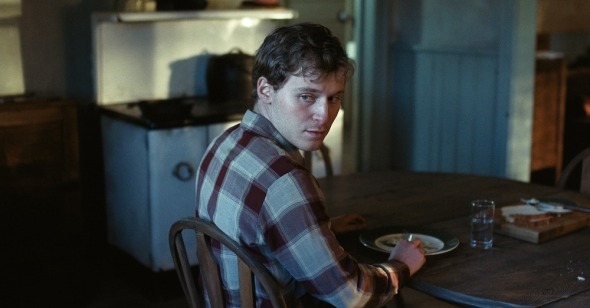
“It takes a certain type of soul to live this close to heaven,” says Uncle Frank (Martin Freeman), lamenting his sister’s private hell. Mike––loyal, content, and unquestioning––was unaware of any trouble in paradise. His own year-long sojourn working in Idaho shielded him from the knowledge of his mother’s physical and psychological deterioration, rendering him both the odd man out and the center of their world. He is the center of Haigh’s as well; his damaged innocence––searching day after day for a presumed-dead mother he never really knew––goes hand-in-hand with an overturned perception of this pitiless, unchanging, “comfortable” corner of American life, and the man who selfishly contrived to keep his kin wedged within it, forming the film’s dramatic core.These parallel reckonings are, unsurprisingly for Haigh, compounded by Mike’s burgeoning homosexual desires, with two foiled crushes punctuating a tormented coming of age. Hechinger, a born character actor, is an inspired casting choice for a soft-spoken everyman surrounded by larger and more demanding personae, becoming an anchor and a reflective surface for their angst while magnifying his own.
These are the makings of a classically awesome picture, descriptors of tropes, styles, and subversions that my cinephilia naturally gravitates toward. Haigh is a filmmaker I admire––his fluent, unpretentious style and fine-grained sense of physicality having elevated gay slices-of-lives like Weekend (2011) and Looking (2014-16) to canonical classics––working in a largely defunct but iconographically rich genre (the western’s “Northern” cousin) ripe for queer revision. Yet it falls short of its compelling conception and considerable craft. Haigh’s handsome frames––shot on sumptuous 35mm by Xavier Dolan’s favored DP André Turpin––drip with more than enough atmosphere and portent to sustain the film’s tensions; his performers are hard-edged and expressive, externalizing the story’s strains of regret, resentment, and repression; and his digressive approach to psychodrama is rooted in decades of literary and cinematic tradition. This last point reflects the film’s tentative approach to revision, and unlocks its shortcomings. The teasing dramatization of all-American myth and madness rarely strays far from the realm of respectability, pulling punches in the name of austerity.
Considerable emphasis is placed on Louise’s silent suffering, but she is a structuring absence even before her disappearance. Embodied stridently by Balfe, this woman is virtually all interior, a walking signpost of her own disaffection. She has abandoned her family before the film even starts; “I’m sorry I knew any of you,” she spits at her husband and son as soon as Lester dumps her stash. The film admirably avoids making her a perfect victim, and also goes out of its way to shift the blame onto Lester, but its portrayal of a long-festering addiction undermines her misery with a strange mixture of abjection and opacity. This combination is most apparent during the one exception to this film’s principled restraint: “You want to know what your mother would do for a drink?” Lester, asked why he so violently hates their nearest neighbor, rolls the question cruelly in his drunken mouth as Mike looks on, shattered. What Lester describes, on the verge of tears himself, is clearly a sexual assault, but his parlance makes her out to be an erring woman. The scene’s inclusion seems like an attempt to humanize Lester’s all-or-nothing approach to her recovery. It is hatefully empathic, upsetting the film’s tidy morality.
Another important figure in the film’s matrix of gender and sexuality appears to fill the household’s twin voids. Left to their own devices, Lester and Mike squabble over the household chores. Lester goes and hires Jimmy (D’Pharaoh Woon-A-Tai), a half-Indigenous man from the next town who has no qualms doing “women’s work.” Relegated to the kitchen on one hand and Tommy’s vacant bed on the other, Jimmy is cornered into maternal and fraternal roles. His repeated harassment and emasculation by Lester run parallel to his sexual tension with Mike. Though their attraction, smartly, remains unconsummated, its proximity to Jimmy’s domestic servitude presents another troubled dynamic. Jimmy, withdrawn but ready to stand up to himself, resists stereotype, but he is pigeonholed by narrative function; he offsets Mike’s first object of desire––a young cop from Louise’s half-hearted search party––and symbolizes his change in sympathies from unfeeling patriarchy to a more tender form of masculinity.
In short, Jimmy facilitates the last leg of Mike’s psychological journey. We’re treated to the young men’s bonding activities: birding, snow angels, boyish games in the snow. The film climaxes with the pointless slaying of a buzzard, who emits a horrible scream, and Mike is shielded from this encounter with death by Jimmy’s silent embrace. Straining for the sort of rough-hewn bleakness endemic to the western’s modern incarnation, A Long Winter instead evokes an arty, elevated sentimentality. For a filmmaker like Haigh, who wields sentiment faithfully and deliberately, perhaps this is unsurprising. After his previous, All of Us Strangers, occasionally leaned into mawkishness in both daring and disastrous ways, A Long Winter reins in such unruly shades of feeling––but they keep spilling out. It is both endearing and frustrating. Caught in this limbo, A Long Winter is strange, beguiling, and thoroughly taxing; it evokes the trammels of its traditions––via culture, genre, gender, race––but repeatedly capitulates to them. Haigh might have been better equipped to subvert this genre by letting his impulses run rampant.