Trust Fall
by A.G. Sims
Minotaur
Dir. Andrey Zvyagintsev, France, Germany, Latvia, MUBI
Andrey Zvyagintsev’s Minotaur is set in the cushy domestic sphere of the upper class of Russian society, among wealthy business execs who might just take their family on a coastal vacation to escape the bleak mood wafting in from the battlefields of Russia’s war on Ukraine. It’s 2022. At the beginning of the film, middle-aged husband and dad Gleb (Dmitriy Mazurov) is wrapping up a visit with his mother at the secluded luxury home he shares with his beautiful wife, Galina (Iris Lebedeva), and their teenage son Seriosha (Boris Kudrin) on the outskirts of an unnamed city. Gleb and Seriosha walk Gleb’s mother down the long driveway to the front gate where she can catch a cab, but she’s forgotten her glasses. Gleb returns to the house to retrieve them and stumbles on Galina in the kitchen having a phone conversation that she attempts to conceal. And with this efficient sequence of storytelling, the seed has been planted in Gleb’s mind that his wife is cheating on him.
Gleb and Galina’s marriage is as fragile as the glass walls framing their dining room, which Zvyagintsev and DP Mikhail Krichman shoot from outside and under soft orange light, creating a postcard-perfect image of cozy familial warmth that’s illusory. The dollhouse point-of-view heightens the sense that we’re looking at a mere reproduction of a happy family. The mystery surrounding Galina’s extramarital life drives the film, paralleled by a messy situation Gleb finds himself in at work. As the CEO of a manufacturing company, he and other executives are tasked by the mayor’s office with providing a list of 14 employees to be conscripted to the frontlines of the war. While Gleb struggles with this professional demand, in his personal life he freely abandons any sense of morality or conscience in his dogged pursuit to uncover his wife’s secrets.
This film marks a return for Zvyagintsev after a difficult nine-year hiatus involving his exile to France from his native Russia, as well as a near-death experience with COVID-19. Minotaur, the Grand Prix winner at this year’s Cannes Film Festival, is a gripping continuation of Zvyagintsev’s trademark examinations of the spiritual rot underlying Russia, a symptom of living under stifling authoritarianism. Since his 2003 debut, The Return, the director has used his films, including The Banishment (2007) and Elena (2011) among others, to paint a picture of a society in freefall. His fourth feature, Leviathan, widely lauded in the West, triggered a campaign against him in his home country for its unflattering depiction of Russian life in the provinces. That seems to be the point of the director’s project, to offer a counter to Putin’s propaganda of an orthodox nation filled with happy families hungry for war. In Loveless (2017), Zvyagintsev’s last film before his break, a radio broadcaster discusses a fear of apocalypse pervading the country. In Minotaur, more pointed in light of the ongoing war with Ukraine, the apocalypse is here.
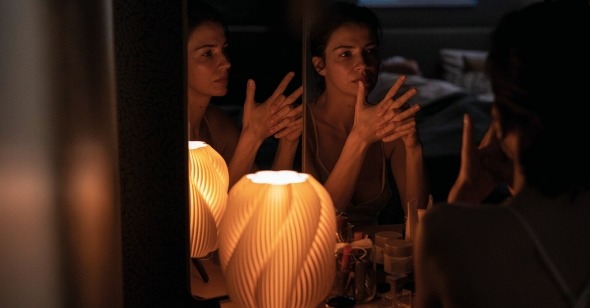
Gleb is a traditional family man with a strong disposition. He’s clean shaven with dark hair and glowering eyes that probe and penetrate from across the dinner table. He doesn’t rule his household with an iron fist, but he’s not passive either. Galina is a pampered housewife. We see her shaving her legs in the shower and moisturizing in the mirror. The couple move around one another silently, harboring more intimacy with their phones than within their marriage. They take their devices into bed and stare into the glow of blue light before sleeping back-to-back. You get the feeling that they’ve been operating under this frosty dynamic for a while, and it’s only once Gleb begins to suspect another man on the end of the phone that he’s suddenly awakened to the idea that his wife might have a complex inner life, or even an outer one.
Early on, Zvyagintsev and co-writer Simon Lyashenko establish Gleb and Galina’s Russia with a scene at a swanky restaurant featuring the couple, two of Gleb’s business world friends, and the friends’ wife and girlfriend. At the table, the unmarried woman, a blonde, dressed more revealingly than the wives, tells a raunchy sex joke that gets the men laughing. Later, the men go outside for a smoke, and the married women excuse themselves to the restroom, leaving the young woman alone at the table blowing cloud plumes from her vape. She’s basically outcast for not having a defined role in the patriarchal structure, neither a man nor a married woman, but as she gazes directly into the camera—one of three formal swings in Minotaur that invite you to pause and reflect—the superficial values and codes of this affluent, degenerate part of society begin to crystallize. Zvyagintsev implicates the viewer in this fabricated world of comfort and provocative dinner games, idle and distracted as the real provocation rages on off-screen.
Outside the restaurant, the men grumble and moan about the war, highlighting a level of cowardice among the business class, who may not jingoistically support Putin’s invasion but decline to resist in any way. In the bathroom mirror, the married women touch up their faces and whisper smugly about marriage. Galina’s friend dispenses some depressing wisdom: “A happy wife knows nothing.” At this level of society, Zvyagintsev seems to say, everyone has their blinders on. The director’s note puts it plainly: “People in Russia today are apathetic, under the yoke of censorship … Everyone tries to close their eyes, because every day that passes only increases the debt to the truth, and looking into her eyes is more and more frightening—Russia now looks like a monster.”
Minotaur is adapted from Claude Chabrol’s 1969 erotic thriller La Femme Infidèle, exchanging Chabrol’s critique of the French bourgeoisie for the Russian oligarchy. Their world is one of luxury modernist architecture (though the film was shot in Latvia) and fine dining that looks indistinguishable from the kinds of places you might find members of the Western elite, despite anti-West attitudes promoted by Putin. Before Russia mobilized in 2022, Gleb might have been considered an ordinary corporate executive, normal in his love for his family, and even in his marital conflicts. Not especially patriotic, or astonishingly evil. But in the current political environment, his class stands apart for one glaring truth: they’re almost completely insulated from the war. It’s at their doorstep but doesn’t breach the threshold. Gleb doesn’t discuss it with his family over dinner, and though he counsels his son about confronting schoolyard bullies, he never mentions the bully in the Kremlin with designs on turning back the clock to the Soviet era. Even as Gleb uncomfortably contends with the government’s orders to supply soldiers from his company, signing them up for, at best, an uncertain future and, at worst, death, he never so much as looks at Seriosha in a way that suggests any apprehension that his son could be next. His privilege protects him from the scale of the grief.
Without the war weighing on his psyche, Gleb is free to burrow deeper into his personal anxieties. And his paranoia is justified. Gleb discovers that Galina’s been having an affair with a 33-year-old photographer named Arthur, who lives in a modest studio apartment in the city. Gleb shows up at Arthur’s apartment, without much of a plan. Hurt more than anything, he almost graciously accepts the tea offered to him by his wife’s lover. It’s only when he thumbs through a stack of photos lying on the coffee table of Galina wrapped in bed sheets that he’s jolted from his confusion into blind rage and bashes Arthur over the head with a film camera, killing him. If the sudden murder could be considered an emotional crime of passion, the deliberate pace of its aftermath, clean-up, and disposal is methodical, which Zvyagintsev lets unfold for almost 20 minutes, in broad daylight, underscoring its depravity and brazenness. In this silent Hitchcockian sequence, recalling Norman Bates’ drawn out clean-up in the aftermath of the killing in Psycho, the director continues his work on the audience. Are we on the edge of our seat now, hoping Gleb will get away with murder?
Minotaur works as a kind of companion piece to Leviathan, released almost prophetically in 2014, the year Russia invaded Crimea, setting this era of Russian imperialism in motion. Leviathan also balances dramatic conflicts of government corruption and infidelity. In that film, a mechanic is pushed out of his family home by a crooked mayor who has it out for him and has the law completely at his disposal. Making matters worse, he catches the lawyer representing his case, a longtime pal, with his wife. In both films, a wife’s betrayal becomes a metaphor for government corruption, and the cuckolding a symbol for the inability to do anything against a dominating authoritarian regime. In Zvyagintsev’s films, what happens in the family is always representative of the afflictions of the country.
La Femme Infidèle ends with the implication that the murderous husband will be brought to justice. Minotaur has no such illusions. After two cops show up at his home, Gleb returns to the mayor’s office to get them off the case, once a cog in the machine, now using the machine in his favor. The same man who earlier in the film showed some apprehension about signing his employees up for war has come up with a list by deceptive means and eagerly adds a name—another sacrifice to the minotaur—to help clean up his mess: the private investigator who discovered his wife’s infidelity.
Many images from this film linger in the mind, including the final one, an extended black-and-white shot of clouds from overhead that could be smoke from the battlefield. But the stickiest may be a portrait of Putin hanging on the wall in the Mayor’s office. There was an identical image in Leviathan, of a corrupt local administrator with the president’s much younger, blonder, picture behind him. In the intervening years between these films, whose director is now in exile, that portrait stays the same. Putin has been in power for more than 25 years. In a Russia whose future feels uncertain, it’s the one thing that remains inevitable.