Life Is Bittersweet
by Gavin Smith
New York Film Festival 2026:
Tender Loving Care
Dir. Mike Leigh, U.K., Bleecker Street
Ordinary people—this could be the title of most of the ten Mike Leigh films that have graced the New York Film Festival. From film to film, and maybe most of all in Tender Loving Care, the faces and bodies of his actors remain staggeringly, beautifully ordinary.
None of his actors have been stars at the outset, but some have created and played star-making roles for him: Lesley Manville in Another Year, David Thewlis in Naked, Marianne Jean-Baptiste in Secrets & Lies, Sally Hawkins in Happy-Go-Lucky. I don’t know what’s in the professional future for the cast of his latest (and perhaps final) New York Film Festival selection, but Kate O’Flynn, who won an Emmy this year for her role in Widow’s Bay, is clearly on her way. All the same, while Leigh’s films are devoid of glamour, they shine bright, even the gloomy ones (maybe not Naked). None of them are “grand” and “important”; on the contrary, they’re modest and humble—you never feel Leigh reaching. “Slickness” is not in his vocabulary, and there are no easy answers to be found in his films. I’m not sure he’s even asking many questions.
Leigh’s films always seem to be greeted and received with a special feeling by New York Film Festival audiences. Something of this has to do with the England and the singular Englishness he leads the viewer to—not an idealized or cute or confected Englishness, but something as close to the real thing as you can get in cinema, and, without being feel-good, one comforting in its ripples and waves of humanity. The audience counts on Leigh the way they did with Eric Rohmer. They know he’ll lead them to a place inhabited by characters that don’t merely exist in service to a story, they live—and are so dimensional that they are alive before the film begins and live on after the film ends. (This is what all actors lay claim to but seldom achieve.) The glib, inadequate labels for what Leigh does are “slice of life” and “social realism,” and when you read David Thomson’s opinion (in a basically positive evaluation) that Leigh’s films “may come dangerously close to a patronizing attitude” towards “the underclass,” you may want to reach for your gun. “The underclass”? Seriously?
You might have noticed certain patterns in the films Leigh has made since crossing back over to the big screen after ten creatively critical years of television and theater. Only three of his last 14 outings have been centered on men. Also, unlike his earlier films, only three deal with family life—Life Is Sweet, All or Nothing, and the 2018 historical drama Peterloo, which might seem like Leigh’s most “political” film in the most superficial sense of the word, in the manner of Ken Loach perhaps. (None of these were selected by the festival, unhappily.) Leigh’s eight remaining stories are built around the lives of women, either as part of a couple or more often single. Tender Loving Care is the furthest he’s pushed out and away from the precincts of the masculine imperative.
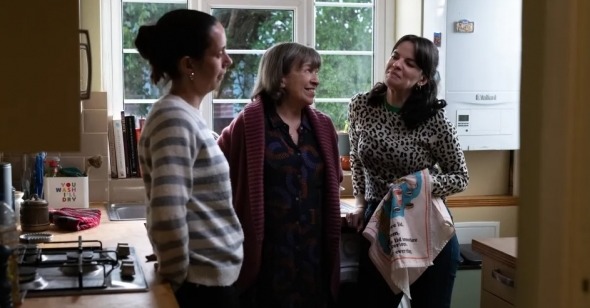
“She’s finally left the bastard,” announces Birdie (Marion Bailey) to her husband, Geoff (Paul Jesson)—she being their daughter, Amy (Kate O’Flynn), a social worker who lives with her BFF colleague Rosie (Alice Bailey Johnson), who is like a second daughter to Amy’s parents. Said bastard remains pointedly offscreen, as does Rosie’s fireman date. Aside from Geoff, there are only fleeting single-scene appearances by an affable doctor paying a house call (played by six-film Leigh veteran Peter Wight), and, in the course of Amy and Rosie’s casework, a middle-aged hoarder and a youth in foster care. (And there’s one more, more troublesome, but I’ll get to that.) These two pairings form a compact, interconnected four-hander.
Amy and Rosie work in the most demanding, nigh impossible of jobs, even as they contend with the fraying social safety net caused by government cutbacks. As each makes her rounds, she applies her people skills and patience to the full range of human misery in a series of discrete brief encounters. Leigh depicts up close how they make their living through authentic caring and compassion, without exalting them. At the same time, their personal lives entail another set of challenges. What to wear on a third date to convey the right combination of signals? At home or out for tea with Birdie they’re good-humored and their shop talk, inconsequential chat, jokey shared anecdotes are all of a piece. Their sense of humor is unforced and not played up, but it’s vital to who they are and how they cope—and if there’s only a small hint of burnout in Amy’s self-medicating wine consumption, there’s also more than a little disenchantment with men. Asked how her Friday night date went, Rosie firmly replies “Gonna need a drink”—but being stood up is no drama, just another of life’s forgettable letdowns. For the most part Tender Loving Care isn’t intended to be taken as the stuff of either high comedy or melodrama—it’s just an unsentimental look at how people get on with their lives, with what passes for joie de vivre in English terms (the titles say it all: Life Is Sweet, Happy-Go-Lucky). And interestingly, these are characters that have little or no baggage, and no agenda, particularly when compared to Hard Truths, Leigh’s 2024 masterpiece, where the baggage was crushing.
Birdie and Geoff would initially seem to have the least baggage: their office-romance marriage is coming up to its 50th anniversary, and the couple are happily and lovingly retired and keenly attentive to their daughter’s love life. (You can perhaps see where Amy gets her empathy from in a quietly devastating scene in which Birdie and Geoff’s recently widowed friend Josie, played by three-time Leigh veteran Tilly Vosburg, spills out her agonized self-recrimination over her estrangement from her son, a third offscreen man, her face etched with the lines of a life of anguish—in that sitting room Leigh tells an entire story in a single scene.) It comes as a shock when Geoff quite suddenly begins to show signs of dementia, but the drama of his rapid cognitive decline is played with pitch-perfect restraint. In a reproach to the melodramatic treatment of Alzheimer’s in so many of today’s films and TV shows, Geoff’s undiagnosed infirmity is depicted with a calm dignity that’s never maudlin. And it represents an opportunity for a redoubled togetherness, as Amy, Rosie, and Birdie sit at Geoff’s bedside, reminiscing and, in a throwback to the working-class of yore, finding his happy place in singing songs of yesteryear—The Platters’ doo-wop hit “The Great Pretender” and the turn-of-the-century cockney music-hall song “Boiled Beef and Carrots.” (I wondered if the latter was really part of the English collective unconscious, but no, there’s a modern-day performance of it on YouTube.)
Leigh only ever moves the camera in his films when it’s absolutely necessary—and it is, here, when the camera discreetly withdraws from the bedroom and our final glimpse of this foursome. The film is dedicated to Dick Pope, Leigh’s DP for the past 25 years, whose death must have felt like losing an arm (the death of his producer Simon Channing Williams, in 2009, after a ten-film collaboration, surely did as well). Taking over from Pope, Lucy Bristow brings something special to Tender Loving Care: London, shot in a gentle, balmy light, in the film’s frequent establishing shots, has never looked so damn beautiful (again, the beauty in the ordinary). It’s a far cry from Naked or All or Nothing. Gary Yershon’s spare, jaunty marimba score also seems just right for the film’s mood and tenor.
“Everyone’s in their own bubble”—at two points someone makes this comment. One of them refers to Amy’s startled encounter with Brid Brennan’s old lady, lying on her back in a park, “communing with the earth”—while it’s still alive, I guess. At another point Rosie acknowledges that there are “people out there with worse problems.” Tender Loving Care is bookended by one of them, George (three-time Leigh veteran Alan Williams). The film opens with a tight shot on his closed eyes, prone in a hospital bed, less than responsive to Rosie’s questions about his welfare. She sets a date to pay him another visit, and when the day comes, he’s vanished, having checked himself out. In the film’s haunting final shots, Leigh returns to George, sitting on the steps of a building as pedestrians and traffic cross through the frame. In a series of unostentatious jump cuts, the frame closes in to end in silence on a tight shot of the spectral George’s eyes. His story hasn’t been told. It’s a bleak final note in a film that refuses anger or despair (or false hope), and it perhaps puts a pointed accent on the film’s title. If this is to be Leigh’s last word, the political and moral fire that has smoldered throughout his films is still burning.