Where Is Home?
By Leonardo Goi
New York Film Festival 2026:
Fatherland
Dr. Paweł Pawlikowski, Poland/Germany/Italy/France, MUBI
“Where is home?” Sixteen years after he fled Nazi Germany to settle in the U.S., and four since Hitler killed himself in a bunker, Thomas Mann (Hanns Zischler) is fielding questions from a phalanx of reporters in downtown Frankfurt. The writer, who received the Nobel in 1929, has returned to his native turf to pick up another award, the Goethe Prize. But the atmosphere inside the cavernous hotel hall where the presser is taking place has turned pugilistic. You’d be forgiven for mistaking the conference for a trial. Opposite the literary titan and his daughter Erika (Sandra Hüller), presently acting as his interpreter, reporters from either side of the Iron Curtain take turns to challenge Mann’s allegiances. There’s the German journalist who asks what he might have to say to the countrymen who viewed his departure in 1933 as a betrayal; a Soviet colleague who wants him to attest to the East’s superiority; an American who wonders if rumors that he may pick up a second Goethe Prize in the DDR are true (they are). But it’s Betty Knox (Anna Madeley), Erika’s partner and fellow war correspondent, who gets to ask the most personal question—curiously, the only one Mann doesn’t know how to answer. “My home now is California, but my heimat, where I belong—that’s a much more difficult question.”
The first time I watched Paweł Pawlikowski’s Fatherland, in Cannes, I remember hastily jotting down Mann’s words, convinced that they might serve as a Rosetta Stone to decipher the entire journey. As it turns out, they do. Like Ida (2013) and Cold War (2018), the first two instalments in Pawlikowski’s black-and-white postwar trilogy, which this brings to a close, Fatherland follows people fumbling after a sense of belonging in a postwar continent riven by all sorts of divisions, old and new—heimat remains a mirage in all three works. But on my second viewing, another question lingered: How tall is that ceiling?
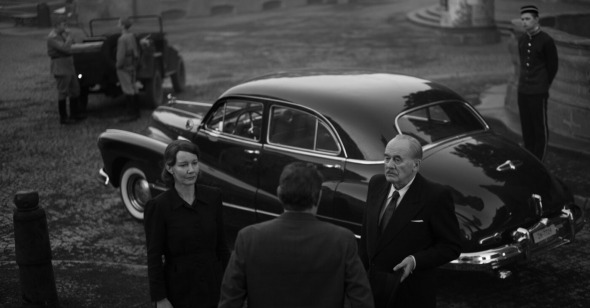
Now on his third collaboration with cinematographer Łukasz Żal, Pawlikowski’s honed an instantly recognizable aesthetic. Ida, Cold War, and Fatherland all tend to traffic in static shots in which people often appear from the shoulders up but only occupy a small portion of the frame—poking out of the boxy Academy ratio as if from windows. The rest is vertical headroom, plenty of it, a stylistic choice which in Fatherland reaches a kind of apotheosis. Virtually every indoor scene is designed to keep the ceiling out of sight, leaving characters floating in immensely and oppressively spacious rooms. The marbleized conference hall in Frankfurt, where columns jut dizzyingly skyward to dwarf the Manns and their audience; the sinisterly semi-deserted bar in East Germany, the camera perched just far enough from Thomas and Erika so as to turn the place into a cathedral; and the derelict church father and daughter visit in the closing sequence, reminiscent of Cold War’s own coda.
To call that empty space would be both technically correct and somewhat misleading: there is nothing empty about these backgrounds. Thomas and Erika do not hang in a vacuum but move across a string of liminal places—hotels, restaurants, theatres—and it’s a hallmark of the director’s artistry that these do not just stand as inert backdrops, speaking instead to his characters’ mental states. Pawlikowski mines postwar architecture for a pathetic fallacy. His wanderers seem to exist in a molecular relationship with their vacated milieus, which are an extension of their inner lives—a broken world housing broken drifters. This is why all the vertical headroom in Fatherland is no formal gimmick, and why the two questions—the exact location of Mann’s heimat, and the vertiginous size of the locales he roams while searching for it—are intimately connected.
The first person to grace the screen in Fatherland only appears in the opening scene, but his absence haunts the film. On May 21, 1949, early into Mann’s cross-country tour, his son Klaus died from an overdose of sleeping pills while in Cannes. A fellow writer, Klaus was best known for the formidable Mephisto, a scathing, fictional portrait of an actor clawing his way to stardom in Nazi Germany whom authorities deemed too similar to real-life thespian Gustaf Gründgens and banned over a libel dispute. While doctors couldn’t quite agree on whether his death was an accident or a suicide, Pawlikowski’s script irons out all ambiguities. Naked and disheveled, crouched at the foot of his bed in a sombrous hotel room, Klaus (August Diehl) looks and sounds like he’s long lost his will to live. “I can’t remember the last time I felt something,” he murmurs, funereally, to his sister listening in from the family’s California home. But he misses her dearly, and though Diehl and Hüller never share a frame, the distance only makes their bond more vivid and tangible. Erika invites her brother to join their tour; when he doesn’t show up in Frankfurt and news of his passing reaches her, it’s as if all the loneliness the film had surreptitiously accrued until then could finally detonate. Fatherland grows gloomier, the gulf between father and daughter wider. She’s devastated by the loss; he’s so insulted by it that he’d rather travel East to pick up another accolade than attend his own son’s funeral. Neither can muster the right words to process that trauma. “Let us love what is alive and mourn what is dead, but leave it behind us,” says a quote by Goethe that’s particularly dear to Mann; you could read Fatherland as a story about two people trying to live by that maxim, to no avail.
Klaus might be dead, but traces of him still litter the road trip. He’s in Bach’s cantatas—the only music, says Erika, that “almost made him believe in God”—and he’s in the crowds listening in rapt silence to Mann’s speeches about Goethe, love, Germany, the future. Early on, Erika has a vision of her brother looking at her during one such lecture from a gallery on the other side of the theater; when she returns to the venue after everyone’s left, the stalls are vacant, but a high-angle shot makes the entire auditorium look like a whale’s skeleton stranded on a beach, the rows a gigantic ribcage glistening under the sun. Here, as in other moments in which Erika stands as a tiny silhouette in Pawlikowski’s frames, the film’s form suits the story and the emotional void at its center—to borrow from Herzog, these are all “landscapes of the soul.” It’s a beautiful, unfading image, and Fatherland teems with similarly striking compositions. But the source of its arresting power resides in their gradual erosion. Fatherland is more glacial and austere than Cold War. Gone is the jazzy exuberance that billowed from that self-destructive romance; there are no intoxicating dance scenes, and no sinuous camera movements. Only once does Żal forsake the tripod to trail after Erika as she ditches one of her father’s public appearances to seek solace in the shadowy chasm of a nearby garden; only once does she raise her voice at him: “a cold-blooded narcissist” hiding “in a great castle of words.”
Fatherland concerns a father and a daughter trying—and failing—to repress an unspeakable loss, and its aesthetic testifies to that same failure: it thrives on the dissonance between its immaculate, meticulously studied surfaces and all the pain that percolates into them. At 82 minutes, it might register as the work of a miniaturist stripping down his style to conjure something cold and compact, a tale shrouded in caliginous light, almost cool to the touch. But there’s a palpable electricity coursing through it, most of it radiating from the actress at the film’s center. Hüller’s Erika might project an impenetrable façade, but hard as she tries to maintain it, grief still works on her, threatening her composure in myriad tiny ways: a pursed lip, a slight arching of the eyebrows, a thumb nervously rubbing her palm. Hüller communicates tangles of emotion even in repose—that she can convey so much by doing so little is a measure of her genius, and her understated performance is a perfect fit for a work that makes restraint its operating principle.
There are no loud, declamatory scenes here, and Fatherland is all the more lacerating for all that withholding. When catharsis finally comes under the notes of Bach’s “Jesu, Joy of Man’s Desiring,” the release feels contagious—it’s one of Pawlikowski’s most indelible sequences. As father and daughter sit among the ruins of an abandoned church and Klaus’s favorite music echoes from a battered organ, Fatherland wraps on a life-affirming note: a belief that what is no more is still around us, filling the air we breathe and all the empty space we traverse.