Settling the Score
By Mark Asch
New York Film Festival 2026:
Behemoth!
Dir. Tony Gilroy, U.S., Searchlight Pictures
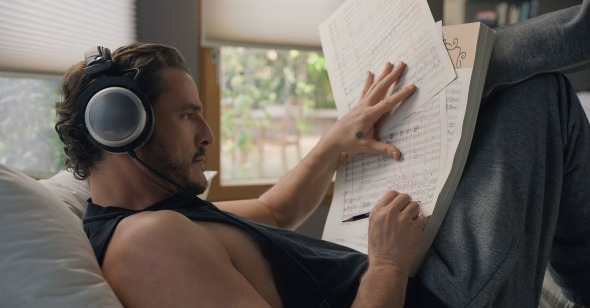
Surprisingly for a movie that turns out to be so gentle on its protagonist, Behemoth! begins where Tár ended. A classical-music star finds himself in straitened circumstances, reduced to playing commercial gigs for new media, beneath his talents and far from any symphony hall. Settling into the Barbra Streisand Scoring Stage on the Sony lot, cellist Alex Serian (Pedro Pascal) is met with vigorous handshakes and incredulity. He’s back; what is he doing here, man; what happened to the Chicago Symphony; where’s his pedigreed cello? The younger woman in the second chair is less happy to see Alex—some sort of reputation precedes him.
Alex has a cover—he’s caring for his sick mother—but the reason his cello is gone is messier, and has to do with the peculiar circumstances of his thief-in-the-night departure from Chicago. One of the stars of the symphony, he had been sleeping with Carol (Olivia Wilde), the wife of its leading donor, possibly hastening his return to Los Angeles. (The symphony fundraiser who reams out Alex for his dalliance with such an important backer is played by the formidable Kate Lyn Sheil, microindie queen of the Obama era, and what a thrill it is to see her onscreen for the first time in three and a half years.) On the soundstage, Alex settles in to play some score cues for a spy film, and this becomes the soundtrack for his Chicago escape, genre music for a genre chase scene in which Alex, eluding the woman scorned via the back stairs, ends up commandeering an off-duty cab and sending the driver into the snowy night, where it’s t-boned at an intersection, costing Alex his instrument and sending him home chastised and scarred.
Back in his hometown, Alex does the rounds of his mother’s nursing home and family storage unit, meeting old acquaintances and reopening old wounds as the movie's hopscotching chronology reassembles the jumbled pieces of his lonely life. A flashback-driven male memory piece, in which a difficult man revisits lost lovers and professional disappointments, Behemoth! could almost be called Tame Strawberries—the mode is therapeutic, and writer-director Tony Gilroy is quite fond of his wandering troubadour.
Romantic entanglements such as Carol, and their risky imbalances of power and position, are part of the pattern of Alex’s life, though her hard feelings, so emphatic in that opening scene, portend no guilt on his part. Wilde, who with her self-amused feline eyes is a naturally predatory screen presence, sports a leopard-print coat when stalking Alex’s apartment, and eventually tracks him down in Los Angeles; he really is her prey. Earlier in the film, when Alex is playing in Dallas, the much younger violinist Natalia (Eva Victor), aware that he slept with her old Juilliard roommate during her conservatory days, flirtatiously chastises him for charming the symphony’s box-tanned society-wife donors: “You’re a monster.” Especially because the line is delivered by Victor, the writer-director of campus #MeToo drama Sorry, Baby, we might expect the irony of this mock-j’accuse to deepen and curdle, but the two fall first into bed and then into a relationship—which she ends, in favor of her own married would-be patron. The most direct blow she can land in an almost incoherent breakup argument is “Fuck you for letting this happen.” (Victor appears in two scenes; in a late-movie montage, we see a shot from what would presumably have been a third, and might have clarified how exactly this character became the one that got away.)
Later in the film, when he rekindles things with an old flame, Alex reveals that he lost his virginity at age 13 to a 20-year-old music teacher. The grooming he was subjected to was not merely sexual: the child of a harpist-heiress (JoBeth Williams) and a resentful career studio musician (Hank Azaria), Alex was destined for the greatness that eluded them both, beginning with a childhood appearance on The Tonight Show with Johnny Carson that now embarrasses him. The first sound we hear is the dissonant plucking of a harp, suggestive of his mother’s bitterness and fraying lucidity, and Azaria makes a meal of his sole scene, as a ranting hepcat resentful of the excellence he forced on his son, and which opened a gulf between the two of them. Alex’s brother, Andy (Will Arnett), rebelled in a different way, becoming a rock-and-roller and remaining mired in a perpetual adolescence—I counted at least three chains of distinct precious metals glinting through the unbuttoned collar of his Henley shirt in one scene, and he drives a vintage Alfa Romeo. An earlier bit of character exposition had established that Andy crashed his dad's prized Alfa as a teenager—there is no such thing as a stray line of dialogue in Gilroy’s script.
Michael Clayton, Gilroy’s directorial debut, was a well-made ’70s-throwback paranoid thriller that caught the recessional zeitgeist in 2007, and 2009’s Duplicity was a clever corporate caper, less substantial but intricately plotted. He subsequently directed a Bourne sequel (having cowritten the first three films in the franchise), but his touch has lately been more present on television, as the showrunner of Andor, the Star Wars show that everyone swears is good. Directing his fourth feature, a decade and a half after his third, he takes a renewed pleasure in formal play; he anchors the flashback structure of Behemoth! with Alex in the studio recording disconnected snippets of movie music; the music, which is invariably fluent in Hollywood cliché, seems to conjure the flashback and set its tone. Additionally, Alex is surrounded with music, classical and otherwise; a recording of one of Serian père’s cartoon music cues happens to score a bit of slapstick business with Andy and his angry wife chasing each other around a kitchen table like Tom and Jerry, and a piano performance by an unsullied child prodigy hits Alex like a non-diegetic Oscar-clip swell.
All this is clever, and notionally ironic, but thematically insubstantial. Many of the flashbacks, such as that opening chase, take on a heightened, air-quotes quality, but Alex’s life really is a movie: he wears a tuxedo for work and women throw themselves at him like he’s James Bond. For almost the entire running time, we are waiting for the other shoe to drop, for this hurt person to hurt people, but Alex is guilty of nothing more than bobbing through life, floating on the current. Pascal, his leonine hair windswept or dyed or cropped to keep up with the film’s continuity, is majestically handsome but also sad-eyed and effacing; viewers can and do project onto him, and read bemusement or fondness into his general sympathetic passivity. To those real housewives in Dallas, Alex appears sly and caddish, while to a musical mentee, he’s paternal; he’s equally happy to make a suggestive comment or a dad joke, to let his partner call the tune. Pascal has a Teflon charisma, never causing friction and never allowing anything or anyone to stick to him. Alex is isolated by his talent and closed off to the world by his trauma; the role could be a way for our least problematic leading man to subvert our expectations, to at least madden us with his diffidence as he seems to enrage the thinly written Carol and Natalia, but that’s not the route the movie takes.
Gilroy comes from an artistic family, as well. He and his brothers, including both writer-director Dan and Behemoth!’s editor Jon, are like Alex and Andy following in the footsteps of their father, playwright and screenwriter Frank Gilroy. (One of his memoirs is titled Writing for Love and/or Money, though unlike the Serian patriarch, he was no hack—he won a Pulitzer in 1965.) In its portrait of a talent subject to the whims and manipulations of people and forces beyond his control, Behemoth! seems to be a lament for the permanently conditional status of a professional in the arts. The film knows about postproduction workflows and entertainment-business economics; Spotify is “vapor,” says Andy, whose residuals are drying up, and in a Los Angeles that’s never fully recovered from COVID, studio hands like Alex have to play gender-reveal parties for extra cash. Appropriately, the film premieres against the backdrop of the Paramount–Warner Bros. merger, the looming specter of further dwindling output from consolidating major studios, and more jobs lost once David Ellison forces his AI interests on Hollywood.
But in defiance of the dark clouds spotted on the horizon for the culture industry, Gilroy ultimately plays Alex out on a note of hope. He is deft at the drip-drip of narrative reveals, which clarify key relationships at satisfying moments; the film's climax brings Alex fully into focus, revealing the void at the center of his self even as it fills it. Behemoth! is so well-constructed that this final, hopeful note resonates—Gilroy's classical filmmaking makes for easy listening.