On the Road Again
By Dylan Adamson
New York Film Festival 2026:
London
Dir. Sebastian Brameshuber, Austria, no distributor
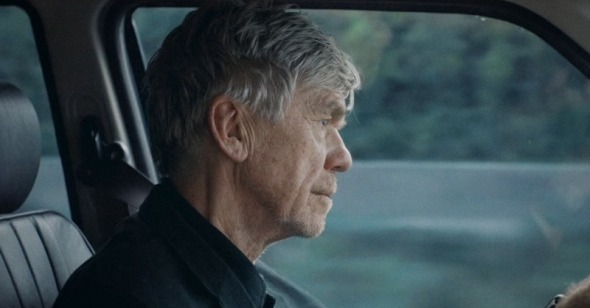
Though it’s named after a place, Sebastian Brameshuber’s London is, first and foremost, a film about its lead actor, Bobby Sommer. He first appeared in a feature film as one of two leads in Jem Cohen’s Museum Hours (2012), playing a pension-aged former punk band manager working as a guard at an art museum in Vienna. Here as there, his worn, elegant face seems capable of listening with an almost superhuman patience; his Viennese German is supremely polite without a note of pretension. He seems wise, like he has everyone else’s best interests at heart, though there’s only so much he can do.
In London, Sommer (as “Bobby”) drives the West Autobahn between Vienna and Salzburg, picking up strangers for company and gas money along the way, facilitated by an unnamed rideshare app. The film’s opening beats are spent looking out the windshield from a fixed camera position. His first passenger hops in with McDonald’s in hand; he is a military conscript, we learn, on leave from Austria’s famed Gardebataillon. With the quick intimacy borne of a long car trip, he swiftly confesses his PTSD to Bobby, along with his skepticism of the Austrian army. The scene cuts between three angles: the windshield from a middle perspective, Bobby from the passenger’s perspective, and the passenger from Bobby’s perspective. It ends before the soldier is dropped off. There’s a pleasing simplicity to this structure. Rather like Sommer, it seems lab-designed for the best possible listening experience.
Though it henceforth cuts to rides in progress, London repeats the opening scene’s basic structure ten times. Not satisfied with the premium listening conditions of an extended car ride, Brameshuber opted to do away with surrounding traffic noise by shooting the film almost entirely in a studio, with carefully concealed rear projection plates of the Autobahn covering the three camera positions. For the most part, the production consisted of bringing actors—many, but not all, sourced from an open call—into the stationary car with Sommer, where they would have filmed conversations, usually taking from their own biography. In place of written dialogue, Sommer had only a few details about his character to work with, as was the case for one or two passengers, such as the conscript. Between each ride, we depart from the studio-bound Land Rover to watch Bobby pee, fill up his car, or sip coffee. These spare moments are shot handheld, giving the impression of someone popping a hole in a vacuum-sealed bag.
London exercises maximum restraint in the dispensation of details about Bobby. Every conversation starts from scratch, and Bobby is more comfortable listening than speaking about himself. Iteratively, we learn that he is traveling to visit a friend in Salzburg; his friend is in the hospital; his friend is named Arthur; Arthur had a stroke and has not woken up; Arthur and he played rock music together, decades prior, in London (hence the title). The backstories of his passengers are mostly organized around themes of migration and war, with two mildly funny cameos from a young person monologuing about the unintentional anticolonial masterpiece that is Avatar (2009) and experimental filmmaker Ted Fendt as a rather grating version of himself, hitching a ride to a spot on the Autobahn to photograph Nazi-era columns being torn down. Bobby listens, offering morsels of his own history every 15 minutes or so, edging us toward the full poignant reality of his situation.
The film lives and dies in these conversations, which are so unanimously tender and moving as to suggest a rideshare app that filters for conviviality and interesting family background. A long chat with a young Ukrainian woman lingers on the question of a lover Bobby left long ago when concerned for his independence. “And what have you done with your freedom?” she asks. “I still have it,” he responds after a beat. Later, speaking to a queer activist estranged from her family, he reflects on his relationship to aging: “It is not endless, this life….” The film conjures the magical highway consciousness of a thousand unknowable stories running parallel to one another, heartbreakingly circumscribed by the Autobahn lanes, and, here, the rigid camera angles and disciplined structural approach.
At the same time, the tasteful humanity and guarded exchange of vulnerabilities threaten to become oppressive, the intervals by which the film lets down its guard a touch too calculated. When Brameshuber uncorks the emotion, breaking his abstemious structure for a short musical reverie with “Pale Blue Eyes” (one of the Velvets’ most restrained songs), he hastens to cut the track short. London operates in a register of cultivated moderation particular to arthouse drama films and Germanic-speaking peoples. Its improvisations feel safe, minus any sense of potential hazard associated with picking up strangers. A Romanian passenger with whom Bobby doesn’t share a language arrives as a welcome rupture in the relentlessly affecting series of dialogues. To cast back to another melancholic road movie, Two Lane Blacktop (1971), one longs for Warren Oates to hail a ride and shake things up with a sense of mystery capable of being threatening or abrasive, rather than merely heartbreaking, but there are few surprises lurking on the roadside of Brameshuber’s pre-filmed highway.
London flirts with docufiction, but the proportion of reality it is able to admit is relatively small, by invitation only into Brameshuber’s studio, minus the risk of the open road. Fendt’s character introduces a sense of history, but the film demonstrates little interest in contemporary Austria. It feels convenient for the film’s tonal register that Bobby encounters only people with either sympathetic or unspoken political leanings, especially given the severe political polarization in the country. It is also odd that none of his riders, nor Bobby himself, ever openly discuss the gig economy in a film that is both concerned with migration and structurally dependent on a rideshare app. Indeed, clues about the driver’s economic situation are few and far between. Considering his relatively new Land Rover, it seems entirely possible that his incentive is less gas money than conversation, and the film shares this sense of humanism detached from material realities. Though you wouldn’t know it from watching London, traffic is loud, gas is expensive, and strangers can be dangerous—a film about the importance of listening feels bereft without a little noise.