A Sound of Falling
By Dan Schindel
Chime / Serpent’s Path
Dir. Kiyoshi Kurosawa, Japan, Janus Films
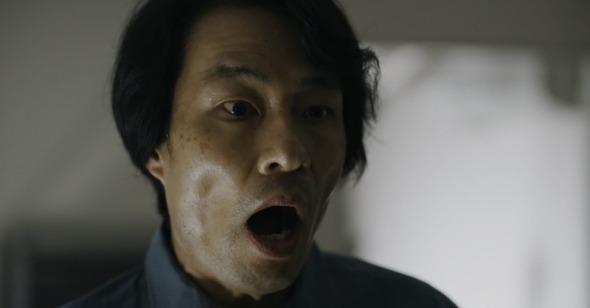
Kiyoshi Kurosawa studies social contagions—which often manifest in his films through violence, but also sometimes through minor unsettling irrationalities. The lead of his new short Chime, a cooking instructor named Matsuoka (Mutsuo Yoshioka), “catches” a homicidal impulse from a student whose off-putting behavior ramps up until he calmly sinks a knife behind his own ear. As Matsuoka’s behavior spirals into professional self-sabotage and murder, one wonders whether his wife and son’s tics are evidence that they have also caught the virus, or if the wife obsessively crushing discarded cans and the son gormlessly playing video games while fingering a fidget toy are simply symptoms of everyday malaise.
In a review of last year’s Cloud, I wrote that Kurosawa captures the “persistent tinnitus-like hiss in your mind, the background radiation of unease” in contemporary life. That quality is literalized in Chime, since the vector for the violent compulsion (or perhaps its herald) is a sound only the affected can hear. Matusoka’s student is the one who describes it as a chime, but when we hear it through Matsuoka’s perspective, it’s more of a bassy thrum. Rather than self-consciously creepy, the sound is actually somewhat soothing in an ASMR sort of way, lulling the infected to sleepwalk into violent attacks on others or themselves. Grasping for logic is pointless, but it does seem salient that the student stabs himself after Matsuoka instructs the class in slitting bread dough to let air escape, and that Matsuoka later kills a student who asks him to demonstrate carving a chicken. Hearing the chime accelerates the defamiliarization of normal alienation; suddenly, you can’t tell apart different kinds of meat.
Kurosawa’s films tend to observe this kind of context collapse as people, groups, communities, or even the entire world spiral. Think of the seeming imminent apocalypse of Cure, the suggested one of Charisma, or the fully realized one of Pulse. Chime fits this full arc into a mere 45 minutes, demonstrating how finely the director has sharpened his approach. It deftly weaves in details gesturing at the spread of the chime. In one terrifyingly discombobulating scene, Matsuoka’s job interview in a restaurant abruptly veers off course when an unrelated bystander attacks a woman. In an interview with Paula Costa, Kurosawa describes the protagonist’s arc in terms of crossing three lines: of social taboo, personal morality, and his own conscience. Once they’re transgressed, a person is capable of anything—a disquieting prospect.
Chime itself was conceived as a kind of virus, produced by the Japanese blockchain-based platform Roadstead to be distributed as an NFT. There are at present no plans to make the film available online or on home media, though it is fortunately showing in theaters. In the U.S., it is playing on a double bill with the 4K restoration of Kurosawa’s 1998 feature Serpent’s Path, originally made to go direct to video and not previously released here. The movie proves a suitable companion to Chime, as it also tracks the personal degradation inflicted by perpetuating violence. It follows two characters who, at the outset, have reconciled themselves to crossing the legal, moral, and personal lines Kurosawa references. Miyashita (Teruyuki Kagawa), a former yakuza grunt, is out for revenge against his former comrades for the torture and murder of his daughter. Helping him is Nijima (Show Aikawa), who despite being a teacher, is much more adept with the logistics of kidnapping, interrogation, and killing.
Produced on a minuscule budget, Serpent’s Path at first seems appropriately stripped-down thematically, with almost archetypal characters: a vengeance-seeker, his sidekick, and a gallery of anonymous rogues. But their attempts to pursue satisfaction instead mires Miyashita and Nijima in an ever more complicated web of complicities. The first goon they capture immediately names other yakuza as the true culprits, and they in turn implicate others. So too does the crime in question become labyrinthine: not only has one girl been murdered, but there surfaces a whole underground industry of snuff films. The details of the daughter’s death become grislier and more upsetting as they are clarified—Miyashita recites it to his captives as a kind of badass litany, but he’s ill-suited to the role of a righteous punisher, sputtering more with each attempt.
If Chime is an inward spiral with hints of outer chaos, Serpent’s Path is a vortex destroying all in the orbit of its main characters. The film’s most distinct image is of the duo dragging a sleeping-bag-wrapped victim through a field of grass, which suggests the animalistic quality of the title. The killings are brutal but conveyed in a detached, matter-of-fact way that leaves them bereft of the catharsis expected from revenge pictures. The expanding sphere of violence also recontextualizes how we understand both Miyashita and Nijima—the former is not the bystander to his associates’ crimes that he pretended to be, and the latter gradually reveals himself as the true protagonist of the story.
Alongside Cloud and Chime, Kurosawa’s third Japanese release in 2024 was a France-set remake of Serpent’s Path. What’s most intriguing about that film is not the more polished production or the relocation, but how it updates the details of the crimes its characters are reacting to. Now they are no longer fighting mere snuff-film-making yakuza but an Epstein-style conspiracy of European child organ traffickers, a nefarious “circle” within a greater “foundation.” That the rest of the plot fits so well within this framework testifies to how well Kurosawa speaks to the manifold anxieties underlying life in the 21st century.