Another Look:
An Interview with Ross McElwee (Remake)
By Dan Schindel
In Six O’Clock News, his 1997 meditation on emergencies, Ross McElwee visits acquaintance Barry, who’s set up a Marion Stokes–like project to constantly record everything on television, running ten sets at once, stacked together like a Nam June Paik installation. Barry’s compulsion is a variation on McElwee’s own—at least based on how he’s presented himself in this and other works, a camera always in hand. In his earlier documentary Time Indefinite (1993), which concerns several simultaneous family tragedies, McElwee narrates: “There must be some way to deal with this through my filming.”
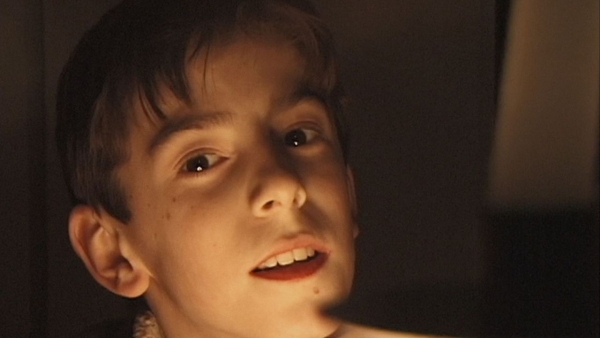
Since his thesis film, 1977’s Charleen, McElwee’s work has acted as a long-form study of his life, like an autobiographical, irregularly released version of the Up series. Along the way, he’s also found methods to interrogate this life logging, and to interrogate his interrogations. In one shot that recurs inseveral of his movies, he films his young son, Adrian, as he toys with the kaleidoscopic image created by pivoting two bathroom mirrors toward each other. McElwee himself can be seen in the reflection, holding his camera. The visual is a useful key to his broader project and its interest in cinema as a mediator for memory and personal identity.
These themes come to a head in Remake, McElwee's newest feature. In it, he grapples with Adrian’s 2016 death. The many clips of his son throughout the years (some seen in his earlier works, some not) represent how he continually turns events over in his head, wondering what could have gone differently. He also follows various misaimed attempts to adapt his 1985 personal epic Sherman’s March as a fiction film (or, of course, a miniseries). Ahead of Remake’s theatrical release, I sat down with McElwee over Zoom to discuss the documentary and his evolving feelings toward his craft.
Reverse Shot: In Remake, you say that you used to call yourself a filmmaker. You say this while making the film. Was it intended as a statement to apply retroactively, or is it more capturing how you felt at the time?
Ross McElwee: That quote occurs right at the beginning of the film; it’s reiterated two-thirds of the way through, and it echoes throughout. It just popped into my mind as I was working. I was confused about exactly what I would do next. It came probably a year after my son had died, and I didn't know how to begin to process that into a documentary. During that year, I grappled with whether to try to write something, like a memoir. I didn't feel I wanted to work with home movie footage of him because it was too painful at that time. Gradually, I got to a point where I could go through the footage, but that phrase—I used to call myself a filmmaker—stayed with me throughout the whole process. “This has upended so much in my life, including what I think of my work. How do I go from here?”
RS: And your films are on time delays from the events they capture. The operetta based on Sherman’s March appears toward the end of Remake, but that happened back in 2014.
RM: Right. I filmed the opera performance in 2014, two years before my son died. I was thinking I’d follow this film, wherever it goes, to anything even tangentially related to the notion of remaking Sherman's March as a fiction film. The operetta was one of the more surreal things that's ever been offered to me. I decided to give the rights to the composer, and later I called him and said, “Wait a minute, I'd like permission to film the rehearsals and the opening performance.” And he of course agreed.
There were other things we filmed after Steve Carr's production. Another Hollywood person wanted to take a crack at it, and she worked on it for at least half a year. I went out and filmed a table read in L.A., which doesn’t appear in the film. Maybe it's obvious, maybe it's not, but I filmed a lot of things with no idea of how they would be interesting or what film they would end up in. It’s all part of the tradition I was rooted in as a young filmmaker, which is cinéma vérité or direct cinema, where the idea was to be alert enough to capture things as best you can.
RS: You’d also documented an earlier attempt to adapt Sherman’s March in Six O'Clock News.
RM: I've always found myself interested in what Hollywood and fiction filmmaking try to do, as opposed to my kind of filmmaking. You could say that on a grander scale, Bright Leaves was pursuing something I thought would be revelatory, a Hollywood movie by Michael Curtiz that supposedly represented the story of my great-grandfather, a tobacco manufacturer in North Carolina. That turned out not to be true. These missteps, the things I expect to happen that go glaringly off course, are what give the films some vitality that they might not otherwise have.
RS: In Sherman's March, you wonder if you're filming your life so that you can have a life to film. Has that feeling persisted?
RM: Of course. It never goes away.
RS: How prevalent has that filmmaking impulse been in your everyday life over the years?
RM: I think people have the mistaken impression that I always have a camera ready to go. There were periods in my life when this was true. But certainly, around family, I filmed less than 1% of the time. But I let the impression stand because I think it has comic potential—this persona, or a character played by me, with his obsessions. Somehow, there's a truthful version of me wrapped up in all that.
RS: How have you preserved everything you’ve shot over the years? How much is digitized?
RM: Most of what has any potential of making it into a film in the future has been digitized. And even that's a risky assumption, trying to choose what's going to be relevant 10 years from now. Sometimes I think I should just digitize everything, but it would be too much. And I don't want the responsibility of going through all that footage. I try to do a pre-edit through my archiving. I don't think there'll be too much lost in that approach. Everything's on drives—some in New York, some here in Boston—and all the films themselves are in an archive at the university. So stuff is being preserved outside my house.
RS: You reuse certain scenes throughout your films, especially this one. How do you get the feel for how much old footage is appropriate to use?
RM: It’s always intuitive. I don't have a formula that says, “Okay, you've used this three times, you can't use it a fourth”’ Also, the older you get, the more there is to look at what from you filmed in the past. I’m a lot older than you are; maybe you feel that way about your writing. You look at this huge volume of stuff that's accumulated over the years. There's just so much more to choose from that I find myself more and more looking backward in my films, as opposed to looking forward. That makes me a little bit sad because I always like the idea of going out, discovering something new, and filming it. I hope my films always have some quotient of that. But as you get older, it's less and less likely—for me, anyway. I have to have faith that whatever I go back and choose has some relevance to the story I want to tell now.
RS: But there's also value in looking back and finding new significance in old footage, seeing how these scenes get recontextualized through what’s happened since.
RM: Yes, I think it's true for all of us. We look at something we shot when we were 20, and then you look again at 40, and things have radically changed. The world has changed, your family has changed. And that's interesting. I think that’s becoming more and more a part of documentary filmmaking. There’s more video coverage of people who, for whatever reason, end up being the subjects of films. That certainly wasn't true 40 years ago, when I was beginning my filmmaking career. I think the world at large has made it very easy to film anything and everything. And the huge amount of possibilities becomes a massive editing problem.
RS: You've taught for many years. How have you seen this technological and social shift play out in your students’ work, or how they respond to your work?
RM: It’s hard for me to say. I don't show my own films in class; they can see them on their own if they want. And it depends on the class, but for introductory-level courses, I prohibit students from making films about their own lives, because I think it's difficult enough to master the technology. These people have never shot with a camera before. They may have shot with cellphones, they may think they know what they're doing in terms of composing shots, but invariably, there's a lot for them to learn. It’s not just me but my colleagues as well: at the entry level, we insist that students go out into the world and find people, places, events, subjects that seem interesting for whatever reason but are not autobiographical, and to film them. And they do it. At first, they're a little intimidated by that mandate, because it's so much easier to film on campus. It’s intimidating to approach strangers in a strange city. Most of them are not from Boston. But they find a way to do it.
And we have more people applying for these classes than we can accept. They’re popular in a way that sometimes surprises me. We have one 16mm course, and it stays on year after year. That course has been taught since way before I was teaching at Harvard, but it keeps going and is very much in demand. Students have heard about 16mm and want to try it. It’s too old for them to be nostalgic for it, because they weren't alive when it was used. I think they're drawn to the arcane and analog qualities of film and audio recording that don't exist in the digital world and their cellphones.
RS: Besides reusing old footage, you also revisit some of the people from your earlier films. There’s Charleen Swansea, of course, and Wini Wood from Sherman’s March. Were there others you tried to reconnect with whom you couldn’t, or who didn’t want to be filmed?
RM: Oh, yes. There were a couple who declined, mainly people with families. There was one person who didn't think returning would be the best thing for her career. But I was delighted with who I got. I wish I'd been able to film more people from the South over the years. It would've been interesting to see how their lives changed. But that was just not possible because I was teaching and had my family in Boston. One person I was able to film in absentia was Phillip, the mechanic from Sherman's March. He died, but I got to visit his son and film in the same warehouse where we filmed in Sherman's March. I think that has a kind of resonance.
RS: Did you also shoot the scenes with Wini on the same island where she was living in Sherman’s March?
RM: Same place. She doesn’t live there anymore, but she was there for a week visiting people she knew. I’d said, “If you ever go back to Ossabaw, it'd be fun to film there.” That seemed like an apt place to film a follow-up with her. And we did. That said, I would've filmed her anywhere. Wini brings the film to life and offers some really complicated and well-taken observations. She's sort of my double, articulating things perhaps better than I could about the relationship between film and memory.
That particular connection is important to me. The surgery scene, where I have a brain tumor removed, and suddenly we're seeing MRI pictures of my brain and its tumor, and moments from past films appear double-exposed. That’s my comment on memory in filmmaking. When you see my son fishing double-exposed over a shot of my brain, people get the idea because they see it, as opposed to me explaining it.
RS: Returning to the existential aspect of I used to call myself a filmmaker, what do you call yourself now? Is it a career, or what you are?
RM: Somehow, I think it's a little bit of both. And the further I get from Adrian's death and the completion of this film, the more I think I will be willing and able and ready to undertake another. I haven't arrived at that decision. Frankly, I've been too distracted by all the auxiliary responsibilities of releasing Remake. So, I hope this isn't my last film. This could very well be the capstone to my career, for whatever that's worth.