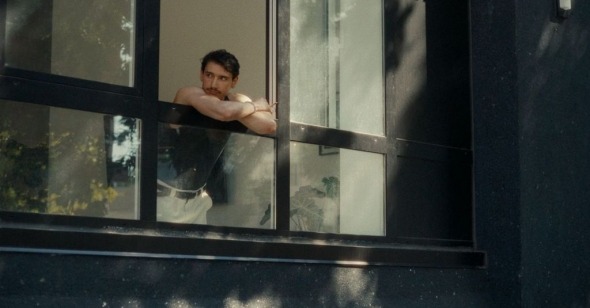
Summer Loving:
A Conversation with Lucio Castro (Drunken Noodles)
By Ricky D’Ambrose
The risk in calling Lucio Castro’s Drunken Noodles “dream-like” is that it puts this mellow magical mystery tour of a movie into the realm of pure sexual fantasy. And while twenty-something art student Adnan (Laith Khalifeh), seen from the get-go coming down the stairs of a subway station and drifting into an urban summer with all its heat and libidinal promise, is hardly chaste across the film’s 80-plus minutes, there’s something about the way Castro mixes sex with art, food, poetry, and the natural world that makes the film feel both wholly invented and stubbornly, sensuously real.
The director, best known for his 2019 film End of the Century, divides his film into four parts, presented out of chronological order, each prefaced by section titles embroidered by hand. That hand belongs to Sal (Ezriel Kornel), a kind of queer Falstaff figure of the Hudson River Valley, whose candy-colored needlepoint erotica gets the white-cube treatment at the gallery where Adnan interns. From the strange city swirling with amorous food deliverymen on bikes, who eventually join Adnan in a nighttime orgy that’s cut together as a series of frozen poses; to the countryside, a place of easy cross-generational friendships, haunted by eros and death; to the pristine and impersonal rooms of the summer vacation home that Adnan will share with his boyfriend (Matthew Risch), the film puts a single character in a rake’s progress that isn’t really a progress at all, but a series of recursive encounters charged with resonance and intrigue.
It’s a lovely film. What follows is a conversation about how it was made and what it discloses.
Reverse Shot: Does the movie change for you when you rewatch it? Do you learn things about yourself that you didn’t realize while making it?
Lucio Castro: There’s something that happens, especially at the beginning of a movie, that I only become aware of with an audience. It’s like walking a tightrope. There are moments where it feels like it’s about to fall: a frame too long, a shot too short. I only experience those micro-imbalances when I’m sitting with other people. Maybe because you’re more exposed, more sensitive to them. That’s why the first screenings are so nerve-wracking. Then you get used to the film’s rhythms and everything becomes permanent, fixed in time. But that first time with an audience, you’re still so close to tweaking things. After a while, the film becomes what it is and could never have been different.
RS: You’ve pointed out—and I think one of the characters says it—that desire is sparked by looking at something with another person.
LC: Yeah, it’s true.
RS: As a filmmaker, watching your own work with other people is a strange experience because it usually feels disembodying.
LC: That’s a great way to say it. You’re forced into being someone else. And that’s probably the source of every filmmaker’s awkwardness at screenings. The person you’re trying to become is almost like a strange average that doesn’t really exist. Oh, someone moved in their seat—but who cares? Who is that person? It’s a really uncomfortable position. But I do learn things, especially with humor. If humor doesn’t land, it’s like jumping and not landing; it feels terrible. If you’re not attempting anything funny, you’re never at risk. But when you are, you’re exposed. What I’ve learned from watching the film many times is that if the actor truly believes what they’re saying, the humor works. If they’re too in on the joke, it kills it.
RS: When the actor is too close to the joke, they’re identifying with it conceptually. It sounds like you’re working against that, both in writing the script without a fixed trajectory from point A to point B, and in encouraging the actors to have a looser relationship to the material. You’ve spoken about how writing is probably the most pleasurable part of the process, partly because you don’t need money to write. Can you talk more about that? And is this approach a homecoming to how you worked on your earlier features, or something you adopted for this film?
LC: For the film I’m making now in Argentina, I’m working the same way I did on Drunken Noodles: tiny crew, just myself, a sound person, and my niece, who’s studying film, as the producer. I gather locations, think about possible actors, and once I have all that, I write. But I write without a map—with a cloud. I use this for every movie: films that orbit the one I want to make, books, ideas, places, lines from books. When I start writing, it becomes very free. I don’t know where it’s going, but I have this cloud of images and possible locations.
When I make a movie without asking anyone for money—zero budget, just feeding people, renting a light—it allows me to be bad. I really believe in working against quality. When you’re writing to make something good, it’s very stifling. It’s like writing with someone else’s mind: your favorite filmmaker, your favorite critic, your favorite audience. I find that constricting. I want to make something where it doesn’t matter if it’s good or bad. Then hopefully my instincts guide me toward things that feel interesting, fresher, less explored—a moment in a movie that I want to see.
Film is the only artistic medium where you have to explain exactly what you want to do—in a very abstract way—to someone who will give you money. It’s not like writing, where you can draft freely, or painting, where you can make something and then sell it. Film reverses that. It’s perverse. You’re selling something you don’t fully know yet, and at the same time you’re pretending to know too much about it. But art is a dance with the unknown. If you explain it too much, you kill something.
RS: The way the film sets itself up is very striking. The first thing we see is Sal with his needlework, giving us the title—almost like an overture. He’s this gregarious, aging, bearded figure, a little mischievous, almost magical. It’s like someone weaving us into the movie. Then we see Adnan descending from the elevated subway stop, and from that moment it feels almost like Alice in Wonderland. We don’t really know who he is. He’s impassive, wandering. Were those images there from the beginning?
LC: You’re giving me ideas. But yes, I always write fairy tales. I love the fairy tale as a format. It’s always about an arrival, a beginning. And the weaving. Have you seen [John] Carpenter’s The Fog? One of my favorite openings, with the old man telling a story to the kids. Sal was my version of that. We don’t really see his face, just sideways, white beard. It’s a connection between the old and the young, and then the movie starts. The fairy tale works for me because it’s such a strong structure that you can break it. And when you do, you feel it even more. If you start very loose—Altman-style, lots of characters milling around—there’s nothing to rupture. But if you create a solid fairy-tale beginning, an arrival, you establish clarity. And when that clarity destabilizes, you feel it deeply.
There’s an Argentine writer, Cesar Aira, whom I love. In one novel, a character is in the bathroom putting shampoo in his hands, and it feels slightly more liquid than usual. That small perception sets off everything. Something very concrete becomes unstable. But for something to become unstable, it needs to start stable.
RS: I like how playful the film is with identification. When Adnan listens to the delivery guy’s headphones, we don’t hear the music until the second time, when the delivery guy puts them back on. These shifts in point of view feel like writing choices but also staging and editing decisions. How coordinated was this during the shoot and in post? Are you the same filmmaker on set and in the editing room as you are at the desk?
LC: All of that was in the writing. It was connected to the idea of maybe making a bad film—switching point of view abruptly. When the delivery guy suddenly explains the paintings to the other delivery workers, it’s such a drastic shift. That’s my favorite moment in the movie. After that, I can relax.
At first, maybe it could seem like a conventional film about class dynamics. But that moment breaks something fundamental. The film falls off the track. And then I’m free. Once the rules of storytelling are broken, I can go anywhere. The music detail was very clear in the script: when we hear it and when we don’t. It’s a hint of what’s coming later, and also about artifice. We strive for naturalism, but it’s fun to let the puppeteer become visible.
Even though the writing feels free, I never improvise. Everything happens as written. In the edit, I moved only one thing: the scene where Adnan spits out the cum was originally at the end. I placed just the entrance earlier. That was the only major change.
RS: Do you storyboard?
LC: Yes. I work with my DP, Bart Cortright, and we sit together. I draw the storyboards because they help me understand how things will cut. I’m not a perfectionist. After fifty, you understand your limitations. There’s looseness, but I don’t improvise. On a slightly bigger-budget film I made, the actors wanted to improvise a sequence in Puerto Rico. We spent a week doing it. I cut it all. It wasn’t my voice. That’s when I realized the writing needs to remain intact.
RS: You teach film, and you’ve said that you emphasize how important it is to write the movie you know you can make.
LC: Film school is still structured around an old model: write a screenplay, find a producer, spend a decade trying to make it. By the time you do, the film isn’t interesting anymore because it’s been softened by too many voices. Students need to connect with their limitations—that’s part of style. I’m slightly against polishing. Some film schools have a philosophy that writing is rewriting. I don’t fully agree. When you write something concentrated and then pull it apart, it becomes something else. Then you’re fixing that new thing, and you lose the original impulse. Rewriting can become the imposition of something already proven—quality interfering with freshness.
RS: The immediacy gets lost.
LC: Exactly. And if you lose the joy of writing, you stop doing it. Discipline is hard enough. You can only sustain it if you enjoy it.
RS: Is the idea of home important to you? There’s a recurring pattern—Airbnb, house-sitting, temporary spaces…
LC: Now that you say it—yes. Movies are so tied to nationality: title, director, year, country. Those four things frame how we view a film. I’m Argentinian, but I’ve lived half my life in New York. I have an American passport, but I’m not fully American as a filmmaker. And I’m not fully Argentine either. There’s always something slightly off. That sense of displacement connects to the fairy tale again. Fairy tales begin with someone arriving somewhere new. All the rules have to be discovered. It’s a powerful entry point for an audience.