
Scene Partners:
An Interview with Kyra Sedgwick and Kevin Bacon
By Sarah Fensom and Chris Shields
Kyra Sedgwick and Kevin Bacon will receive a Moving Image Award for their body of work from Museum of the Moving Image at its 2026 Spring Gala on June 10, 2026.
Kyra Sedgwick and Kevin Bacon have more than 250 screen acting credits combined. Bacon’s career has spanned almost five decades, with numerous high-profile roles including the beloved classic Footloose, box-office juggernaut Apollo 13, idiosyncratic horror-comedy Tremors, and more recently niche TV favorites like City on a Hill and I Love Dick. The eternally boyish, deeply serious actor is an indelible part of the American movie landscape, so much so that he can be connected to any other screen performer in just six quick steps, allegedly. Sedgwick, who started acting in her teens in the 1980s, captured the Gen-X spirit in Singles, added potent emotionality to Born on the Fourth of July, gave a real kick to Something to Talk About, and spent eight seasons bringing Brenda Leigh Johnson to life on The Closer, which earned her an Emmy.
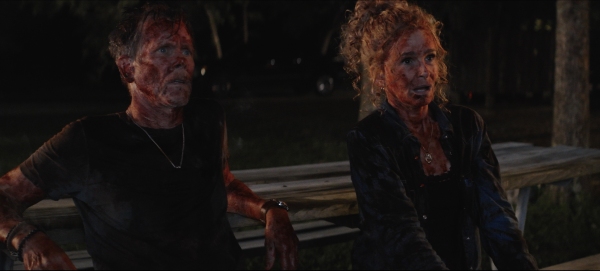
Separately, they’re screen stars of the highest order—unmistakable faces and familiar presences—and together, one of Hollywood’s most beloved and long-lasting couples. Both actors have done time in the director’s chair, as well, often involving the other in their projects. Most recently, the pair has taken on co-directing with Family Movie, a horror comedy they star in alongside their kids.
This year, Museum of the Moving Image will recognize both actors with its highest honor at the 40th annual Moving Image Awards. In the lead-up to the award, the duo sat down with frequent Reverse Shot contributors—fittingly, a pair of married film critics—to discuss acting, directing, and how their relationship has been reflected in their collaborations.
Sarah Fensom: Congrats on your Moving Image Award. How does it feel to be honored by Museum of the Moving Image?
Kevin Bacon: I was really touched by the award for a few reasons. First off, movies and making movies is so incredibly important to us—it’s how we’ve both spent our lives. I started on stage, and Kyra and I go back every once in a while, but we are fundamentally screen actors. It’s also lined up so nicely with having decided over the last few years to do more work with each other. We’ve always overlapped in different ways, but now basically we acted in two things together and co-directed back-to-back—we’ve never delved quite this deeply into working together. So it just seems like great timing, plus we’re New Yorkers, so that’s a cool part, too.
Kyra Sedgwick: Any place that celebrates film is so important, especially with everything [in the industry] feeling so precarious. So much of my blood, sweat, tears, brain power, heart, and soul have gone into making movies and television and telling human stories.
SF: Let’s start from the beginning. When you two met on Lemon Sky, were you already familiar with each other’s work? Kevin, you had already done successful films—especially Footloose, and Kyra, you had been on Another World.
KS: Did you watch Another World, Kevin? (Laughs). I knew him from theater in New York. My mother is an avid theatergoer. She would come home and say “Oh, I just saw that Kevin Bacon. He’s so good. He’s so talented.” When he did Album at the Cherry Lane Theater in 1977, my mother gave me tickets to go see it. I was like, this is the guy everyone’s talking about and, god, he’s so good. We ran into him at the deli across the street in between shows, and my brother said, “Tell him how much you like him!”
I came out to L.A. at 18 or 19, and auditioned and got called back for a few films that he was in, but I didn’t get any of them. And then I saw him at an aerobics class and told him I was an actor and had auditioned for some of his movies. And that was it. Then when Lemon Sky happened we both got cast. At one point they said he might not be able to do it, but I had a feeling he would, and in the end he did, and the rest is history.
SF: Kevin, do you remember any of these interactions Kyra is describing?
KB: The first time I don’t remember at all, but the exercise class I do remember because she was an absolute knockout.
KS: And you were in the class, too.
KB: Yeah, I was in the leg warmers and the cut-off sleeves. I was smitten with her. With Lemon Sky, it was a Lanford Wilson play, and this was the Second Stage production and a filmmaker from Boston, Jan Egleson, wanted to film it for public television. A half-play, half-movie type thing. He approached the cast that was doing the play, and in that cast was Jeff Daniels and Cynthia Nixon. Neither Jeff nor Cynthia was available, so we have them to thank for our relationship.
Chris Shields: We’re both fans of the film Pyrates you starred in together.
SF: Which I had on VHS when Chris and I met, and we watched it together.
KS: Pyrates was really fun. They wanted me to do it. I convinced Kevin to do it because they needed a guy. We had a great time. And he probably didn’t want me rolling around in bed with anyone else anyway.
KB: You know who shot that fucking movie? Janusz Kaminski. It was his first American movie, and he was so great. I thought it was a good weirdo movie.
SF: And can you talk about another collaboration, Murder in the First, Kevin?
KB: It was sort of the opposite. I had that part, and Marc Rocco, the director, came to me and asked if Kyra would play this one scene as the prostitute. I thought, sure, it’s not really much of a part, but it was one of those situations where she probably wouldn’t have done it if I wasn’t involved. But she was great— it was a really emotional scene.
CS: And what about The Woodsman?
KB: The Woodsman—weird story. It was handed to me on a beach. First off, I wasn’t looking for an indie. I was like, “I’ve done enough indies. They never work for me.” I’m never in sex, lies, and videotape. Mine were all straight-to-video.” I wanted to do mainstream stuff. And I read this script, and one of the cardinal rules is if you want to sustain a successful career as an actor, do not play a child molester. It’s the kiss of death. But I said, “Honey, that dude that handed me the script on the beach, I read it and I think it’s kind of great.” She read it and said, “Oh my god, you have to do it.” When I reached out to the producer, Kyra was their first choice for the female lead. I said, “Awesome, we can do this together.” I knew Kyra had the kind of vulnerability needed for the part, but she was hesitant because she didn’t want to take people out of the movie. I told her “Look, we’re good enough, people will accept it if we do our work the right way.”
CS: You’ve both worked with a who’s who of directors, including one of our favorites: Oliver Stone.
KS: I’ll start because I was first. I went in for a meeting with him [for Born on the Fourth of July] when I was like 23—I didn’t audition. He just kind of made fun of me, and I gave it right back to him because I grew up with brothers and I don’t take shit. And he was like “Oh,” and I really think that’s why I got cast. He had a bad reputation with women, and I believe he thought, “Okay, this is a person I don’t have to worry about.” Then I met with Tom [Cruise] and we read through some scenes. That was a huge break for me. I was pregnant when I did the movie—the first trimester. Some of it was scary—the protest scenes, because I was pregnant and the cop actors were pretty rough. But I loved working with Oliver, he was very specific, and working with Tom. I felt like he was at his best. And now, Kevin….
KB: We were on our honeymoon when Kyra got called back [for Born on the Fourth of July], so it got shrunk. When I heard the cop actors were roughing her up in the protest scenes, I think my head was going to fucking explode. But for me, JFK was great. I don’t look at jobs being career changing but that definitely was. I was spinning my wheels and hadn’t accepted the fact that I’m a character actor more than a leading man and that movie definitely gave me that opportunity.
Oliver sat me down and said, “Can you be transformational?” And I said “Yep.” He did fuck with me a little bit. He initially did some manipulative things to make sure I brought a certain fire, which is not really my preference in terms of being directed, but it worked. I felt I really had to deliver. One of the first scenes I shot was the one with [Kevin] Costner. After the first take there were no more questions. We were completely in the trenches together, me and Oliver. It really changed the trajectory of my career.
CS: I really see that. There’s a lot of dark, idiosyncratic characters after that. You’re also in so many iconic horror films, like Tremors, Flatliners, and Stir of Echoes. And now with Family Movie, it takes place on the set of a horror movie.
KB: I love horror, because the stakes are so high, it’s a good challenge as an actor. But also you have to remember, when I started out, horror was not a place a serious actor wanted to be. I never really felt that way, so I have gone back. With Friday the 13th, that was a gig. I didn’t have two nickels to rub together. I was working off Broadway for like $125 a week and waiting tables. But you look at Friday the 13th structurally, in terms of the way it was set up, I think it was made for under a million dollars. It was thrown together. Scrappy sort of stuff. And then it had this incredible success. And that’s the sweet spot for what horror can be: a version of a very independent film that can reach a wide audience.
SF: Shifting to a very different type of film, Kyra you played Ruth in James Ivory’s Mr. and Mrs. Bridge. I’m a huge fan of the novels and the adaptation.
CS: Sarah had me read the novels when we first got together!
SF: It’s true, I had to make sure he could hang. But you’re in the film alongside another super-famous movie couple. What was your experience like on that one, and what was it like working with Paul Newman and Joanne Woodward? Do you ever reflect on seeing their relationship as actors behind the scenes.
KS: To me that movie, those novels, were about the repression that’s inherent in the world, and the pain and damage it can do. And I think it’s still so powerful. It was really Joanne’s love for those books that got the movie off the ground. I was so grateful for that [role] because I knew I was breathing rarified air. I’d seen so many of their movies separately and together. And, of course. I admired their relationship. There’s a scene where I’m doing Romeo and Juliet with Paul, and it was extraordinary. I was an absolute sponge taking in everything, and I can still remember very specific things Paul said to me. And working with James Ivory was incredible.
I was enamored with how Paul and Joanne worked together, how they laughed together, and hosted together. They would invite us over for dinner, and he would be cooking on the grill, and I remember him asking if I wanted a glass of wine. I said, “I don’t know, I’m breastfeeding—the brain cells.” And he goes, “You got a lot of brain cells.” It was so funny.
CS: That leads well into our next question. For your forthcoming project, Family Movie, you co-direct and act in along with your daughter and son. What does co-directing look like for you two? And directing and acting with your family?
KB: For us with co-directing, we didn’t go, “Oh, you take this and I’ll take that.” We worked on everything together. And to me that wasn’t a hard adjustment because when I’ve directed in the past, it really has been a collaboration with everyone on set. With this project specifically, we started talking about it years ago. We shot it last summer. But basically, during the pandemic, we decided we wanted to do this movie with the kids. So, we worked on it constantly. We planned stunts in the living room. I could show you this collection of miniature people and mock sets that we built to lay out blocking. After years of planning, it was a dream come true to make it happen together.
KS: We collaborate in life, being married as long as we have been. But also, we’ve always shared our thoughts about character or like, “I’m thinking of shooting this scene this way.” We’re not “leave your work at the job” kind of people. Especially loving what we do so much. Honestly, [directing] is not something I want to do with anybody else. I like being the last word, making the decisions and not being questioned about them. But I certainly don’t mind investigating questions and decisions. With Family Movie it worked out great because there wasn’t a huge budget or a lot of time—I guess there’s never enough money or time. I would always take longer in the makeup chair. He took 15 minutes, and I took at least an hour and a half, so in terms of the economy of time, it was helpful to have him there. But I also think we’re a really good team. I always say separately we’re great, but together we’re unstoppable.
CS: What you’re describing resonates with us because we’re married and we write together a lot. People are often surprised that we love working together, but we’re surprised that they’re surprised—we’re looking for any excuse to spend time together.
KB: Yeah, Kyra started producing when she was about 23, and the first thing she produced, I directed. So, we’ve overlapped a lot. She’s directed me, I’ve directed her.
SF: Kyra, can you describe directing Kevin in this or Space Oddity or Story of a Girl?
KS: It’s great. It’s not hard—well, I wouldn’t say that.
[Everyone laughs]
KS: The truth is, he really doesn’t like notes, and he’ll say that. Instead, you just give a little suggestion here and there, and it’s like an alley-oop, and it’s lovely. I always know that the other actor in the scene is going to be the best that they’ve been because they’re working with someone who’s totally there and present, who’s catching the ball and throwing it. In Story of a Girl, for instance, he did something really different and outside his wheelhouse, and it was a part he really hadn’t played before, in my opinion. His work was extraordinary.
CS: Kevin, what’s it like to direct Kyra?
KB: I think there’s a notion that the director is the person that comes up with a piece of critique after you do a take, and you’re better in the next one. The amount of times that has a) ever happened, and b) actually been successful for me out of all the movies I’ve done is very minuscule. For an actor with the level of talent my wife has, my approach is just to kind of create a situation where the actor feels like they’re ready to do their best work. I know she’s going to come with a very specific idea and be prepared and immediately available. She’s the best actor I know.
SF: Could you each describe the other’s process? And what’s their particular magic on screen?
KB: Kyra does a lot of homework. She spends a lot of time thinking and writing. But her magic on screen is she’s just hard to hate. It’s an elusive thing. You can be great, but to have people want to spend a lot of time with you, that’s big—The Closer is a great example. People spent hour after hour, year after year watching this woman play a character that, by the way, is nothing like her, maybe besides the chocolate. [Her character famously kept Hostess Ding Dongs in her desk drawer for emergencies.] But yeah, there’s shit you can learn, but that’s something you just can’t.
KS: Kevin is just so endlessly watchable. And surprising. He’s an experimenter, and he’ll try something new with every take. He takes really big swings.
CS: Were you supportive when your daughter, Sosie, expressed interest in acting?
KS: No, I hated it. We had this family rule that you can’t work professionally until you’re 18, unless it’s in mom’s film. So, we begged her to act in Loverboy, and she did that and said, “I think I’ve got the acting bug out of my system,” and she went off to college. As successful as we’ve been in this business, it’s incredibly hard and painful. They love you one minute and hate you the next. So, when she said, “I want to leave college and pursue acting,” we were like, “Oh, fuck.”
KB: We were shocked, like what happened to that whole “I don’t want to act” thing? Also, they had never seen any of our movies until like five years ago. They famously had never seen fucking Footloose!
SF: [laughs] No way!
CS: How is that even possible?
KB: They wear it like a badge of honor.