Multiplayer: Peripheral Vision
by Kambole Campbell, Holly Green, Esther Rosenfield, and Dan Schindel
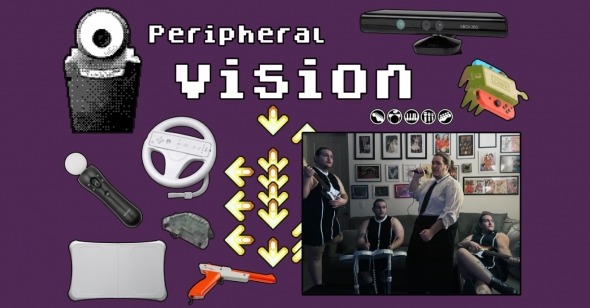
The Nintendo NES’s ROB. The Dance Dance Revolution floor pad. The GameShark. The Guitar Hero and Rock Band instruments. Rumble packs. The myriad attachments for the Nintendo Wii’s remote controller, like the steering wheel or the gun. The Sony EyeToy. VR rigs. Various microphones, like those for the Gamecube or Dreamcast. From the beginning, there have been games that employed peripherals that break the traditional control paradigm of controllers, button consoles, and keyboards. Video games have a complex moment-to-moment relationship with their audience, and changing the fulcrum of that relationship can change the experience of a game in fascinating ways. In this multiplayer roundtable, Kambole Campbell, Holly Green, Esther Rosenfield, and Dan Schindel discuss examples (successful and not) of accessories and add-ons and what they do for their respective games.
Dan Schindel: To start with, what are your favorite and least favorite game peripherals? My favorite was always the Game Boy Camera, and by extension, the Game Boy Printer. It was a—now quite crude, but for the time revolutionary—swivel camera that captured low-pixel images. If I wanted to play psychologist, I might imagine it played a role in my interest in visual culture. People make genuinely beautiful images with the camera—there’s a whole virtual exhibition you can access through Itch. On the flip side, there was the e-Reader, a card-swiping attachment for the Game Boy Advance. Nintendo manufactured these cards with special barcodes that you could run through the reader to get extra levels, characters, or whatever. I mostly remember it being associated with Pokémon—for a time, every Pokémon trading card had an e-Reader barcode on the side, for synergy. I think I used my e-Reader to pretend I was in Digimon Tamers exactly once and then never used it again for anything else.
Kambole Campbell: That e-Reader looks like my knife sharpener. Anyway, when we say "peripherals," I wonder if we count regular controllers here, too. I thought the Joy-Cons for the Nintendo Switch look a little toyetic, like so many Nintendo products do, but also feel like they have a more ergonomic design than their previous controllers—like the Nintendo 64 and GameCube pads. But that more minimal look doesn't mean cutting back on functions: you can play it like a traditional NES controller, or you can use it like a more modern gamepad if you use the grips that come with the console. It's unique to have a modular console which acts as a hybrid of Nintendo Consoles to date, and miraculous that even the act of changing between these modes feels quite satisfying in hand.
If we were to narrow the definition of "peripherals" to mean accessories that aren't required to use the console, I think I would go for the GBA Wireless Link. Might be a boring choice, but the Game Boy Advance (and its follow-up, the SP) was the only console I owned until about 2006. So the social aspect it opened up for the Game Point Advance—mostly trading Pokémon—meant quite a lot in terms of making my own console more sociable compared to going to my friends for their PS1.
For least favorite: the Rock Band drum kit. It's gigantic, they sound horrible when you hit them.
Esther Rosenfield: The one that came to my mind immediately was the Wii steering wheel. To me, that is the most iconic peripheral ever. The key to the peripheral as a concept is to make the video game less abstract. The Wii wheel is a great example of a peripheral where the whole point is to collapse the distance between the actions you’re undertaking in the game and the actions you’re performing in real life. You are literally steering the Mario Kart. If you move to the right, the kart moves to the right. It felt so cool as a kid to feel less like I was figuratively driving. This feels like I'm physically holding the wheel of the kart. I still have very fond memories of that.
My least favorite is the GameCube microphone. There was a Mario Party game—Mario Party 6, maybe—that came with a little gray plastic microphone. It looked like an old '60s game show host microphone. There were various games that would require you to speak into the microphone or blow on it. My sisters and I had heard this rumor that if you said a number out loud while rolling dice, it would influence the dice to land on that number. It never worked.
DS: The Wii was big on this in general. Along with mobile games, it helped create what’s now called the “casual” demographic. At the time, a lot of “real” gamers made fun of waving the Wiimote around, but plenty of people thought it looked fun and simple.
Holly Green: Esther, I love that you brought up the steering wheel for Mario Kart, because I feel as though games are such a strong self-insertion fantasy. And when we improve upon or strengthen the bond in that self-insert, I think it leads to improved performance. When I was learning to drive, video games, even with just a regular controller, actually helped me learn things like remembering which direction to turn when I'm trying to back out of a parking spot. Peripherals are amazing in terms of sports psychology; there's a bond between visualizing an action and the success of that action.
And I believe that I'm absolutely a better Mario Kart player when I have the Nintendo Wii wheel. I have a bucket that my husband and I use as a graveyard of all my Wii peripherals. I was getting all the stuff as they were coming out, experiencing their novelty, and enjoying how much they improved my performance. I think my favorite, going way back, is the Nintendo Zapper. So many of those early peripherals, if you look at their history, are guns, which is unsurprising. It was such a fascinating early application of the technology. You got your NES, you got Super Mario Brothers, and you had your Duck Hunt. Duck Hunt made you feel so powerful, telling yourself you would be such a good shot if you had a real gun, because you could get these little flapping birds. It's sad because the Zapper probably could've had a lot more applications, but it didn’t really happen. And that would kind of be true of Nintendo for the next couple of decades, where you would see them try certain things and it wouldn't really happen at first, but then decades later, it would come back around in a much better way. And you can see the result of that evolution now with the Joy-Cons. Peripherals became a big part of their identity and were so well implemented and supported that they could become a part of their identity.
My least favorite peripheral is probably the Nintendo Labo. When that came out, my husband and I had been married about a year, I decided to get him Nintendo Labo, because we thought folding and putting them together would be a cute activity to do with my young son and niece. The concept is so smart. It's a system of build-it-yourself peripherals that support different mini-games. Family-friendly, much cheaper than buying a different peripheral for every game.
But those peripherals ended up taking up a lot of space. I wasn't able to store them very well either, especially because they're rather fragile and sensitive to moisture. Also, they actually didn't end up being as well supported as you might've thought, considering that particular era of Nintendo devices. When the Wii Remotes first came out, their success really depended on how much Nintendo supported the developers making stuff with them. Whereas the PlayStation Move was an optional device that wasn't well supported internally, PlayStation didn't have as much control over its developers as Nintendo did.
If Nintendo had made a second generation and brought that back in some way with better support, maybe it would still be a thing. Although it had a lot of potential, it only lasted about two years before dying out.
DS: So many peripherals end up as historical footnotes for precisely these reasons you describe. That’s a symptom of a broader issue within the game industry, which is constantly chasing new technology. It fits their bottom line well, forcing consumers to continually upgrade. And it’s exponentially more difficult to preserve a game along with whatever arcane controller they made specifically for it.
KC: Since I basically missed a generation of consoles, my experience of this is, again, primarily through the Rock Band, Guitar Hero, DJ Hero genre of games with bespoke peripherals that you would buy with those games. Sometimes, the player base innovates by having these quirky adaptations of those controllers to see if they can beat Halo 3 just using a Guitar Hero controller or something similar. But outside of this, I wonder how much said adaptability was supported by developers as well. Did anyone think, "What if we could use the DJ Hero controller for our own purposes, and figure out how to build around that?" It's almost like having a single-use tool for your kitchen. "This crushes garlic and doesn't do anything else."
HG: Yeah, honestly, that right there is the reason I avoided some of the more popular games that did have those single-use peripherals. There was that Donkey Kong game that you play with the Bongo drums—Donkey Konga? Beautiful pun. But not having all the space for that in my 900-square-foot condo is definitely a deterrent; that space issue is part of why I didn't get into Rock Band. For a long time, I was a Dance Dance Revolution player. And the nice thing about those games was the dance mats, which you could fold up and store pretty well. Then the Kinect came out and solved that space issue once and for all. Just one small device that took up a little bit of space outside your TV.
I'm really fascinated by the modded uses of these peripherals in order to extend their usability, but also just their general usefulness. If you do some research about the Kinect, you’ll see it has all these different medical applications that, because of the emphasis on commercial entertainment, never really met their full potential. People used the Kinect to train surgeons and help stroke patients recover from injuries, and also elaborately modified Wii U devices, which is probably the most use the Wii U got at all.
In the Dance Dance Revolution community, for example, some people use the dance mats to improve accessibility by changing out the controls to be foot-based instead of hand-based. On the opposite end of that, some increase the difficulty of games by playing a game of Elden Ring with no kills entirely with the Dance Dance Revolution mat. It's absolutely fascinating the range and the spectrum between those two experiences. Not only is it a wonderful way to eliminate the waste of these plastic peripherals, but it’s also a way to give these devices a new life and increase the range of our experiences.
ER: I'm glad you brought up the “beating Elden Ring on a DDR pad” phenomenon. What's interesting to me is the novelty o fartificially inflating the difficulty. The challenge comes from using an "improper" method of input to beat the game. First of all, you have to sync up all the different parts on the pad to particular functions on a controller, essentially translating the input from one device to another.
Peripherals that are unique and have a lot of different capabilities run into the same issue: people who play a lot of video games are accustomed to the traditional controller layout. I remember when the Kinect came out around the same time as Mass Effect 3, and there were promotional videos showing players using voice commands to activate abilities. Instead of pressing a button to tell Liara to use Warp, you can say, “Liara, Warp!” as though you’re actually commanding her in battle.
It seems cool in a commercial, but a lot of people would look at that and say, "Well, I can also just press left on the D pad and do the same thing." We have these items that have interesting, fun use cases, and a lot of the time, the reason they don't succeed or catch on is that the traditional controller has just become too ingrained. So instead, they take on the second life as like, "I used the DDR pad to beat Elden Ring” because it's way more finicky and complicated. The peripheral creates an extra barrier, whereas the peripheral was created to eliminate it.
HG: I do a lot of research and writing on the topic of cognitive issues within games, and what you're bringing up relates to how our brains map onto controllers, assigning certain buttons to do certain things, and then we map our brains onto that configuration. Anyone can tell you, switching between the PlayStation and Xbox controllers is no big deal. Switching from one of those to the Nintendo controller with just a two-button swap of what creates functionality, you're in shambles, right? And that constant remapping is very taxing and fatiguing to our brains. When I'm playing Mario Kart with that steering wheel, I'm Fast and Furious–style, arm locked straight out ahead of me, pretending to rev that gas pedal. It just gets me there, because I feel like I'm actually driving. I would love to see more studies done on that sort of thing. How do peripherals improve our performance by improving the self-insertion fantasy?
Anyone remember that one Wii peripheral that looks like a gun, where you’d slide the Wiimote in?
DS: That was the Wii Zapper, named in tribute to the NES Zapper. I had that. I only used it for the game it came with, Link’s Crossbow Training, and with Resident Evil: Umbrella Chronicles, one of the worst Resident Evil games. You’re getting at how peripherals can strengthen the mimesis between your own action and what you’re doing in the game. With a gun peripheral, you’re actually aiming a weapon.
The YouTuber Nerrel has explored different control schemes for shooting games in multiple videos. In one video, he runs a performance test for a control stick vs. a mouse vs. a trackpad vs. gyroscopic aiming. The conventional wisdom goes that a mouse is the best way to aim, that it’s fastest and most precise. But he found that gyro controls actually worked best. Gamers have this idea that it’s too much physical movement, but it actually allows for some very subtle control. You don’t even need a gun-shaped peripheral; tilting a traditional controller works perfectly.
KC: I did find that using gyro aiming made using the bow and arrow in Breath of the Wild much simpler than aiming with the stick, even if I didn't like the idea at first. Your suggestion of the Zapper as a halfway point between the analog stick and the keyboard and mouse also makes me think of it as recognition of the controller having some limits. I'm playing Marathon at the moment, and there are people coming up with combat strategies intentionally made to wrong-foot console players, basically aiming to duke around console players so fast that they can't use the stick to turn in time compared to a keyboard and mouse player. I guess this ties back into what Esther was saying at the beginning, that the best peripherals are literalizing the way we feel playing these games, as well as anticipating what we instinctively want to do in reaction to playing them.
HG: In that sense, there’s one peripheral I've always wanted that has never existed, or not a peripheral, rather, but an effect that we could have but don't: when I'm playing stealth games or any games where I have to sneak around, and there's an enemy that's particularly sensitive to noise… I want there to be a situation where the mic has to be on, and if I make any noise in real life, it blows my cover. When I'm playing Fallout 76, I'll be sneaking around and suddenly cough or say something to my husband in passing, then get all tensed up as if a nearby ghoul is actually going to hear and come after me. Obviously, my cats and the ambient noise of city life would sabotage me at times, but I think it would add a lot of fun to certain experiences.
KC: Someone on the street yells at you, and Mr. X turns around.
HG: We talked earlier about preservation issues from video games and how peripherals infinitely complicate that. There was a long time when I never would've thought they'd try to bring back the Virtual Boy in any form, but it’s actually heartening that they did with the Switch 2 and the Nintendo classics collection, keeping that alive and helping people play those old games.I just really respect how Nintendo will try new things, and they maybe don’t land the first time, but they'll hang on to those ideas even if they only come back decades later and find a better way. Sometimes Iask, is it just that they were so fascinated with the idea that they wanted to make it work later? Is this a saving face kind of thing? Or do they simply refuse to be beaten by their own ideas?
DS: Kam already mentioned the Joy-Cons. In some ways, they feel like the actual realization of what was promised with the Wii. Nintendo has been iterating constantly. When the Wii was first released, you could only make broad gestures that would loosely correlate with actions in the game. It wasn’t until the Wii Motion Plus attachment came out that a Wiimote could actually match your precise movements. And now, with Joy-Cons, motion controls work very smoothly. And in between, there was the Wii U, which was Oops! All Peripherals! Did anyone even have a Wii U? I didn’t.
ER: It's funny, though, because they really proved themselves right with the Switch. The dream of the Wii U is that you can just grab it and turn it into a handheld, and other people can use the TV. They did that with the Switch to great success. It's another great example of Nintendo just not giving up on a concept and saying, "You don't like it now, but we will be proven right eventually.” They've been vindicated by other companies as well with the PlayStation Portal and the Xbox ROG Ally.
DS: We talked earlier about how the Kinect and other peripherals have found unintended usages in medical contexts. Fellow Reverse Shot gamer Forrest pointed out that the Kinect has also found a second life amongst ghost hunters. It was featured in Paranormal Activity 4, and this led real-life ghost hunters to believe its motion tracking could spot ghosts.
ER: There's the implicit idea that the Kinect can see better than the human eye. And of course, no, not really, but we naturally assume that if this device is designed only to see things, it must be extra good at seeing things.
DS: That goes back to reducing the abstraction involved in control. A successful peripheral has that balance. The Guitar Hero controller lets you feel like you're playing a guitar, but you don't have to actually know how to play a guitar to use it. At least theoretically; I also sucked at using it.
ER: Something that makes games unique as a medium is that the controller presents a learning curve to interaction. I've been playing games and I know what all the buttons do and I don't have to look at the controller, but that's a barrier for a lot of people. I saw a post not too long ago where someone said, it would be great if games had a feature that gives you a refresher on the controls if you haven’t played in a while.
For people who don't play games as much, they don’t have the ingrained muscle memory to know what to do when told to “press triangle.” Especially if you're coming from another console. I remember when I got my first PlayStation but had grown up on Xbox, I had to create this mnemonic system: Y is now a triangle, and the Y shape, the shape of the prongs of the Y is kind of a triangle. And if you look at the circle, the B is kind of a round letter, so that's a circle. This is a barrier that no other medium has to contend with. It's funny to think that while a lot of peripherals are designed to break down that barrier of entry and make the act of playing the game more natural, it's clear that some are about making your interaction more elaborate and complicated.
KC: We've been talking a lot about the tactile experience of playing games, and that feels like something unique to how you engage with it as a visual medium. Many of my favorite peripheral or controller experiences inspire different ways of thinking about how your hands interact with what's on screen. And even something as small as the quirks of the PS5's Dualsense, not the fancy haptic rumble but how developers [like Housemarque on Returnal or Insomniacon Ratchet & Clank: Rift Apart] have sometimes been playing with different levels of trigger squeezes and how that can serve different functions. So you're not just thinking about the button on the face of the controller, you're also thinking about the pressure that you're applying. It's interesting seeing new ways of tactile interaction open up to different game pads and stuff, like the touchpads on the Steamdeck.
ER: I love the touchpads on the Steam Deck, by the way. It's such a good fidget toy to roll your thumb over and it feels like you're rolling a ball.
KC: I cannot wait for the Steam controllers. They've done the Steam controller before, but this time it's maybe with the understanding of the SteamDeck and how it can replace a mouse touchpad. And the extra buttons on the back. Those minor iterations on very traditional console game pads have been interesting, even if the number of more bespoke peripherals has thinned outside of Nintendo's work.
DS: That gets back to what you said about how controllers themselves are peripherals. And games are continually iterating to fit more complex interactions within the confines of what a controller is, how it fits into human hands, and what's possible for mapping the buttons in ways that are intuitive and comfortable.