The Driver
By Mark Asch
Tropical Park
Hansel Porras Garcia, U.S., no distributor
Tropical Park screens May 3 at Museum of the Moving Image’s as part of the 2026 First Look festival.
The first thing you see in Tropical Park is a Trump 2024 banner through a car windshield. The windshield is grimy at first, but soon enough Frank (Ariel Texido) comes out to wash it; it’s his driveway, and presumably his Trump banner on his front porch. The car, though, belonged to his late father, and now he’s going to give it to his sister Fanny (Lola Bosch), who, 20 years since the two last met face to face, has followed her brother to Miami from their native Cuba. The only way to get around Miami is by driving, Frank explains—and anyway, public transportation is “communist crap”—so he’s going to give her driving lessons.
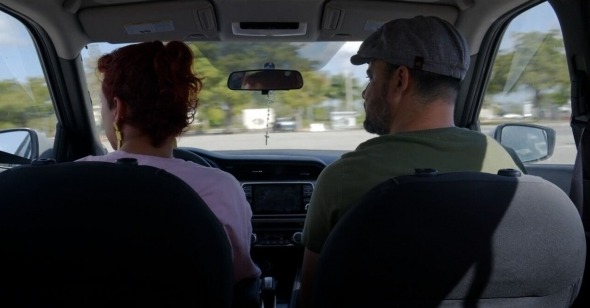
Hansel Porras Garcia’s film is shot in a single take from a camera set up in the back seat of the car, and consists entirely of Frank and Fanny’s outing from beginning to end, as they drive from somewhere in West Flagler or Little Havana to the northern parking lot of the titular green space (the camera does not pick up the equestrian statue of Ronald Reagan, by the Havana-born Florida artist Carlos Prado, at the park’s entrance), take a few spins, and return home. The film’s opening image displays the private sanctums that define the American nuclear family—detached home surrounded by well-kept lawn, automobile—and makes them stridently politicized. The interpersonal drama that follows gets at interrelated ideas of property ownership, kinship, and freedom (meaning either independence or loneliness), as the automotive sprawl of America’s built environment flows past.
The recent film which Tropical Park most resembles is the Australian director David Easteal’s The Plains (2022), which was similarly shot from a fixed backseat camera, across several iterations of an office worker’s drive home, each fundamentally the same but also distinguished by variations in weather and light, music and radio, phone calls and the occasional carpool. At three hours long, The Plains gives one of life’s most mundane rituals an epic scope, as if the daily commute from city to suburb is a pastoral return and culmination of a hero’s journey. The car in The Plains was a Hyundai Elantra, and the camera was jammed in behind the center console, peering beyond the backs of driver and passenger heads bounding the frame to take in a low-angle proscenium view of Melbourne. Tropical Park is an American film and so naturally was shot in a larger vehicle—the director’s own Nissan Kicks—and the camera is further back from the front seats. Glimpses of the tree-lined streets of Coral Gables and the billboards of Bird Road are visible through the windshield, through the passenger and driver side windows and the windows over the rear doors, for a wraparound widescreen view that also feels swaddled, the world kept somewhat at bay. The car, no less than the home, is a man’s castle, and this private transport is more absorbed in domestic dramas than the world at large.
Privacy and autonomy are main concerns of the dialogue: Fanny doesn’t know how to drive, having arrived from Cuba just a month ago; with a half-serious childish whine, she says she doesn’t want to learn, but Frank insists it’s necessary for her to become self-sufficient, as he did. He came to this country with nothing, he reminds her, but now takes immense pride in his home, his two little girls, and his “gringa” wife Erika, who stood by him when he was no one (and whose parents, in their benevolence, helped set him on the road to financial success).
Frank’s paternal guidance comes with more than a little boot-strappy ideology, which is underlined by the ulterior motive of today’s sojourn: he wants to shove Fanny out of the nest as soon as possible. Fanny is trans, a fact that Frank, who remembers her as the kid brother he left behind, and corresponded with through their parents’ deaths, only found out when he picked Fanny up at the airport. Though he slips between “hermano” and “hermana,” Frank accepts his newfound sister, and even professes to admire her bravery, but his personal compassion and heartfelt offers of charity, intended to give her a leg up as she seeks housing and employment, are on his terms, and hardly the material support needed by a gender-nonconforming Spanish speaker likely to face discrimination on multiple fronts in Florida as in Cuba. Erika, who callously misgenders Fanny in a speakerphone call, comes from a very conservative family, and Frank is eager to resume hosting her parents for their regular Sunday-afternoon visits—it’s a nonstarter to expose them to his transgender Cuban sister, and he feels, perhaps, more ashamed of himself, and more precarious in his hard-won American life, than he is willing to admit.
There’s symmetry to Fanny and Frank’s backstory: she was with their mother when she died in Cuba, while he was with their father when he died in Miami, after emigrating in his widowerhood. You see in Tropical Park’s setup the formula for a movie that contrasts a macho individualist and a feminine communal definition of thriving and gets at the whiplash contradictions of Cuban-American identity in which each character has the values and blind spots of the context that shaped them. That’s not really the way the movie goes. Fanny protests a little at being sacrificed to the imperatives of normative family structures and shows flashes of her tendencies toward avoidance and naiveté. But mostly, she can barely get a word in edgewise. Frank explains his poverty upon arrival, his hustle to survive, his heart-swelling responsibilities as head of his own brood, and his hairshirt guilt at having no choice but to put out his own flesh and blood; soon enough he breaks down sobbing at the enormity of his obligations.
It’s accurate enough, one supposes, that the exchange between these two characters ends up dominated by a patriarch’s lectures, his histrionic self-justifications, his weaponized tears; of course Fanny, who exists outside the family unit that guarantees social and economic capital, would be pushed to the margins of this conversation, and have to listen more than talk, and understand more than argue. The conversation only achieves parity as the two return to their store of shared memories and their parallel sadness over the deaths of their parents. Porres Garcia, whose father taught him to drive in Tropical Park, and who then taught his mother to drive there, pushes his fictional family toward a raw and tender rapprochement, expressing hope that collective history and love in the abstract can outweigh the very real social and economic conditions demanding their estrangement.
The film is quite a formal achievement, its single 80-plus minute take executed after just one rehearsal, with the director listening from a following vehicle. Texido and Bosch improvised their dialogue from a brief outline and respond to the alternating chaos and longueurs of Miami traffic, embedding the high melodrama of confession and catharsis in the banal rhythms of rolling stops and slow merges. The driving-lessons conceit is a bit of misdirection, as Fanny takes just a couple circuits around the lot before shifting gears into park so she and Frank can have a real conversation—but there’s a logic to this choice. What’s more American, after all, than pulling into a parking space and crying in your car?