Variations on a Theme
Chris Shields on Two Lovers
In Luchino Visconti’s 1957 adaptation of Fyodor Dostoevsky’s novella White Nights, Marcello Mastroianni expresses the unbridled joy of new love through dance; it's one of cinema’s sweetest scenes of abandon. Robert Bresson, in his own White Nights adaptation, 1971’s Four Nights of a Dreamer, uncharacteristically employs live music throughout to communicate a sense of exuberance. In James Gray’s 2008 interpretation, Two Lovers, Joaquin Phoenix shows romantic intoxication through rapping—not particularly well—in the back of a car on the way to a club. Phoenix dances too, trading Mastroianni’s impish moves for popping, locking, and even an attempt at the worm, a move that causes his shirt to hike up on his back, a consequence veterans of the maneuver know all too well. But the dancing in Two Lovers is suffused with a degree of irony when measured against the experts Phoenix, like Mastroianni, follows on the dance floor. It’s the rapping, somehow devoid of self-consciousness, that truly captures the feeling of freedom burgeoning love can bring. It’s a clever and authentic transposition by Gray of both the novella and Visconti’s sequence into a different time, place, and milieu.
White Nights is, like Notes from Underground, a work of existential and psychological drama, but it’s also the modest story of a dreamer’s unrequited love for a woman still devoted to another man. There are few literary works that capture the totalizing effect of youthful infatuation with such a realistic, modern strain of mania and philosophical misanthropy (perhaps Turgenev’s First Love or Torrents of Spring). Representing the turbulent inner world of the novella’s protagonist on screen seems, given the nature of the work, daunting. But for Gray, as with Bresson and Visconti before him, the challenge of bringing Dostoevsky’s dizzying text to life is perhaps part of what makes it worthwhile. Adapting White Nights is a feat that requires great skill and a faith in what cinema is capable of—and a willingness to dream. As we learn in all of these films and in Dostoevsky’s novella, dreams and passion can lead us down a treacherous and exhilarating path.
The psychological and philosophical complexity of Dostoevsky’s work poses an implicit challenge for filmmakers hoping to adapt his writing to the screen, a fact evinced by a tellingly short list of well-regarded adaptations. Kurosawa, Bertolucci, and Von Sternberg are some of the most notable film artists who have dared to try. What makes White Nights, like much of the author’s work, so compelling is the way in which mundane events take on an epic scale in a protagonist’s mind, creating a space for deep psychological exploration. In White Nights, the protagonist refers to himself as “the hero” of his story and dreams of a life much richer than his own. He is alone but also delighted by the world around him and the possibility of love and connection (the gleeful inverse of Notes from Underground’s misanthropic narrator). He encounters a woman, Nastenka, on the street and saves her from being harassed by another man. The two begin a mysterious and complicated courtship which leads to a nested narrative structure wherein Nastenka recounts her unresolved love affair from the past, revealing that she is still waiting for the return of the other man. The protagonist and Nastenka continue their new relationship with the understanding that it can only be a friendship. The protagonist eventually confesses his love for Nastenka, but soon after, her former lover reemerges and she leaves with him.
Stylistically, Visconti’s White Nights is a near-surreal cinematic ballet that mixes existential solitude with visual beauty, while Bresson’s film sees the director’s meticulous formalism mirroring its young subject’s radicality and isolation. Gray’s Two Lovers is not a direct adaptation of Dostoevsky’s novella, but rather a spiritual one that borrows from the story’s romantic yearning and some key plot points. Gray uncovers the chaotic passion of youth in his protagonist’s suicide attempt and unbridled, spontaneous sexual passion, translating Visconti’s balletic film and Dostoevsky’s cerebral novella into a naturalistic film idiom.
Phoenix plays Leonard, a young man who, after an ill-fated romance, is suicidal and living with his parents in Brighton Beach, the same setting as Gray’s 1994 debut feature Little Odessa. Leonard works at his family’s dry-cleaning business without enthusiasm. But he is, true to the novella, a dreamer, a photographer whose black-and-white images of the lonely Brighton beachside are devoid of people. The young man’s close-knit Jewish family is warm, and obviously concerned for him, but still suffocating, which only intensifies Leonard’s malaise. Things change when he meets Sandra (Vinessa Shaw), the daughter of a man looking to buy his family’s business. With some encouragement from his parents, Sandra and Leonard connect, and a ray of light, still dim, enters his dark room.
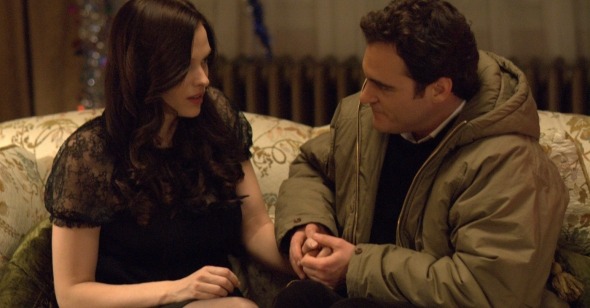
At the same time, he begins to fall for a new neighbor, Michelle (Gwyneth Paltrow), who is having an affair with a married man. While his relationship with Sandra seems more sensible—they’re a cultural match, it’s good for business, and she’s kind and beautiful—his passion for Michelle consumes him. As the sale of the dry-cleaning business draws closer and his union with Sandra appears inevitable, Leonard confesses his love to Michelle after she breaks off with the married man, and the two plan to abscond to San Francisco. When Leonard arrives at their appointed rendezvous after sneaking out of his family’s New Year’s party, Michelle tells him her former lover has left his family and she’s taken him back. Devastated, Leonard goes back upstairs and gives the ring intended for Michelle to Sandra, as he cries tears of both sadness and joy.
Dostoevsky’s White Nights provides a powerful story structure, in which the unmatched freedom and personal transformation romance can offer leads to eventual disappointment, and screenwriters Gray and Richard Menello harness some of its most potent elements for Two Lovers. In this loose adaptation, however, the details of Leonard’s life and environment add another essential layer, inflecting the story with a specificity that creates a further psychological and cultural dimension. Gray himself is of Russian Jewish descent, and he brings the Brighton Beach Jewish milieu to life with well-chosen details:family, work, food, and duty. There’s the presumably regular gathering over Chinese food (for context, listen to Rick Moranis’s ode to the Jewish family’s weekly Chinese meal on his album My Mother’s Brisket & Other Love Songs), a glimpse into the family’s history as illustrated by the photos on the wall of the musty apartment, and the computer in the living room devoid of any privacy. It’s an impressively realistic vision of middle-class life in the boroughs, particularly Brooklyn, in which things are well-worn, with a patina of history that gives them a sense of tradition and respectability. Gray and Menello’s script is exceedingly good at finding the right details to communicate volumes about working- and middle-class tristate neighborhoods—such as Leonard’s father (Moni Monshonov) loudly enjoying Benny Hill (as my best friend’s Russian Jewish father, a resident of Brighton Beach, did), the magic trick Leonard performs at dinner (an interest in magic being something that unites modern Jewish artists from Marc Chagall to Ernie Gehr), and the default use of the word “weird” to describe anything just left of center.
Two Lovers’ uniformly excellent performances, including Paltrow, Phoenix, and Shaw at their best, carry the film. Phoenix is brooding yet charming in a proto-Joker role as a soft-spoken man who’s struggling, but unlike his now most famous role, is a true adult dealing with the hurt of the past, while proving he’s open to love in the future. He’s lighthearted at times, in his head at others, but his weirdness is an assignation given to him by other people. The stifling, normative family and culture he’s part of sees any variance as “weird” (a situation or action that would necessitate too much analysis, interpretation, or description to understand fully), and Gray uses this tension to emphasize Leonard’s alienation. This is the reality of being just a little bit different in a largely homogeneous milieu. But Leonard is not weird; he’s honestly, brutally human, something that Phoenix’s multi-register performance brings to delightful and painful life.
The young man we encounter in the various screen adaptations of White Nights is a city creature, an observer by nature, mesmerized by the parade of endless faces, just out of reach, on the street. Bresson and Visconti use different methods to turn down the volume on the bustle that breeds the protagonist’s isolation and to bring us closer to him. For Bresson this seems quite natural, a byproduct of his precise sound and image control; his Parisian protagonist is trapped in the director’s often alienating frames. Visconti’s approach is more bewitching, recreating Livorno on the stages of Cinecittà as a quiet and ghostly dream world, more like the backdrop for a ballet or an opera than a realist film of small gestures. For Gray’s more realist approach, the unvarnished apartments and streets of Brighton Beach reflect the gentle naturalism of his performers and imbue the story with a disarming authenticity; the community depicted is contemporary but also somehow trapped in amber. But like all versions of White Nights, the city and its proximity to the water provide a strong metaphor for human fragility. Just beyond the Brighton boardwalk lies the ocean. Life and death separated by only a small partition. The story plays with this idea of aqueous oblivion, with Phoenix’s Leonard attempting suicide in the icy water. But the water also symbolizes the world beyond Leonard’s cloistered life. When he and Sandra have lunch at a boardwalk restaurant, Leonard is preoccupied with thoughts of Michelle, the potential for both discovery and self-destruction loom like land’s end just outside. It only takes a few steps off the prescribed path to enter the abyss.
The tension between the “nostalgic” feeling of the world Gray sets his film in (as one character calls Leonard’s apartment) and the limits such cultural tradition and history present adds something new to White Nights. Leonard is expected to follow in his family’s footsteps. His father is an Israeli immigrant and business owner who is working to secure Leonard’s future. The young man’s parents recognize that he is unique, but still attempt to redirect his particularities into preordained, acceptable customs. When it’s revealed that Leonard is a photographer who shoots moody landscapes in black-and-white, his family and the people around him suggest that he shoot photos at a forthcoming bar mitzvah. His unique ability is therefore acknowledged, but any extrapractical or irrational aspect is squashed in service of the sensible. But art and life at their best are not sensible, they’re expressions of idiosyncratic passion; even the choice to adapt the Dostoevsky novella—thereby placing himself in the lineage of Visconti and Bresson—into an American romantic drama might go a long way to proving this. In Two Lovers, Gray tries to retrieve that time in film history when cinema was our collective dream at the same time as he strives to create something profoundly personal.