That's the Past
Conor Williams on Jonas Mekas's A Letter from Greenpoint
Jonas Mekas will be forever remembered as the man who transformed American cinema, introducing the world to a generation of avant-gardists through his creation of institutions like Anthology Film Archives and the Film-Makers’ Cooperative in New York. At the same time, Mekas’s own films stand as totems of a new cinematic language. Walden, also known as Diaries, Notes, and Sketches (1969), Reminiscences of a Journey to Lithuania (1971-72), and Lost, Lost, Lost (1976) were his first masterpieces. In 2000, Mekas made his greatest film, As I Was Moving Ahead, Occasionally I Saw Brief Glimpses of Beauty. An assemblage of footage from his archive, As I Was Moving Ahead was Mekas’s unofficial goodbye to celluloid. He had begun making work on a digital video camera ten years earlier. Straightforward in title and content, A Walk (1990) was an hour-long, single-take excursion documented by Mekas on a rainy day in SoHo. He talks aloud to himself, to the camera, and the low-resolution, grey, and blue pixelated puddles. With the swap of his 16mm Bolex for a digital camcorder, Mekas gave himself new creative possibilities. Perhaps most significantly, unlike the Bolex, a video camera could record image and sound at the same time. In his previous films, Mekas had collided past and present through voiceovers recorded likely during the editing process or while Mekas was looking back at his footage. Now, Mekas could react in real time to what he was shooting.
In the early aughts, Mekas and his then-wife Hollis Melton divorced. For a long time, they had lived together in a loft apartment in SoHo with their children Oona and Sebastian. This loft could be seen in Mekas’s films—in fleeting frames of their cats basking in the sunlight or in footage of Oona’s first steps, scored to the Velvet Underground’s “Run Run Run.” But when Mekas and Melton divorced, it was time to give up the loft. This is where Mekas’s 2004 film A Letter from Greenpoint begins.
A turning point in the filmmaker’s life, brought on by separation, A Letter from Greenpoint is startlingly intimate. For an artist who pioneered the “diary film,” simultaneously living and recording and sharing his life for decades, there’s oddly not much written information out there from Mekas regarding his divorce and move to Brooklyn. In the 800-page second volume of Mekas’s New York diaries, there are only a few details about the time. Therefore, this Letter is a rare vantage point into a particular point in the artist’s life.
In part one, “Farewell to SoHo,” a fresh-faced Sebastian grins and clicks drumsticks together while singing along with his father. Friends sit around the long, wooden dinner table. In the next scene, Mekas stands at the entrance of his loft. More stuff has been cleared out. He walks from one end to the other, to the window. “It is snowing,” he says. Sebastian rides his bicycle through the room. In a brief interlude, Mekas sits in a nearby coffee shop. Then he cuts back to the loft. It is even emptier. It is not really his loft anymore. Now, it is just a room. He speaks aloud and walks across the room again. “With no personal objects in it, just space. Just a space. There must be a lot of little atoms of myself, Hollis, Sebastian, Oona, attached to it somewhere. Floating in the air. But they’re just atoms. Totally invisible.” Mekas lets out a loud, Santa-like chuckle. A barbaric yawp. “I guess we are still here. But slowly, slowly…everything will be changed by new and different atoms coming into this space.”
With his new camera, Mekas can record the steps across his old space in real time. Everything is immediate now. In a 2012 interview with actor Benn Northover, Mekas said, “It took me ten years to master my Bolex, and about the same to master the video camera, to make it an extension of myself…Much of my later videotaping is like anthropological vignettes.” He mentions the scene from Greenpoint of himself and Northover wrapping gifts for the artist Louise Bourgeois. “It happens millions of times, across the world, when somebody is preparing a gift for somebody one loves. But it’s something unique. There is an intensity, a concentration in that moment; it’s not theater, it’s not artificial, it’s real. That’s where my Bolex and my video cinema differ.” Given that Mekas historically championed celluloid-as-cinema, it’s remarkable that here he advocates so firmly for video.
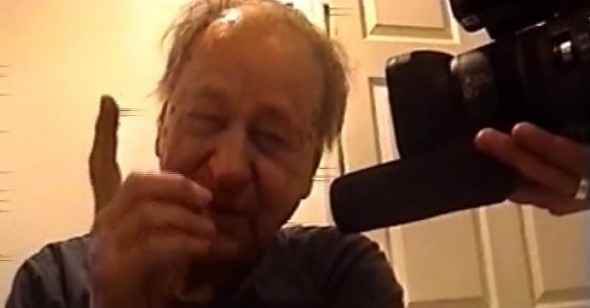
Part two of Mekas’s film is set in his new neighborhood, the traditionally Polish enclave of Greenpoint, Brooklyn. He pops into a church to film people leaving the cathedral and greeting the sunlight. In a way, Mekas has ended up right where he began filming, when he came to Brooklyn with his brother Adolfas as a Displaced Person in the ’50s. He is moving into his new apartment. He is engulfed in cardboard boxes. The digital camera, with its low fidelity, turns everything into a wash of beige. Mekas seems to lack a certainty of what to do now. The new bachelor spends a lot of time with people of a younger generation, in their thirties, and getting to know strangers in bars. For all the waxing poetic on existential loneliness he has put into his films over the many years, A Letter from Greenpoint is Jonas Mekas’s loneliest film. At 82, he is having his midlife crisis. He proposes marriage to his black cat Mitzi. “We have to wait until it becomes legal in New York State.” He sits at home and eats soup with Northover, who reads from Mekas’s diaries in a cringey, over-acted performance. On the radio, commentators stoke the flames of war in the Middle East. Later, at another bar, his young friends toast to “tomorrow” and then to “now.” Then Mekas says, revealingly, “All past is bloody. There is nothing much to learn from it. Blood is running down the hills of every country you put your boots on. That’s the past.”
Whereas Mekas’s 16mm work provided his past with a fidelity that allowed its images to be clear, even if his memories might not be, the video work he would go on to make lacked that visual clarity. These videos, A Letter from Greenpoint included, play in 240p resolution, 360p if you’re lucky. It’s fitting, really, that such a destabilizing event in Jonas Mekas’s life would be documented in poor resolution. Not only is there a loss in clarity in terms of image, but there is also a loss in clarity for Mekas in a more concrete, literal sense.
A Letter from Greenpoint proved to be quite a generative shift for Mekas. In 2007, several years after the film’s release, he began the 365 Day project, making a short video every day of the year. With this project, Mekas harnessed the capabilities of short-form, digital filmmaking and made early iterations of what we might now consider “vlogs.” Some of these can still be seen on his website, although because it ran on the now-defunct Adobe Flash Player, much of what used to be viewable has been lost to the ever-changing technological times. As Mekas pointed out in a 2013 interview, “Already it is difficult for me to see material I recorded just five years ago. Recording formats become obsolete, the machinery dies out, and vast quantities of recorded material turn invisible. They are only as permanent as the technologies that support them.” It is a gift, then, that we have what remains—dispatches from the life of a legend that only digital technology makes visible.