Intelligent Design
Julien Allen on the Handheld Gimbal and The Raid 2
The next time you go to the movies on a hot summer’s day, try to be conscious of that moment when the first wave of cold air hits your skin—your heart might soar a little—and spare a thought for the guy who invented air-conditioning: the Chinese engineer Ding Huan. Like nearly all inventors, he didn’t come up with the idea himself, nor was his version the very first. But Ding Huan researched, designed, recorded, and effectively patented two different mechanical air-conditioning methods: evaporative cooling and his own prototype of the rotary fan (on wheels). I should mention that Ding Huan lived and worked during the Han dynasty, in the 2nd century A.D. The subject of this essay is based on a sister invention of Huan’s: the stabilization mechanism known as a “gimbal.” It permits an object (in Huan’s case, an incense burner, explicitly designed for use amongst highly flammable cushions) to remain stable, while outside forces operate to disrupt it. A gimbal uses rotational impulses which work counter-cyclically to the stimuli that are brought to bear upon it, meaning that a camera rig comprising two or more gimbals can stabilize a moving image that would otherwise look uneven or skittish due to the circumstances of its capture. In other words, cinema really has a lot to thank Ding Huan for.
The most technically advanced example of a gimbal in existence predates even Huan’s: it’s the three-axis stabilization instrument located inside the human eye. Everything we watch and see in our daily lives, and to a lesser extent on a cinema screen, is stabilized by the floating mechanism lodged inside our heads, heads which tend to move across three axes (four, if you were to count the eye’s ability to focus, but let’s not go down that rabbit hole). If we didn’t have gimbals in our eyes, our entire lives would look and feel like a Neill Blomkamp movie. Huan’s original incense burner gimbal (180 AD)—based on the Ancient Greek antikythera—begat more prominent inventions, such as Léon Foucault’s gyroscope, which he used to demonstrate the rotation of the earth (1852), and closer to our theme, Garrett Brown’s Steadicam (1975). These were all essentially defensive contrivances, attempts to overcome instability by replicating or emulating the unimpeachable biological magnificence of the human eye.
Naturally, the Steadicam has for the last half-century provided a hyper-effective gimbal-based stabilization mechanism for long traveling takes. It removed the need for miles of dolly track, and opened up an intimacy with the action in spaces where a dolly won’t fit, as well as new aesthetic dimensions. Whereas Alan Clarke uses the persistent, lingering effect of Steadicam to create raw psychological intimacy in Christine (1987), Kubrick harnesses the same technology to situate Eyes Wide Shut (1999) in a dreamlike state. Here and now, the makers of the Indonesian martial arts film The Raid 2 (2014) have demonstrated an additional development, which takes that spatial facility and adaptability one step further, by freeing the camera from the body rig of a Steadicam and enabling the whole gimbal apparatus to be held in either one or two hands. This liberates the movement of the camera much more than before: exponentially multiplying the positioning options, allowing shots to evolve at high speed. It also eliminates numerous obvious obstacles which would otherwise obstruct a Steadicam operator or appear in the take, while preserving the crucial narrative and forensic impact of the single-take aesthetic, and in many cases boosting it.
The Raid 2 (AKA Berandal—“thug” in Indonesian) is ostensibly a sequel to the breakout 2011 crime flick The Raid (for the few who haven’t seen it, imagine the political conceit of Bong Joon-ho’s Snowpiercer, but being set in a tower block, vertical instead of horizontal, with a higher body count and a more credible payoff). In truth The Raid 2 is only a sequel to The Raid in the sense that The Hound of the Baskervilles is a sequel to The Sign of Four—the two stories have nothing in common except their central character: Rama (Iko Uwais), an incorruptible police officer inhabiting a world of violent gang crime. In The Raid 2, supercop Rama inveigles himself into an Indonesian criminal gang by befriending the gang boss’s son, Uco, in prison. Naturally, Rama needs to pass a series of self-imposed and ultraviolent tests while in captivity, to both seduce and convince his new friend Uco that he is thug material. On release, he learns that his new gang buddies are in a triangular turf war with a rival Japanese mob and a third-party Indonesian pretender, Bejo. Uco, who has terrible daddy issues, joins forces in secret with Bejo to destabilize his own father by fomenting a breach of a truce with the Japanese. He promises Bejo a cut of the business once he has taken over. Rama does his best to navigate this ungodly mess while keeping his own nose relatively clean. There is a pleasing classicism, in action terms, to this kind of crime film screenplay, which is designed to keep the violent confrontations rolling along while slowly releasing a persistent stream of suspense around the risk of Rama being burned.
Uwais, who comes from a family of martial artists, shares with Buster Keaton an immaculate stone face and a gift for jaw-dropping physical performance. In addition to being the leading man, he served as the fight choreographer and stunt coordinator in both Raid films, exhibiting his mastery of pencak silat, a specific strain of hand-to-hand martial arts native to Indonesia and Maritime Southeast Asia. The improbable director of these violent films, the genteel Welshman Gareth Evans, was originally working in Indonesia on a documentary about silat when he “discovered” Uwais and immediately set out to build a fictional genre film around him, which became Merantau (2009).
The simplest way to distinguish silat from more familiar cinematic martial arts, such as those within the vast Chinese umbrella term of kung fu, is by its emphasis on speed and aggression as the most effective methods of self-defense. A silat master advances swiftly toward an opponent, even—especially—if they are armed, and refuses victim status even when palpably outmatched. The dynamics of silat are characterized by relentless and lightning-quick mini-attacks designed to destabilize, through a mixture of anticipation, surprise and pain. In response to a single flick of a knife by an aggressor, a silat master would deploy at least a dozen blows (even more, if the assailant doesn’t immediately go down). Unlike more traditional screen pugilism, the fighting on screen in the Raid films is not designed simply to provide an emotional catharsis (e.g. seeing bad people getting hurt), but a cardiac event: it raises the pulse through the multiplication and acceleration of intricate moves.
Crucial to this hyperdynamic effect on a cinema audience is the single long take, engorged with movement and clarity. Cutting would add kinesis artificially, which would destroy our appreciation of the natural speed and evolution of the movement itself, and thereby dilute the intensifying effect which organically belongs to silat. The ability of Evans and his crew to capture and harness the controlled chaos of silat in minute detail without cutting is fundamental to the formal design of The Raid 2. Without image stabilization, a lot of that precious detail, and consequently the viewer’s appreciation of the pace and skill on show, would be lost.
In addition, a key stylistic asset of the handheld gimbal’s relatively low mass is in the camera’s ability to jerk quickly away from the center of a particular confrontation to follow a rogue element (such as a new weapon being unsheathed, a new assailant appearing, or even an impact spatter), then return the camera back to its original position with tremendous speed, without destabilizing the viewer’s visual understanding or breaking the rhythm of the action. Immediately we can detect that the handheld gimbal outperforms not only a straight handheld camera, which could not make such a capture with clarity, but also a Steadicam body rig, which would be too slow. By retaining the structural integrity of what is being filmed, and expanding the possibilities of gimbal technology, Gareth Evans and his DP Matt Flannery may have created a new normal in practical action cinema.
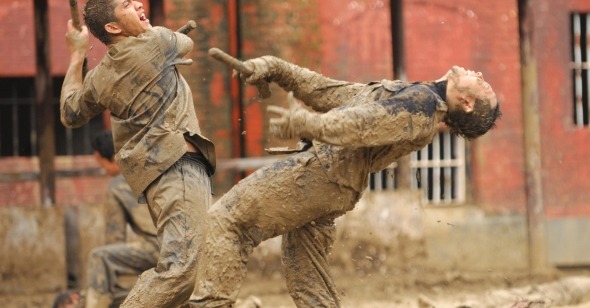
An early example of the ambition and scope of The Raid 2’s action credentials is a close-quarter fight between at least a dozen men in a prison toilet cubicle built to fit two at most—where Uco’s men first attack Rama. This is followed in short order by an epic prison courtyard free-for-all, characterized by being shot in driving rain and ten inches of mud, where Rama first performs heroics on Uco’s behalf. The toilet sequence is overtly stylized around the space and features an overhead shot in the manner of the moment from Hitchcock’s The Wrong Man (1956) when Henry Fonda is filmed in high angle long shot as he is thrown into a tiny jail cell. But where Evans and Flannery take the adaptability of the handheld gimbal into uncharted territory isin the epic mud fight. The camera shifts seamlessly between individual confrontations, and in the same shot closely follows a more developmental chase sequence over the fence of the courtyard—a shot that would not have been physically achievable with the Steadicam. Although filmed in a completely different way, the courtyard scene bears striking resemblances to the battle of Shrewsbury in Orson Welles’s Chimes at Midnight (1965). While both sequences showcase the terrible challenge and vulnerability of fighting in mud—the drag on movement, the exhausting weight of everything, the risk of drowning—Welles cut furiously, assaulting the viewer with shot after shot (many less than a second long) piling on the filth, death, and degradation. Gareth Evans by contrast keeps everything rolling as the bodies romp and die in the mud. Welles’s film deplores the violence by exaggerating its monstrosity, while Evans revels in its choreographic dimension and doesn’t let you draw breath while you do the same.
In later fight sequences, as Rama further embeds himself into the criminal organization and takes on Uco’s rivals and unhappy collaborators, another stylistic brushstroke emerges, relating to the viewpoint of the camera. Here, The Raid 2 contrasts sharply with established gun-fu methodologies. For example, when a man goes through a plate glass window in a John Woo film, the camera will generally film around him (from a gap in the set) with a dolly track or Steadicam, giving a fluid, balletic quality to the action. Conversely, when a man goes through a plate glass window in The Raid 2, the camera goes through the window as well, filming the stuntman so tightly that as he lands, the shot finishes up—as he does—at a 90-degree angle. One imagines that on these occasions, if the gimbal is used, it must be locked at the crucial moment to allow this shot to be performed without the gimbal trying to correct it. This effect is deployed numerous times in The Raid 2—most notably in a climactic kitchen fight between Rama and a terrifying hoodlum played by Cecep Arif Rahman. This kitchen scene—dramatizing a situation where Rama has finally met an opponent at his level—is the centerpiece of the film: a pulsating exhibition of martial arts prowess, camerawork, choreography, and editing.
Despite the gimbal’s abrasing mechanism, the images within the fight sequences in The Raid 2 are not entirely “fluid” in themselves. They are frenetic, and they still contain a handheld quality (in the same way as the Panaglide image in Halloween, for all its smoothness, still uncannily reflects the cameraman walking). But the key is that within this frenzy, thanks to the gimbal, the finer details are both accessible to, and processable by, the viewer, rather than confusing or destabilizing. The outcome brings us closer to the rhythmical appeal of an immaculately timed dance sequence by Stanley Donen, where the impact of a particular dance move, however eye-catching or explosive, cannot interrupt or detract from the overall musical flow.
Along the way, The Raid 2 introduces us to more colorful assassins and their set pieces, including a man who kills people by barreling baseballs at their heads (played by Very Tri Yulisman), and a terrifying young woman with dark glasses (Julie Estelle). In a clear homage to Cheng Pei-pei's character Golden Swallow from King Hu’s Come Drink With Me (1966),Estelle dispatches an entire gang of men in a tube-train with the aid of just two clawhammers, a scene for which the handheld gimbal negotiates the chaotic speed and tightness of space without any need to cut out a wall from the set.
Perhaps the ultimate example of the handheld gimbal’s flexibility in The Raid 2 occurs during the central freeway car chase, where Rama—being transported by his captors as part of a convoy of Mitsubishi SUVs—is rescued by Uco’s men, driving Nissan saloon cars. This features perhaps the most technically accomplished and recognizable single take in 21st-century action cinema, wherein the camera approaches a speeding car from the front, enters the car from the front passenger side window, witnesses the driver being shot at, then arcs across and through the car, finally exiting through the rear driver’s side window to identify where the shot came from (a sniper mounted on a car approaching from behind).
This shot was executed with much ingenuity and meticulous planning. The passenger side front seat is in fact a second cameraman disguised as a car seat, who suddenly comes to life out of shot, grabs the camera from the first cameraman (on the low-loader outside) films the action inside the car, then completes the shot by handing the camera through the rear window to a prone cameraman attached by a steel cage to the other side of the car. Behind-the-scenes footage of this stunt, widely seen and vaunted on YouTube, shows how the two-handed gimbal rig needed to be light and nimble enough for such a shot even to be contemplated. The result is as clean as can be expected, which, like much of the film, is a testament to the craftsmanship of the crew as much as it is to the technology itself. While a Steadicam may require a more highly developed skillset to operate than a gimbal, Evans’s ambitions still place significant demands on his crew, who operate almost as stuntpersons in themselves.
As with most technical innovations, cinema purists haven’t all immediately aligned behind the positive potential of the handheld gimbal. After all, great cinema has survived to date without over-stabilizing the image, and very bad cinema is often over reliant on it. Advertorial content places a gimbal in the same “smoothing” category as airbrushing or photoshop, with all the dishonesty that carries. The compromise lies between absolute truth and the ability to express truth. If all that a gimbal does is create a cozier, cleaner image which is more socially acceptable but less meaningful, then it is being wasted. The cinematographer Sean Price Williams (Good Time) has thus far refused to use a gimbal, considering it “a step toward an AI look” and he adds for ironic measure: “the machine is perfect—the only mistake can be with the operator/human.” Evans and Flannery take up the artistic challenge: they see corrective technology not purely as a replacement tool but as a means of preserving and improving the highly tangible effect on audiences of what are essentially still very practical images (before everything becomes/became computerized and painted in). In doing so, they retain the forensic richness of highly choreographed physical movement on screen by capturing it as closely and truthfully as possible, as devotedly and successfully as Frankie Manning’s “Whitey’s Lindy Hoppers” sequence in Hellzapoppin’ sought to do.
In the same way a martial arts audience appreciates the precision and capture of the fighting itself, all cinephiles occasionally enjoy lifting the hood on how a film is made. The thought processes that accompany a demonstrative “single take” sequence (be it in I Am Cuba, Le Plaisir, or Children of Men) can sometimes ride roughshod over the Bazin/Clarke concept of the long take as a portal to reality, by having the opposite effect of removing the viewer from the story and catapulting us into the realm of the filmmaking itself. Analogous to the appeal of stage illusion, part of loving cinema is in our imagining how it came into being. Martin Scorsese, for example, adores the imprecise jump cut in Powell & Pressburger’s Tales of Hoffman, where a necklace appears in Robert Helpmann’s hand (one feels his fondness for this visible slip must have inspired the grotesquely—and magnificently—imprecise dummy cut of Robert De Niro before the car explosion in Casino). Better to think of this not as alienation—as Brechtian scholars would have it—but inclusion. In genre, spectacle is everything, but more than ever today—as we find less to trust in what we watch—a degree of human, physical truth must exist within the eye of that spectacle for the spectacle to have any weight or power. Physical and technical dexterity are both a means and an end in action cinema: the “how” is as important as the “why.”