A Chorus Line
Ina Archer on Too Much Harmony and Black Black Moonlight
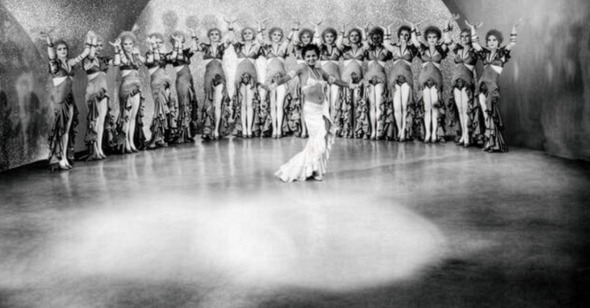
Hidden in plain sight within Too Much Harmony (1933), an ordinary Bing Crosby backstage comedy directed by A. Edward Sutherland, is an extraordinary musical number that highlights a “new” cinematic technology. The production’s release print materials promise: “Speaking of spectacle, ‘Black Moonlight’ will introduce startling lighting effects.” “Black Moonlight,” the number in question, features a remarkable cinematographic trick, imagining a Harlem nightclub where leggy chorines seamlessly change skin color from white to Black and back again, accompanied by a bluesy torch song played by a Black jazz orchestra.
Like many films of the early sound era, especially Paramount’s new Bing Crosby vehicles, Too Much Harmony distinguishes itself cinematically by moving beyond the traditional stage, while revivifying tried-and-true theatrical scenarios in a lively, self-reflexive backstage setting. Still, these films never stray far from previous technologies and stagecraft to explore or exploit the intriguing, underlying cultural presence of racial others. Of the imaginative ways that film characters might enter into blackface to disguise or perform—such as blowing up in a gas stove; falling into mud or another dark, viscous fluid; happening upon some shoe polish or a stray champagne cork—the “Black Moonlight” white dancers’ shift into darkness is unusually graceful and, yes, startling.
“Black Moonlight” might be why Too Much Harmony doesn’t get programmed more frequently. The film was popular and enthusiastically reviewed in its day. As a Crosby stan (don’t judge), I was quite familiar with his recording of the sultry ballad accompanied by Jimmie Grier & His Orchestra from the 1930s. Like the other popular numbers he sings in the film, it was composed by songwriters Arthur Johnston and Sam Coslow. The song wasn’t covered much by other singers, and in 1954 Crosby reminisced about his affection for the song and recorded a version for his musical autobiography. Imagine, then, my disappointment when Crosby’s character doesn’t croon the song in the big number midway in the film, but also imagine my delight and surprise experiencing “Black Moonlight”’s surreal production.
The number opens with a gloved hand tearing an entry ticket and the curtain rising to reveal Kitty Kelly, standing downstage smoking under a streetlight on a bridge illuminated by watery reflections. In the background, dark, velvety drapery sets the scene. Kelly (dubbed by Barbara Van Brunt) sings the opening notes of the number: “Oh, Black Moonlight/where everything reflects your color/Darkness that is endless/Nights that leave me friendless, blue…”
Another dancer, a distraught woman of the night (“Just like me you're faded, jaded and degraded, too!”), tries to catch the eye of a swell in a top hat and other wealthy men. (This being 1933, the film’s overall narrative revolves around money and the financing of the diegetic show.) Society women mock her as they pass by. After being assaulted by a drunk, she flings her cloche hat and bag into the abyss. Deciding to end it all, she begins to climb over the railing, but a passing beat cop gives her the once-over, preventing her jump. She gathers her dignity and walks off stage as the curtain behind this scene lifts to the sound of a kettle drum driving the song’s tempo forward, revealing an Art Deco cityscape with a vertical “Harlem” sign locating the dramatic action in the storied uptown New York neighborhood.
The drums introduce the Chickadees, a Paramount troupe of select chorus girls who appear to be dancing on a colossal drum. The number begins with a dancer in full-body, ostensibly brown makeup wearing a high-split, rumba skirt and bandeau top, wriggling at the center of a round platform. She is surrounded by white dancers in dark, leg-revealing leotards and strappy bodices. Their frizzy blond hairdos echo the lead dancer’s brunette curls. The view shifts to a jazz band compressed into a tight space with actual African American men playing the kettle drums and miming instruments as the camera dollies back to the drum top. The dancers in short skirts with lengthy trails appear statuesque, posed in rows behind the center dancer, standing on the sides of the drum and sitting on the edges of the stage bordering each side of the screen. The dancers’ legs used as frames is a design motif that runs throughout the movie. Their movements emphasize their columnar white limbs, forward thrust hips with their arms posed like angular Egyptian hieroglyphics or exotic but majestic statues.
The snaky lead dancer slinks off upstage as the chorus line takes over. The tempo changes from jungle tom-tom rhythms to a jazzy Charleston, and the women from the sides run onto the stage and appear to seamlessly metamorphose into Black dancers now clothed in light silvery costumes. They move in a complicated roundelay, bent over at the waist, smiling and doing fancy footwork. Slapping their thighs, they transition back to white blondes yet continue to dance loosely and expressively. Shimmying in circles, they become dark again, swinging their arms and holding out their skirts by the hems. Wearing bright smiles and rolling their wide, upturned eyes, they are spontaneous, playful hoofers rather than alabaster chorines. During the song’s climax, the dancers are now (B)lack, executing semi-sculptural poses but imploring with their arms reaching skyward. The singer returns to the center of the drum and intones: “Madly, I await you…Black, black moonlight!” During the crescendo, she stretches her hands up towards the lunation as the Black chorus girls surround her on their knees, crouching and encircling her, creating a corona of dark supplicant bodies in tableau.
What’s extraordinary about the Art Deco minstrelsy of “Black Moonlight” is the head-to-toe transformation of the female dancers, requiring consistently applied full-body makeup rather than concentrating only on (usually male) facial blackening with contrasting white eyes or exaggerated whites of the eyes, coarse short wigs, and blanched, enlarged lips. Unlike concurrent Busby Berkeley numbers, whose productions Too Much Harmony was seeking to emulate or surpass, in this number there are no close-up images of the various chorus girls’ faces, only the lead white singer Kitty Kelly, whose blonde head seems disembodied because of her black dress obscured by the black background.
*****
Throughout my art career, I have always depended on the “kindness” of newly accessible prosumer tools to annex studio-era sounds and images. In such cases I use the newest tech to copy prior duplications (in the lexicon of letterpress printing, these multiple copies of copies are called stereotypes). These include filming a TV set with a Super 8 camera; taping shows on a primary-colored Panasonic TAKE-N-TAPE recorder held up to the kitchen radio; electronically dodging VHS tape copy-codes by camcorder; or digitally writing DVDs of DVR-ed classic movies, many now captured via existentially ephemeral online downloaders, all to be amassed and edited on—fittingly—a timeline. My labored, personal appropriations critically echo Hollywood’s tenacious expropriation of cultural (and corporeal) Blackness by means of outmoded, commercial media technologies. Plus ça change, plus c'est la même chose.
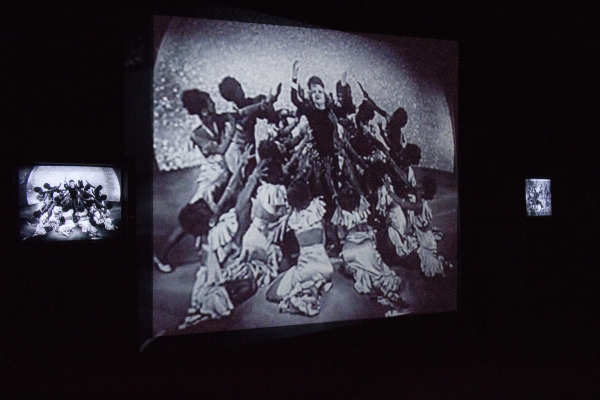
Case in point: my 2024 video installation Black Black Moonlight: A Minstrel Show, which centers my hypothesis on how this spectacular cinematographic effect was achieved. This three-channel video work is an addition to my ongoing research project that interrogates the cyclical re-emergence of blackface minstrelsy, ethnic cross-dress, and masquerade when established or legacy technologies transition to emergent new media prior to the standardization of visual advancements. At these moments, entertainment industries seem to always return to their theatrical, racialized roots. My installation elaborates on this process by suggesting that Hollywood’s innovations are used to maintain the stereotypical tropes of film minstrelsy. The song’s oxymoronic lyrics (black/light/moon) serve as secret descriptors of the methods to create the race-changing effect. Black moonlight, where everything reflects your color.
The “Black Moonlight” sequence runs 4 minutes, 11 seconds. However, in reworking, recutting, and remixing the sequence, I extended the length of the song to almost 12 minutes out of the total 17-minute running time of the installation. The prolonging of the footage invites the viewer to feel bewilderment or even shock, and then intrigue, trying to figure out how the number combines film style, editing, and special effects to produce the blackface—or more precisely—the resulting black bodies.
Black Black Moonlight is synchronized across three channels. The piece is loosely modeled, both physically and narratively, on tripartite minstrel shows, one of the theatrical predecessors of early musical films. A large video projection on a gallery wall painted a dark grey that is almost charcoal black represents the center stage traditionally led by the show’s “interlocutor,” a character who usually doesn’t appear in blackface makeup. Typically, the dark wall would have a white space matted out for the projection to light up the image, but the grey wall creates a softer image that blends the varying resolution quality of the disparate source materials. Smaller CRT (cathode ray tube) monitors sit on pedestals painted the same color as the wall, flanking the left and right sides of the projection, serving as the two minstrel “sidemen” eponymously named “Mr. Tambo,” with a tambourine, and “Mr. Bones,” who plays the bone castanets. Ideally, the room is low-lit with an overhead projector for the center image and audio. A bench also painted grey allows the visitor to sit while watching the looping videos.
This project began as an investigation into how a bit of film trickery was done, conjoining lighting, filtering, makeup, choreography, dancers’ bodies and performances, and music, all wrapped in studio screen style. Akin to a jeweler filing down a small dark pit in a piece of silver, an ugly cavity opens beneath the polished surface of the film.
The greater mystery is why this was done. “Black Moonlight” employs minstrel imagery from previously recognized formats to a new pre-code technology, producing a modern but titillating entertainment spectacle. Is it “Love and Theft,” as Eric Lott speculates in his book analyzing the ongoing and uneasy attractions of 19th-century minstrelsy? Perhaps the song holds the key to Too Much Harmony’s brief engagement with Blackness: “I’ve lost all power to resist you/Madly I await you/ Even though I hate you/Black Moonlight!”
*****
The centerpiece of the installation is, of course, the remixed “Black Moonlight” number, repeated forward and backward, trying to replicate the examination of the footage on a digital timeline. The piece was built using a process that allows cutting and pasting, reversing and duplicating, all intrinsic to digital editing software. The number plays through once as it appears in the film and then is broken down to analyze the footage and play with the image design. The transitions from white to black occur, and then as it gets toward the climax, it reverses and flips.
Repeated viewing reveals that the transitions are not edits but something smoother. There is the use of full-body makeup, but on which dancers? Are all the dancers the same? Red and green light bulbs appear on the sidemen CRTs who give hints about the methodology throughoutand, like the Tambo and Bones characters, provide comic commentary and asides about the main action of the show. As the dancers alternate from white to black, they are overlaid by red and green filters.
This section is accompanied by audio descriptions of a horror makeup trick innovated by Karl Struss in 1931 for Rouben Mamoulian’s Dr. Jekyll and Mr. Hyde, which might help finally shed light on Too Much Harmony’s odd special effect. This was a process unique to black-and-white photography: “So, in black-and-white, when you shine a red light onto red makeup, the camera can't tell the difference between the two. So it looks like the makeup’s not even there. So, when you bring in a contrasting color like blue light, the makeup suddenly appears creating a really cool in-camera transformation effect.” Black Black Moonlight hints that the minstrel performer is, like a white person showing their “Blackness” through blackface makeup, like Jekyll and Hyde, the two selves somehow residing in the same body.