Golden Years
Frank Falisi on the use of filters in South Pacific
There’s no shortage of shadows in Richard Rodgers and Oscar Hammerstein’s 1949 stage musical South Pacific. The work begs of its audience un-hypothetically—and without an answer—to make sense of what constitutes a less believable reality: that two people could fall into immediate, life-alteringly true love, or that the raw material of hatred, passed down baton-like through generations of white Americans, might prove more disruptive to that love than even the Second World War. Based on James Michener’s Pulitzer Prize-winning Tales of the South Pacific—itself based on his own experience as a lieutenant commander in the Pacific Theater—South Pacific spins the love affair of U.S. Navy nurse Nellie Forbush and French planter Emile de Becque on an unspecified South Pacific island during the late days of the war. She’s an ingenue from Arkansas, he’s a middle-aged man with two children by a previous marriage (to a Polynesian woman to boot)—the immediate intimacy they feel, coupled with the distance between their worldviews, is a handy figurative stand-in for South Pacific’s crisis of conscience over race relations in the U.S.
The story’s eternal poles—love and hate, life and death, consummation and war—form the spiritual architectures of all of R&H’s musicals. Definitionally, that musical form sets the unknown to music and lyrics. The technology of the American musical (written into existence by Rodgers and Hammerstein, perfected by Sondheim, and strangely deserted by most other writers) stipulates that when a body enters into the unknown space between knowable poles, song supersedes language. “I know it’s only two weeks,” Emile says to Nellie of their whirlwind courtship, of their creeping mutual feeling that this quick severe fling is truly true love. Logically, Emile reasons, “That is the way things happen sometimes, isn’t it Nellie?” And, illogically, he opens his mouth as if melody will accompany his soaring voice. It does, and he sings “Some Enchanted Evening” and it is true.
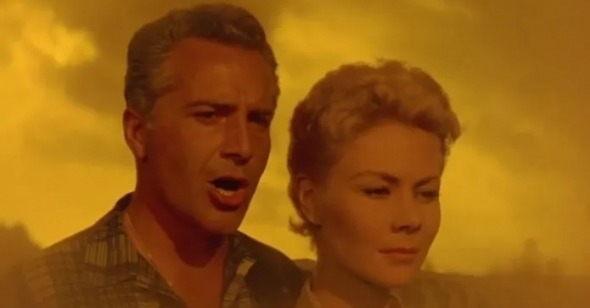
In Joshua Logan’s 1958 film of the musical, Rossano Brazzi, lip-synching to the ghost-voice baritone of Giorgio Tozzi, performs “Some Enchanted Evening” across five mostly stationary close-up shots, the favored unit of the single camera Todd-AO (“Cinerama outta one hole!”), the widescreen format South Pacific was filmed in. Each shot is smudged at the frame’s edges, unnaturally tinted somewhere between the goldenrod printer paper and the pissy sepia indulged in the early aughts to signal a film landing in Mexico, the Middle East, or some other similarly dangerous locale. Unlike the post-production color grading used there, South Pacific’s color treatment is distinctly more tactile: the result of hand-painted filters, deployed—sparingly, sometimes chaotically—as a membrane between the camera lens and the musical’s action. In “Some Enchanted Evening”, the coloration doesn’t begin, as one might assume, as the song does. It indicates a musical choice, which is to say it reorganizes real air into something more, but its timing is hard to predict. After flanging on a few numbers earlier as Nellie (Mitzi Gaynor) observes “that yellow sun,” the gold tint lingers through her performance of “A Cock-Eyed Optimist,” reduces back to “natural color” (if a little smudgy) for the book scene that follows, and fades in again during the instrumental climax of “Twin Soliloquies.” There it remains, through “Some Enchanted Evening.”
This tint fades laterally across the screen like a floating mist, suggesting that the colored filter is being rotated slowly onto the lens, rather than applied between cuts. I belabor their timing only to suggest that Logan’s insistence that cinematographer Leon Shamroy use these DIY filters suggests the kind of half-cocked idea you see in some local community theater productions: half-abandoned once it becomes apparent the tech isn’t cooperating with the desired effect, half-maintained out of a desire to still achieve the effect, even on inching spectral terms. Colored filters were not entirely new to either party: Shamroy’s work on the Zanuck bonanza The Egyptian (1954) sported subtle filtering over that film’s Cormanesque ‘House of the Dead’ sequence, and Logan persuaded no less than James Wong Howe to rosily soften the colors during William Holden and Kim Novak’s “Moonglow” dance in Picnic (1955). In these films, though, the use of filters is a grace note. They are frequently applied between cuts to not call attention to their use. If South Pacific’s own daffy colored filtering lingers in the cultural memory, it’s usually recalled in terms of its failure. Logan hoped that the filters would provide a theatrical counterweight to the film’s practical (and practically stunning) locales.
Recounting his proposed explanation to Shamroy in his dishy second memoir, Movie Stars, Real People, and Me, Logan articulates how changes in stage lighting prepare a spectator for poetry: “A mood has been created that allows spectators to concentrate on the words and music and the emotions of the singer’s performance.” Not entirely convinced by their own plan, Logan and Shamroy shot the bulk of South Pacific’s early scenes twice, once with their rotating filters, and then again without. Producer Buddy Adler, of course, had notes for this expensive practice. He assured Logan that “the lab can cut out the color if you don’t want it later.” The end of the story is familiar to any artist laboring under the twin cloak of inspiration and the clock: the rest of the film was shot solely with the color filters. Logan wasn’t happy with the results and wanted the footage de-colorized. Adler’s proposed leeching process would have taken three months to complete, a detail he hadn’t shared. And South Pacific, booked in theatrical houses months in advance road show-style, had to open before the process could have been completed. It premiered in full, deliriously rotating color, often to befuddled audiences. “I wanted (and still want),” Logan wrote, “to carry a sandwich board in front of every line at the box office, saying, I DIRECTED IT AND I DON’T LIKE THE COLOR EITHER!”
*****
The persistent perception that Richard Rodgers and Oscar Hammerstein II composed a slew of creaky, conservative stage musicals is emboldened by the slew of creaky, conservative films adapted from those musicals. Yet a little patient reattunement to these sometimes boring, often downright weird adaptations reveals a consistent turbulence humming in the source texts. That the composer and lyricist were nominally social liberals in their time was a point of personal pride especially for Hammerstein: he co-founded the Hollywood Anti-Nazi League and, because of contributions to organizations like the Southern Negro Youth Congress and the American Committee for the Protection of Foreign Born, earned himself a hefty surveillance file with J. Edgar Hoover’s FBI. Textually, Rodgers and Hammerstein’s musicals very often fit—sometimes awkwardly—narratives wary of racism, fascism, domestic violence, and other myriad other postwar American cruelties to forms that depend upon the spontaneous bursting out of characters into song and dance. Therein lies the major contribution of Rodgers and Hammerstein to the American stage: their vision for and revision of the book musical suggests that the form did not exist to merely distract a worried, war-struck world away from their troubles. Rather than avoid reality in favor of a more ecstatic fantasy, the fantasy world itself becomes a terrain for grappling with that reality on distinctly fantastical terms.
Like Stephen Sondheim—whom Hammerstein mentored, and in whose whip-witty, pleasure-centric lyrics we find the echoes of Hammerstein’s chiseled poeticism—R&H’s musicals were largely popular with their audiences. It’s no wonder that a money-eyed mid-fifties Hollywood saw an opportunity to adapt them into big budget fantasias, beginning with 1943’s positively boffo, form-inventing Oklahoma! in 1955 and culminating a few years later, with South Pacific. A classical love story that moves like a revue, placing different characters’ different treatise on desire in the round and following each to its logical conclusion, South Pacific is fundamentally about how the human species has nearly let its myriad obsessions with color ruin its chances at connection, camaraderie, and love.
Logan’s verve and willingness to mix a little spit-shine risk in with the stoic bombast was not matched by his contemporaries in adapting R&H to the big screen. It’s perhaps unsurprising that the contemporaneous Hollywood studio executive displayed basically zero interest in the textual tension cooked into R&H’s plays, in how they set national horror and sentimentality opposite one another in a sequence of gruesomely beautiful pas de deux. Adaptation is the trickiest technology, and one inseparable from the dramatic arts. A writer constructs a text, and then a troupe must adapt it into blocking, bodies, and breath. Fundamentally an act of revival, adaptation attempts to render in practical terms all the impractical ephemera that sloughs off a cultural object in translation. A song adapts a feeling in degrees of melody and silence, as a voice adapts a song in breaths, enunciation, and timbre.
If a little over-cheesed (that substance most anathema to Rodgers’s symphonic moving sidewalks and Hammerstein’s chiseled consonance), the film of Oklahoma! maintains an unhomely sense of blood-red wrongness amid its balletic shapes. Fred Zinnemann’s clarity of blocking and dreamy use of space is an altogether different set of adaptive technologies than the DIY-directness employed by Daniel Fish in his 2019 stage production. No contemporary R&H revival has been as critically lauded (and reactionarily pearl-clutched at) as Fish’s production, which merely had the gall to mean the words on the page. Despite protestations that the director had nudged Oklahoma! into territory foreign to its original intentions, anyone who saw the ensuing work on stage could confirm that, if anything, this rendition was even more faithful to Hammerstein’s words, Rodgers’s melodies, and the national implications that result from their collisions. Fish and his collaborators played the frontier apocalypse for what it was, rather than the box fair it had become in the imaginations of many, matinee crowds and historians alike.
Perhaps the most egregious of the R&H film adaptations is Henry King’s Carousel (1956), which comes perilously close to not only misunderstanding but reforming that show’s wrenching domestic violence storyline. Jack O’Brien’s 2018 stage remount attempts to grapple with Carousel’s terrifying ontological ask: what happens to our collective spectating body as it experiences the most gorgeous score ever composed for the American stage while soaking in America’s unmitigated violence towards women? O’Brien sought, by realist instincts and a de-emphasis on the confusing cosmos of Carousel, to problematize in good faith the often-unchallenged parochial sentiment of “You’ll Never Walk Alone.” Indeed, tracing recent revivals of R&H back from Fish’s haunted, vaunted Oklahoma! yields a constellation of curious 21st-century re-approaches that form a laboratory for experimenting on the country’s speculatively better angels and the forms most (in)appropriate for adapting them. Bartlett Sher’s 2015 revival of The King and I granted the titular King dignity on his own terms mostly by ceding authorial control to Ken Watanabe, an actor historically relegated to boring supportive work by Hollywood’s lack of imagination and inborn prejudices. Aid the King and help the court: Sher’s willingness to make Mongkut more than a montage of charisma—as the great and occasionally coasting Yul Brynner does in Walter Lang’s 1956 film adaptation—lent a similar care to Kelli O’Hara’s more dynamic Anna and the ensemble itself, no longer merely a collage of types.
Sher’s steady, unapologetic reentry into The King and I (a work not exactly unencumbered by orientalizing urges) inspired, in Ben Brantley’s review, “shadowy emotional depth to churn up a surface that might otherwise seem shiny and slick.” Sher’s similarly reverent 2008 revival of South Pacific—the most productively troubled of Rodgers and Hammerstein’s collaborative work—feels as if it belongs to a different world when considered against Fish’s punk-dark Oklahoma! It opts for literal periodisms over speculative timelessness, historically accurate enunciations over confrontational honesty, and the proximity of opera over the way American country music swings, occasionally into pitfalls of despair. Yet these are merely different technologies of adaptation. Despite the cockeyed optimism with which we look back at the Golden Age of American Musicals as a period when American hegemony was reboldened, Sher and his collaborators show the lengths to which R&H were cognizant of and horrified by the specter of American racism and the long-gnarled tail of colonial occupation. Guerrilla-like, Sher’s careful choreography kept the Black members of the plucky Seabee ensemble semi-segregated in their own lines, even as they sang, smiling. When Nellie confesses her racist horror at the prospect of the French Emile’s mixed-race children (“It isn’t as if I could give you a good reason. There is no reason. This is emotional. This is something that is born in me.”), Sher and O’Hara insist on the confession as the focal point of the play rather than an unfortunate bit of dated characterization to be hastily apologized for by a subsequent musical comedy number.
*****
South Pacific’s swirling, mutant color changes in-frame make it look like no other American musical film. The golden wash of “Some Enchanted Evening” is so gallingly unrealistic that it both covers and highlights the discrepancy of the fantasy. Having a voice that doesn’t quite match the mouth feels dreamy instead of dreary. Improbably, the totalizing romanticism of Rodgers’s sweep and Hammerstein’s verse feels—in this color-discombobulated world—Romantic, an Occupied Polynesian Gothic. “Bali Ha’i” sports the most severe coloration, a deep violet pall that clings to the lust-struck Seabees and so renders Bloody Mary (Juanita Hall) like Vincent Price in one of Corman’s Poe freakouts. Hall was born to an African American father and an Irish American mother. She became the first Black woman to win a Tony, for her performance of the Tonkinese Bloody Mary in the original Broadway production. Here, she plays Mary in exactly the kind of broad, outrageously orientalized English that mid-Hollywood demanded. It’s disheartening to watch Hall forced to perform these stereotypes and lip sync to another actor’s voice. It’s unsurprising and disappointing that the voice belongs to Muriel Smith, another Black performer historically ignored by Hollywood, here literally shunted to the offscreen space like a phantom beamed in from Julie Dash’s Illusions (1982). “Happy Talk”—Bloody Mary’s winking ode to foreplay—illustrates a text at odds with its own form of expression. Hammerstein’s lyrics are typically cutting in how they span the bridge between the dream space and the lusty human one. They’re well affixed to Rodgers’s plinking melody, revealing the composer’s ear for playful, nearly punny melodic structures. But watching Hall perform it in the gold-eyed Technicolor, we grimace.
Wasn’t that always the point of the play? To grimace? “You’ve Got to Be Carefully Taught” isn’t pat polemic because it’s a fever being sweat out. Performed by John Kerr—and dubbed by Broadway/Disney voice actor veteran Bill Lee—the song has all the twisting tension of a mouth struggling to mean the words it’s singing. Like Sher after him, Logan treats the revelation of Nellie as, appropriately, not merely cola-fizzy but discombobulated by her unexamined racist urges as a scene of melodrama. This is a world wrecked by our perceptions of the world. Gaynor cannily plays Nellie’s meltdown with a Brontëan height of emotion, not a tacit recreation of Hollywood’s hysterical woman type but a reaction to it. The dint of blue pressing down on her actions literally signals that it’s nighttime, an effect on loan from Nosferatu (1922) and, more broadly, reminiscent of silent cinema’s hand-colorized tinting. If there is a rule over when the color filters are applied and when reality looks “real,” it might be that the cinematic world woggles when a character is presented with the sublime.
Whether Logan and Shamroy truly intended the colored, smudgy visual flourishes to elicit fantasy or nightmare is irrelevant; the footage indicates both, simultaneously and filmically. South Pacific becomes, then, an ideal adaptation of Rodgers and Hammerstein’s work. It feels dated, sometimes in untraceable ways but then—and sometimes subconsciously—goes beyond our good-taste desires to fully comprehend our most monstrous or romantic urges. It indicts us, and it indicts itself. That no film has since opted to use such starkly reality-warping colored filters surely indicates something about our culture’s gravitational pull towards literalism. There’s a strain of liberated poesy in Logan’s colored filters, which both are and aren’t a statement about color, which both are and aren’t merely a theatrical, musical signal. How ruinous and fitting to watch a South Pacific and feel that the color is wrong, that there is something unresolvable even to Rodgers’ string whorls and Hammerstein’s picky grace.