New Waves
Max Carpenter on Eurotechno
In 1993, in Birmingham, England, neurophysiology professor Graham Harding codified something medically significant about moving images and luminance—luminance being a measure of visible light and its physical power. Harding posited that if the estimated luminance of a large swath of a moving image goes through rapid increasing-decreasing cycles (at some fiendish rhythm of three-to-thirty times per second) then this moving image has the potential to induce seizures in viewers with photosensitive epilepsy. Harding also proposed that changes in high-luminance-contrast spatial patterns, like stripes or grids, come with a similar risk. Thus was born the Harding test, which is to this day the international broadcast standard for approving programs for epileptic viewers.
Why 1993? And why in England? The website for HardingFPA, the proprietary software version of the test, offers some clues: frames of the late comedian Phil Hartman’s mugging face backgrounded by erratic-looking fluorescent patterns. These frames are from a British instant noodle advertisement from 1993 that reveled in its own stupid psychotropics. In the advert Hartman sits suited up like a news anchor and spouts half-sequitur lines: “At the end of this commercial break we’re gonna ding-a-dang-ding our ding-dangs. Intense! What goes better with an intense snack than an intense film? Watch this!” Hartman then turns around to watch a frenetic video projected behind him: a barrage of strobing color patterns that, upon the commercial’s airing, provoked seizures in a significant number of home viewers. The noodle commercial was promptly banned from the air, and the British Independent Television Commission promptly reached out to Professor Harding to assist them in screening future media for seizure risks.
Less noted in this curious story is the original source of the seizure-inducing imagery. The video excerpts shown behind Hartman were snatched from Eurotechno, a twenty-six-minute ‘videola’ by the mysterious media collective Stakker, released on VHS in 1989.
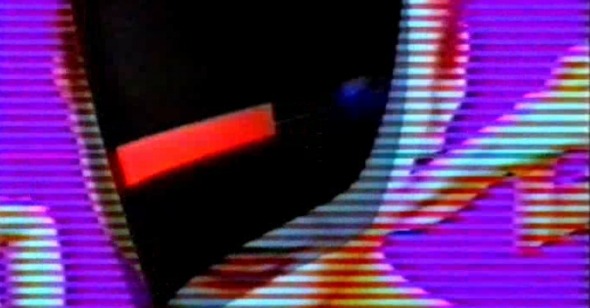
Let’s pop that VHS into focus for a second. The faintest tape glitch loops on the soundtrack as a woman’s hands sway rhythmically in front of her inquisitive face in close-up, her skin and hair reduced to a saturated tropical two-tone palette (aqua and mauve). This image and palette intermittently burn into heat-vision color clusters as though they were clashing with interlaced video signals, all framed inside a lopsided rectangle of a screen skewed in black space. A metallic three-dimensional spiked-star shape spins in front of the frame before a prismatic rotating plus sign, itself imbued with frenetic color clusters, takes the fore, metamorphoses into a sphere, then into a trihedral mirror, and ushers in a beat-synced soundtrack of crunchy acid techno as multiple newly overlaid screens (featuring the woman, colorfucked patterns, etc.) begin gyrating and melting into spinning shapes. Twenty seconds have passed, and more than twenty-five minutes remain. Through the next 25 minutes the soundtrack swoops in and out of the danceable—flirting with a textural headiness that was largely unexplored sonic territory in 1989—as syncopated strobing layers of Kool-Aid-video screens and polyhedra dance in synchrony. Multiple watches of Eurotechno will cause any non-epileptic to question the fortitude of their non-epilepsy—is that my first ever migraine aura I feel coming on?—but if one can get past this well-warranted concern there’s a lot to love in the mania. In 2026, well after an intervening ’90s when all of Eurotechno’s image manipulation techniques became the vapid language of broadcast bump transitions and computer screensavers, it’s remarkable how fresh the work still feels—fresh in its air of confidence, fresh in its technological deftness, but, most presciently, fresh in taste. After ten or 15 minutes of rave-rainbowed shapes liquefying into gyrating video frames to the strobing beat of the music, the thought occurs that this may be, for better or worse, the MTV generation’s smartest answer to Paul Sharits.
Stakker consisted of British video artists Mark McClean and Colin Scott, along with electronic musician Brian Dougans, though the lines between these video-versus-audio roles seem to have blurred, with McLean and Scott (along with a DJ named Simon Monday) contributing extra sounds and overdubs to Dougans’s original techno-adjacent scores. ‘Videola’ is a Virgin Music marketing term loosely defined as a work of video art in which the sounds and images are created simultaneously—a decidedly experimental alternative to the music video—and Virgin Music is responsible for releasing Eurotechno on VHS via its short-lived Videolabel imprint. Stakker was a bit of a late-’80s flash in the pan, and their non-Eurotechno body of work consists solely of two other highly similar video curios: firstly, Stakker Humanoid—an assaultive symphony of saturated colors, geometric tilings, and two-toned dancing women, backed by a now-seminal acid house track (called “Stakker Humanoid” by Humanoid) that Dougans whipped up to accompany the visual style, and which happened to top the UK dance charts—and secondly, the first 30 minutes of visuals for the VHS-released acid house DJ-set-with-visuals The Evil Acid Baron Show.
McLean, Scott, and Dougans built Stakker primarily on the backs of two affordable pieces of ’80s consumer tech: the Fairlight CVI (Computer Video Instrument) and the Roland TB-303 (Transistor Bass-303) synthesizer. The 303 synth, when tuned just so, emits an irresistibly liquid tone whose allure has drawn listening moths to the acid flame for five decades now. This delectable churning synth sound is—famously, in house music lore—the years-later upturn of Roland’s bad luck after the Japanese company’s failure to sell the 303 as a budget replacement for studio bass guitar sounds. In a rhyming fashion of failure, a perusal of vintage Fairlight CVI walkthroughs on YouTube demonstrates a laundry list of quickly dated video sillinesses: from chroma-key freeze frame stenciling effects to distortions via gridded textural overlays to on-screen painting and kaleidoscoping. It’s truly a wonder that McLean and Scott had the sans-hindsight taste to avoid almost every ’80s (and ’90s) VFX pitfall and focus almost solely on the CVI’s secret weapon: direct color channel manipulation (i.e., digital reassignments of red, blue, and green levels). And this they did with a rapid-fire spectral bravura that should have made Toshio Matsumoto jealous.
Virgin granted Stakker £56,000 (about $200,000 today) to make Eurotechno, and this mostly paid for studio time to access pro-grade effects equipment by British company Quantel and California’s Abekas, with which they projected their Fairlight schizophrenia onto the surfaces of platonic solids and made their rectangular frames twirl around and fold in on themselves. Strangely, or perhaps fittingly, these far more expensive effects are the ones most at risk of exiling Eurotechno to a misfit drawer of dated unartful frivolity. (Quantel and, to some degree, Abekas remained broadcast effects leaders for many years; Quantel products were crucial in constructing the shiny layered geometric transitions of the likes of CNN and SportsCenter, and Brass Eye’s brilliant spoofs thereof.) Dougans undoubtedly used further Roland drum machine products (my ears think they hear prominent TR-606 beats) and quite probably an Akai sampler and synths by Casio and Yamaha—Japan was, by all technological accounts, the secret muscle behind the international house and techno revolutions—and McLean and Scott worked painstakingly to strobe and cut their video onslaughts to the ever-changing BPMs of Dougans’s eventual end result.
The immediate legacy of Eurotechno, before it brought about an epilepsy diagnostic, was twofold: firstly, its images were projected for added spasmodic ambience at clubs and raves worldwide and undoubtedly played a hand, for better or worse, in general EDM aesthetics; secondly, its sounds caught the cortexes of the young soon-to-be Warp Records vanguard of Aphex Twin, Autechre, Squarepusher, Luke Vibert, and many other primarily British musical rabble-rousers. Aphex Twin’s record label released, in 2003, archival compilations of all of Dougans’s recordings from the Eurotechno and Stakker Humanoid sessions, and Vice celebrated the Eurotechno compilation as an “acid lover’s paradise.” But as flattering and hip as Eurotechno’s forked audio/visual legacy may be, it is rare these days that anyone watches the work as an audiovisual whole. This is partly because only lucky VHS collectors or private torrenters can access even a half-decent copy or scan of the original video, and this inaccessibility rhymes with so much of the history of techno and dance music, a history written on forgotten bathroom stalls during a collective molly comedown. Eurotechno, though, is a marvel that deserves placement in a far greater cinematic lineage than ‘half-remembered glitchy wallpaper for ravers.’
Half a century before Stakker, and also working out of London, Len Lye breathed dazzling life into a barely birthed avant-garde mode of cinema. Lye was working loosely in an idiom whose co-innovators included Oskar Fischinger and Mary Ellen Bute, the latter of whom dubbed each of her many (eventually color) image and sound synchronization works to be a “synchromy,” a zippy term later readopted by fellow traveler Norman McLaren. Lye’s synchromy experiments with the subtractive Gasparcolor process, notably 1936’s Rainbow Dance and 1937’s Trade Tattoo, bear striking similarities to Stakker’s ’80s output: strobing tessellated patterns (whose interactions with film layered in coats of cyan, magenta, and yellow Lye manually attended to frame by frame); stenciled dancing bodies (whose “trail of colored silhouettes” were likened to Duchamp’s Nude Descending a Staircase in some Harvard program notes); jittery floating shapes that fly in front of, and often swallow, the action on screen; and, in Rainbow Dance, a woman in medium close-up rhythmically looking this-way-and-that rendered in shuffling tropical negatives. Also, ironically, but self-evidently, Lye’s film work lives on in higher definition than Stakker’s videos. But these Lye films don’t quite trounce Stakker even if they very impressively predate the team’s efforts. Lye’s stenciled people register to a contemporary eye like clumsily done early video effects, and his overlaid Gasparcolor-processed films of patterns and tradesmen working feel, at their worst, like watching a bad ’90s VJ set. This hindsight-cheapo quality is the price of working too close to the cutting edge (and it is why Lye’s most indelibly sublime work will likely continue to be his hand-painted and stop-motion creations). Even Stanley Kubrick and Douglas Trumbull’s Star Gate sequence for 2001 (also developed in and around London) has its small share of hindsight-cheapo coloring effects. And Saul Bass’s marriage of John Whitney’s Lissajous-curve stencils with a woman’s red-tinted pupil and iris in Vertigo (the overture that walked so Star Gate could run) veers clunky for at least a split second.
Eurotechno is, decidedly, far guiltier of clunkiness than either of these latter two master sequences, but a meticulousness of electric activity surrounds its ever-morphing layers with a certain forcefield of gusto, and its core embrace of video qua video seems to champion its rendering limitations as badges of honor. Also, who among Sharits, Matsumoto, Lye, Kubrick, or Hitchcock helped to usher in a new subgenre of music alongside their cinematic bona fides? In any case, the march of time will continue to stamp and unstamp cheapness on erstwhile cutting-edge innovation, and so, lastly, on the music front, I think it’s worth revisiting Birmingham in 1993, where we first found Professor Harding at work. A ten-minute drive west from Harding’s lab would have brought us to the apartment office of Downwards Records, an underground techno label cofounded that same year by an ever-punkish Brummie named Karl O’Connor, whose better-known alias is Regis. If Downwards’ founding was quaint, its effect on the world of techno was seismic. Its legacy is the ‘Birmingham sound,’ and this sound was an uncompromising rejection of all the silly bells, whistles, and funkiness of the acid house and techno that predated it. Undecorated, blown-out loops of industrial punches and creaks and were the Downwards credo, and 30 years on this is still the core credo of many techno purists. Speaking in 2013, looking back on acid house, its adherents, and its cheapness, O’Connor called it all nonsense: “I definitely felt something passing when acid house came along. Electronic music was really sophisticated in the mid ’80s, but then it just seemed a bit cheap. Dungarees, men with ponytails, it upset me quite a lot to be honest, that’s why I stayed in for quite a while.” Stakker flirted with a lot of this derided cheapness, and it would be hard to begrudge viewers who feel Eurotechno, for all its merits, ultimately fails to transcend the silliness of the scene. Alas, there’s rarely any winning in the war of aesthetics.
There is, however—perhaps—a way to win in the British-born war on luminance. Pure blue is the color with the lowest inherent luminance. A film made solely of an unchanging blue screen would be about as eye-calming as they come. And how about a soundtrack in which British experimenters from all the best corners and eras are mixed together in calming resplendence? The Muses had this one covered, and in 1993 England no less. Seems there’s always another shade to that dim little island.