Beyond Limits
Nicholas Russell on the Use of “Previs” in Panic Room
There is always a class of filmmakers perennially itching for the next technological leap forward: James Cameron and Steven Soderbergh come to mind as two directors with opposing working styles but similar ambitions for the efficiencies and reality-bending possibilities of digital technology. The transition from the photochemical film process to digital production—from cameras to visual effects to editing within the early part of the 21st century—represents one of the most profound flashpoints in cinema history. David Fincher, just as technically savvy and game to test out the latest toys, has been less has received less fanfare, but if one has paid attention to Fincher’s career for any length of time, a sentimental affinity for the medium lags far behind the more practical desire to move on to the next project. It’s one of a panoply of oft-stated advantages with digital filmmaking, the ability to move quickly and dexterously, without the literal weight of film to slow you down. But Fincher’s work, inclusive of his time in television advertising and music videos in the ’80s and ’90s, illustrates a director’s desire at first to uphold and then transcend the strictures of the camera itself.
There are two competing perspectives of David Fincher: that of a hard-driving auteur who demands perfection and challenges his audiences with provocative material while still working comfortably within the commercial constraints of the Hollywood studio system; and that of the technical savant, an artist who, from a young age, steeped in the filmmaking culture of the 1970s (George Lucas was his neighbor in northern California for a time), absorbed every part of the cinematic production process, from developing film for director John Korty to working in the matte department at Industrial Light & Magic (Fincher worked under both Korty and Lucas on the 1983 animated feature Twice Upon a Time). Both views run parallel to one another throughout Fincher’s career, a gun-for-hire with an insatiable curiosity for process, a defining feature of his style and the narratives of his films.
By 1999, the year Fight Club was released and Fincher’s reputation as Hollywood’s most reliable imp wasn’t yet firmly cemented, film technology had been moving steadily toward a more intensive collaboration between camera and computer. Not only in the development and improvement of computer-generated imagery; not only in the streamlining of the editing process with software applications like Avid, which also helped usher in the ability to stabilize shots in postproduction; but also the specific, repeatable control of camera moves with the use of a Technocrane, at first employed as an extension of a cinematographer’s hand by way of a joystick and then increasingly programmed via computer. The 21st century loomed, and the limitations of traditional filmmaking seemed to be falling away.
One of the shinier new cinematic tools in the emerging innovation box of the late ’90s and early aughts was the concept of previsualization, or previs. As Fincher would later call it, “simply 21st-century storyboarding.” Utilizing rapidly developing digital technology, previs was and continues to be exactly the natural evolution from 2D storyboarding that Fincher quipped about, a pre-production tool that allows for even more creative specificity and freedom in describing potential sequences. The industry standard, which involved static hand-drawn images with technical notes about camera movement featuring comic book-like figures, literally moved, often in crudely rendered 3D space that looked like early generation video games, approximating what was achievable on set while also allowing cast and crew the opportunity to glimpse a more dynamic idea of what the director had in mind. In the wake of Fight Club’s lackluster box office performance, Fincher set his sights on lighter fare, ideally a popcorn crowd-pleaser that could reorient his trajectory. Panic Room (2002) offered a deceptively commercial project, one whose production, though plagued by setbacks and a ballooning budget, solidified Fincher’s aesthetic commitments as they pertained to the digital frontier. Fincher was no stranger to CGI or digitally manipulated images. His first film, the studio-ravaged nightmare Alien 3, featured CG Xenomorphs, while Fight Club utilized a host of visual effects, from its opening title sequence zooming through the fear center of its protagonist’s brain to a sex scene that utilizes photogrammetry techniques similar to those that created The Matrix’s famous “bullet time” effect.
It’s this latter example that seems to have stalked Fincher into the 21st century and onto the set of Panic Room, not necessarily as a favored approach but an indication of where the director would like the horizons of image creation to go. In an interview with Film Comment in 1999, Fincher, talking about the hyperstylized and subjective cinematography of Fight Club that frequently transitioned from a photographed sequence to an entirely digital one, said, “You can’t just cut to a stove, you’ve got to become the gas.” (italics added). This statement betrays a developing philosophy for Fincher, not as a means of recklessly whipping the camera through three-dimensional space, which would become de rigueur in modern Hollywood filmmaking, but expanding the audience’s access to key pieces of visual information.
As if to say: if a human being schlepping a camera can’t accomplish the task of making this new visual mandate possible, there’s a solution for that. In the behind-the-scenes documentary Shooting “Panic Room,” cinematographer Conrad W. Hall, son of Conrad L. Hall, declares, “David’s sensibilities about camera movement is [sic]precision, fluidity, the sort of mechanical perfection that a human being and sometimes even the technology can’t achieve.” Meanwhile, Fincher himself, in the audio commentary for the film, gives a more qualified and typically revealing explanation: “I liked the precision because it’s not something that people can do. It’s so personality-free…I sort of saw it as, there’s no one there. There’s no one pushing the dolly. There’s no one pulling focus.”
Achieving this look necessitated previs and the techniques marshaled in the Fight Club sex scene. A title card during Shooting “Panic Room” claims the film employed previs more extensively than any live-action feature before it. Kevin Tod Haug, the film’s visual effects supervisor, spoke to
Befores and Afters in 2022 about previs in the early aughts, saying, “Well, previs wasn’t necessarily new, but most of what people had done so far was for very specific shots. It wasn’t really used as a director’s tool very much. When we did it, the purpose from David Fincher’s point of view was to work it all out in advance.” The guiding motivation was to streamline the number of complicated camera moves and on-set specifications Panic Room would require—Rear Window for a new era (Hitchcock is an explicit influence on the film) where the audience was no longer locked into the captive observer’s static perspective but could travel anywhere the camera (and computer) could. Ideally, previs would take all the guesswork out of the process, providing the filmmakers with precise measurements of everything from camera height to wall thickness.
Wittingly or not, in trying to map out his film before any footage had been shot while testing out a new technology, Fincher shared the same ambitions as his former neighbor and employer, George Lucas. Ever the envelope-pusher, Lucas helped develop an early precursor to previs for 1994’s Radioland Murders and returned to it again in 1999’s Star Wars: Episode I—The Phantom Menace. His ambitions for the latter film were both hyperbolic and ultimately prescient: “The real point is, how can we manage to change the operating procedures in a way that we can completely revolutionize the way we make movies so that this is all doable?”
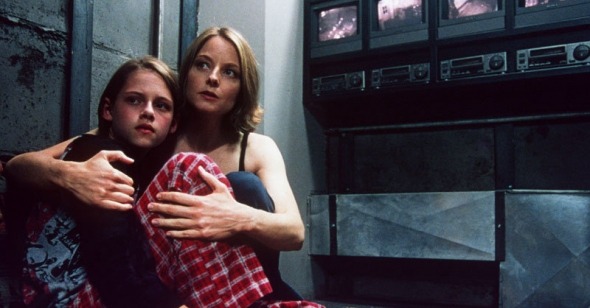
In Panic Room, what was referred to during production as “the big shot” involved the camera traveling throughout the house in one unbroken take. Photogrammetry was suggested to achieve this. The practice, less often used now in place of processes like light detection and ranging (LIDAR) scanning, has multiple applications and methods across a range of fields beyond filmmaking, but the most general approach involves taking high-resolution photographs, frequently using an IMAX still camera, of a setting or a character and blending them together over a three-dimensional plane. The finished effect created background environments, CG objects, and people. As Haug stressed years later, “You have to remember, at that time most of the renderers weren’t super sophisticated. Frequently, you could never get to photoreal. So, starting out with photo-textures was a smart thing to do. It still took a ton of work to fix things like reflections, and the way color shifts move through space, of course, but they started out ahead of the pack.” In the case of Panic Room’s famous oner, which flies through the apartment of an imperiled woman and her adolescent daughter, here played by Jodie Foster and Kristen Stewart, as a group of criminals figure out how to break in, Fincher switches between filmed plates and CG backgrounds rendered through photogrammetry, with reference stills taken on-set, to illustrate a schematic view of the entire building. Not only does the sequence lay out a legible geography for the audience, it also emphasizes the film’s commitment to an even more intimate kind of voyeurism, situating the danger its protagonists face within a visual language that offers them no shelter or privacy.
In retrospect, the results seem to foreshadow the unweighted computer-generated cinematography so often seen today: the camera glides through the handle of a coffee pot, pushing into the tiniest crack in the wall, traveling through a hose, following a feather through an air duct. Still, none of these technologies were nearly as optimized as they are now, and Fincher’s intense focus on essentially shooting Panic Room in previs only exacerbated an already drawn-out preproduction schedule. “An interesting thing about the previs for Panic Room is the film was originally meant to star Nicole Kidman,” Haug said. “But she got injured and then Jodie Foster came in. But Jodie’s almost a foot shorter than Nicole, right? So, the previs didn’t work anymore! We actually had a thing that we called ‘the Jodie box’ that was like an apple box that was exactly the same difference in height between her and Nicole. She would stand on it for certain angles that had to be precisely how they’d been previs’d.” This overpreparation forced Fincher and his crew to improvise new setups while remaining slavishly loyal to the original previsualized concept, a problem created by the clash between technology, reality, and ambition that Fincher has since endeavored never to repeat.
Following Panic Room, as the new century progressed, Fincher’s directorial philosophy crystallized around an idea cribbed from his days working in animation. In a 2006 interview with Stephan Littger, Fincher describes looking at performances “in kind of fractal time-time between time.” These days, the director shoots for extraction, utilizing a wider frame than will be seen in the final cut in order to reframe shots later. But peruse any number of VFX breakdowns of Fincher’s recent films and you’ll witness a visual fastidiousness that would not have been possible 20 years ago, all of it aided by multiple methods of digital postproduction: removing loose hairs on wigs, replacing entire backgrounds, adding blood, shifting a performer a few inches, adding snow or rain, removing blinks, replacing faces, replacing bodies, adding light fixtures, removing lens flares, adding lens flares back in.
While this volume of augmentation is by no means abnormal now, it’s impossible to escape the fact that, once one knows what to look for, no frame of a modern David Fincher film remains untouched by CG. Any given shot is simply one element in an intricate patchwork of assets, each mutable and subject to some form of digital manipulation. Bullish auteurs like Lucas and James Cameron spoke frequently about waiting for technology to catch up to their lofty ambitions, specifically when it came to visual effects. Fincher seems to walk a slightly different path; his demand for endless variability and the option to tweak whatever piece of data he captures recapitulates the iterative capabilities of the digital workflow he so enthusiastically embraced. But it all started with the camera and its limitations. In 2002, on the press tour for Panic Room, Fincher was asked about why he envisioned the film’s cinematographic language as one of weightless yet precise movement. He replied, “I think it’s always a balance between subjectivity and omniscience…The camera is completely unencumbered, while the people are not. The people run up, hit a door, and fall back. They can’t go through the wall, and then the camera just goes right through it.” In other words, why be held back by physics, and the traditional suspension of disbelief that removes the cameraman, the crew, the camera itself when the audience still knows that a physical object is being moved through space.
Of course, previs and photogrammetry encourage this mode of thought by beginning the process with concern for physical limitations (camera angles, square footage, lenses, etc.) via a machine that can’t qualify what makes these details significant in the first place. One is dealing with stand-ins and projections, which is not to say such elements are unhelpful, but that a grounded, reactive filmmaking approach is traded in for a potentially hermetic, overly controlled one. Such is the state of Fincher’s latter-day filmography starting with 2020’s Mank, which is no less compelled by provocative narrative themes but so fussed-over visually and editorially that the result appears more like a smooth, deliberate but computerized hallucination. Fincher’s most recent film The Killer features handheld sequences that involved no actual handheld photography, but the simulated imperfections of a human being lugging a camera on location was added in post.
All said, even the digital standards of filmmaking don’t seem to thrill Fincher anymore. To be fair, the director often tries to persuade us that very little ever does. The 2012 documentary Side by Side, produced and narrated by Keanu Reeves, illustrates a sea change in the film industry, charting the birth of celluloid and digital photography and, unsurprisingly, pitting the two against each other. By that point, Fincher had already pivoted fully to digital, with his first feature experiment Zodiac in 2007 offering a proof of concept for the industry at large. In Reeves’s documentary, Fincher sounded ready for the next thing, speculating that digital cameras would get lighter and smaller and that the accompanying technology would enable filmmakers to further free themselves from the physical limitations of the cinematic process. It should not be surprising that AI, for Fincher, arouses more curiosity than suspicion. In his hands, cinema becomes a logistical challenge.