The Wizard of Us
Julia Gunnison on the Early Films of L. Frank Baum
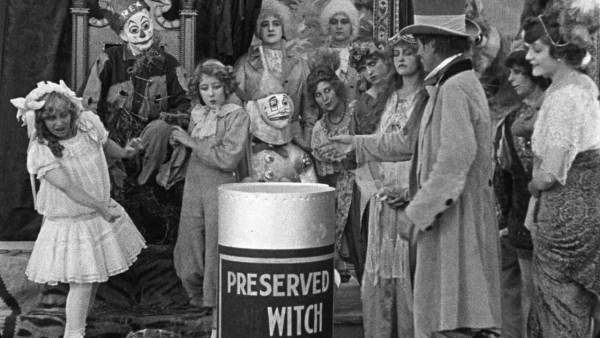
A girl’s beating heart freezes in a witch’s hand. An old woman sees a vision of the future while scrubbing laundry. A pile of cloth scraps reassemble themselves into a magnificent cloak. A band of adventurers vanish before a forbidding stone wall, only to rematerialize on the other side. Translucent fairies dance in a forest, magic spells fill rooms with smoke, enchanted cookware fixes breakfast, and petrified villagers become reanimated. Such are the spectacular visions on display in the moving image works of L. Frank Baum, one of the early twentieth century’s most popular and prolific children’s book authors, and the creator of the magical Land of Oz. His film adaptations of his fantasy stories demonstrate the syncretic relationship between Oz and cinema, two realms where technology and magic bear little distinction. At a time when the innovations of industrialization and urbanization were still drastically impacting the realities of human life, Baum’s Oz films emphasize that cinema’s only technological utility was its capacity to enchant.
Following the wild success of his novel The Wonderful Wizard of Oz (1900), wherein a tornado whisks little Dorothy from dreary Kansas to a magical realm of excitement, Baum wrote 13 more books set in the Land of Oz. Each one expands the wild terrain, curious creatures, and rich lore of his fantasy world. A tireless enterpriser, Baum was not satisfied for Oz to be relegated to the page. After mounting a smash hit “musical extravaganza” (1902) adapted from The Wonderful Wizard, Baum strove to find more ways to bring his fairy land to life. In 1908, Baum toured “The Fairylogue and Radio-Plays,” an ambitious multimedia show featuring live performance, films enacting scenes from the Oz books, and illustrated slides. The elaborate production was a commercial failure despite favorable newspaper coverage, consigning Baum to bankruptcy. In an effort to manage his finances, Baum sold his Chicago home and moved to Los Angeles, where he established the Oz Film Manufacturing Company with the backing of wealthy friends. In 1914, he churned out three feature-length fantasy films in a span of four months: The Patchwork Girl of Oz, The Magic Cloak of Oz, and His Majesty, the Scarecrow of Oz. They initiated one of American cinema’s most enduring preoccupations. From MGM’s classic The Wizard of Oz (1939) to the Wicked (2024) blockbuster franchise, Oz continually serves as a showcase for Hollywood storytelling and spectacle.
Baum was making movies during a transitional period in cinema history. His films fell after the reign of what scholar Tom Gunning calls the “cinema of attractions,” the period from 1896–1906 when short, single-take films aimed to stimulate and shock dominated the moving image landscape. They appeared on the cusp of narrative cinema’s hegemony, when feral attractions were domesticated by story, continuity editing, and feature-length runtimes. The length, story structure, and world-building capacities of Baum’s films align them with narrative cinema, yet they also maintain a deep-seated allegiance to the logic of attractions. In the 1890s, Baum worked as a window dresser and authored “The Show Window,” a monthly trade journal with detailed instructions on the craft of dazzling shop windows. It taught readers all manner of effects employing tools like animatronics, lighting, set design, mirrors, and trap doors. The Oz novels, though driven forward by plot, deprioritize narrative in favor of a chain of marvelous, eccentric set-pieces. Some of these scenarios deliver a degree of conflict or character development, but their primary purpose is to provoke wonder and amusement. Take, for example, a chapter of The Patchwork Girl of Oz (1913) titled “The Trick River,” wherein four Ozians encounter a river whose current continually switches direction. The Trick River functions similarly to the “tricks” of early cinema, special effects that “trick films” were designed to showcase. Though the river presents an obstacle on the characters’ journey from one part of Oz to another, its narrative purpose is secondary to its role as a delightful curiosity.
Baum brought this propensity for tricks to his filmmaking practice, and repeated instances of playful visual deception form a core element of his works’ appeal. Yet at the time of the “Fairylogue” production, he made a distinction between his films and trick films. In a 1909 interview with the New York Herald, he describes a few standard photographic illusions: “These are common instances in trick photography...but in fairy photography, it is more subtle; different effects have to be obtained, and one’s ingenuity is often taxed in arriving at them.” The differentiation Baum attempts to cleave between trick photography and his own “fairy photography” has little to do with the actual mechanical processes of either. Though Baum had plenty of technical ingenuity, he was not an inventor and none of his special effects are truly innovative. But his words speak to the necessity in 1909 for art to use technology in new ways. As Gunning emphasizes, early cinema audiences went to the movies to “see machines demonstrated.” Once they understood the machine and trick films fell out of style, what more could cinema do? Baum’s notion of “fairy photography” serves a clear marketing purpose, to convince audiences of the novelty of the cinematic experience he was selling. Yet it also suggests a unique cinematic aspiration from a time before the film industry dedicated its energies almost entirely to narrative, and when the question of what was to become of cinema was undetermined.
In his essay “An Aesthetic of Astonishment,” Gunning describes a common practice of the earliest film exhibitions in which projectionists would hold on a still image, creating a moment of suspense before the picture broke into movement. This coming-to-life was a dramatic, self-referential flourish that conjured a “magical metamorphosis” for the audience, rather than a “seamless production of reality.” Baum understood the life-giving capacities of the camera and leveraged them in his moving pictures. For the “Fairylogue”’s first grand illusion, an Oz storybook appears on screen. Fairies open the book to a picture of Dorothy, who suddenly alights from the page. The fairies continue turning pages to reveal new characters, and the magical feat repeats until a group of beloved literary figures have gathered, summoned to the screen. Baum and the early projectionists positioned the cinematic machine in reference to older cultural technologies, photography and literature. There’s a boastfulness to their presentation of the movie camera’s abilities, a presumption that it can accomplish all that its predecessors can, but better. In “The Show Window,” Baum articulates the difference between a newspaper ad and an attractive shop window: “The newspaper advertisement says: ‘We have goods to sell.’ The show window says: ‘Here they are!’” The “Fairylogue” coming-to-life sequence functions as a loud “here it is!” for Oz magic that the latter delivered to audiences in an enhanced, visceral mode.
Gunning explains how the moment of vitalization in early film exhibitions created a conflict in the viewer, who was confronted with a vision of reality that they knew was an illusion. As audiences grew accustomed to this paradox, it became less integral to the moving image experience. Likewise, Baum’s cinema concerns itself not with reality but with vividness, the potency of life. Like in early cinema, one of Oz’s primary attractions is its ability to grant life to the inanimate. Plants, animals, and commonplace objects are granted full powers of thought, speech, movement, and agency, and when magic occasionally stupefies life, it is always restored. This abundance of life is one of the key distinctions between Oz and the real world and was of more pertinence to Baum than the tension between reality and illusion. Indeed, far from remaining an unattainable dreamworld, Oz becomes increasingly real to Dorothy as the novels progress. In The Emerald City of Oz she moves there permanently, forever transgressing the ostensible barrier between realms. Cinema could help audiences achieve this as well.
Baum’s worldview was informed by theosophy, a belief system that embraced science while also placing faith in an unseen, mystical world. For him, fantasy and reality were highly integrated, as were magic and technology, forces that work together in Oz to contrive continuous encounters with the strange and marvelous. Motion pictures had the ability to do the very same thing, making life bigger and wilder for those who were watching. Baum’s films were attempts to gently repurpose the cinema of attractions from momentary diversions to the very substance of living. The films lack the “aesthetic coherence of traditional art and culture” that Gunning warns goes against cinema’s natural inclinations; the “Fairylogue” is a concatenation of multiple stories and forms, and the 1914 films unfold with a mirthful chaos that obfuscates the story. The attractions are, however, presented inside a fairy world that possesses some consistency from film to film, and that with the aid of moving image technology, could impart its vividness to the audience’s reality.
An ad for the Oz Film Manufacturing Company’s features declares that they are the “ORIGINAL Creations of the World’s Greatest Living Author of Fairy Tales, L. FRANK BAUM, who has infused Oz films with the rich, red blood of his imaginative genius...OZ FILMS are transferred direct FROM BRAIN TO SCREEN, with all their wealth of Illusions, Marvels, Transformations, Legend, Love and Laughter.” The hyperbolic language has an obvious commercial agenda. Then again, ever since “The Show Window,” advertising was always closely intertwined with Baum’s art, and the ad sheds light on Baum’s conception of the powers of cinematic technology. Although the films are literary adaptations, the ad does not read “from page to screen,” but rather “from brain to screen.” This line shows faith in moving images as a true repository for figments of the imagination. It’s as if film’s status as media has been negated and cinematic projections simply pour from the mind. Children were always Baum’s primary audience. As he writes in the introduction to The Wonderful Wizard of Oz, “every [child] has a wholesome and instinctive love for stories fantastic, marvelous and manifestly unreal.” Cinema shares this “instinctive love” and cinematic technology, with its deep affinity for the imaginary, returns viewers to a child-like state of perception that continually seeks the unreal, on-screen and off.
In his essay “The Myth of Total Cinema,” theorist André Bazin puts forth the idea of “integral realism” as the ultimate dream of cinema that will be gradually approached through technological and creative progressions. By “integral realism,” Bazin means the camera’s ability to reproduce images as the eye sees them, along with the sensorial accuracy of elements like color and sound. But his concept of realism is more flexible than at first it may seem. For example, in “The Ontology of the Photographic Image,” he accommodates the reality of surrealist photography, deeming it “a hallucination that is also a fact.” He also rejects science and innovation as the primary agents of cinema’s development: “[T]he cinema owes virtually nothing to the scientific spirit...The fanatics, the madmen, the disinterested pioneers...are neither industrialists nor savants, just men obsessed by their own imaginings. The cinema was born from the converging of these various obsessions...” To further distinguish the notion of realism, it is not men’s obsessive “observations” that drive them towards cinema, but the visions swimming inside the mind. Perhaps it is not the exterior world’s reality that cinema is increasingly able to capture, but the mind’s reality. Cinema conditions us to see the world with our mind’s eye, with all its distortive, speculative, and fantastical tendencies.
In “An Aesthetic of Astonishment,” Gunning references Soviet writer Maxim Gorky’s account of an early Lumière brothers exhibition, in which he expresses existential despair with the replication of life onscreen:
Yesterday I was in the kingdom of shadows. If only you knew how strange it is to be there. There are no sounds, no colors. There, everything—the earth, the trees, the people, the water, the air—is tinted in a gray monotone: in a gray sky there are gray rays of sunlight; in gray faces, gray eyes, and the leaves of the trees are gray like ashes. This is not life but the shadow of life, and this is not movement but the soundless shadow of movement.
Oz readers may sense an uncanny feeling reading this passage, as it bears some resemblance to the first chapter of The Wonderful Wizard of Oz:
[Dorothy] could see nothing but the great gray prairie on every side...The sun had baked the plowed land into a gray mass, with little cracks running through it. Even the grass was not green, for the sun had burned the tops of the long blades until they were the same gray color to be seen everywhere. Once the house had been painted, but the sun blistered the paint and the rains washed it away, and now the house was as dull and gray as everything else. [The sun and wind] had taken the sparkle from [Aunt Em’s] eyes and left them a sober gray; they had taken the red from her cheeks and lips, and they were gray also.
Reading the excerpts side by side has a disorienting effect, and calls the alignment between the magical, technological, vivid worlds of Oz and the movies into question. Does cinema vivify life, or simply recreate the gray reality we strove to escape from? The 1939 film emphatically argues the former. Dorothy steps into Oz’s Technicolor dreamworld in the same way that one loses oneself in a movie, both lives made infinitely brighter and richer for it. But film’s inherent propensity for tricks complicates any definitive answer. A screening of an AI-altered version of the MGM film at the Las Vegas Sphere this summer inspired widespread critiques of perverse technological overreach. What’s apparent, however, is that the dissatisfactions and inspirations cinema provokes in one age determine the evolution of the medium in the next. The technology of filmmaking is less a technical process than an imaginary one, dependent on how cinematic projections interact with our fantasies, and how close or far away from Oz we feel ourselves to be.