Vertical Integration
By Kathy Ou
Zi
Dir. Kogonada, U.S., Grasshopper Film
Kogonada once stated that his love for cinema is “rather existential.” After breaking through with his incisive, succinct video essays, which found ways of thinking through cinemain everything from Vittorio de Sica’s tendency to linger on in-between moments to the minutiae of hand gestures in Robert Bresson’s films, Kogonada has since made the critic-to-filmmaker transition. His features—Columbus (2017), After Yang (2021), and, most recently, A Big Bold Beautiful Journey (2025), a Sony-produced romantic fantasy starring Margot Robbie and Colin Farrell—have taken him from the contemplative margins of independent cinema to the machinery of Hollywood, though the latter film's commercial failure hardly suggested a triumphant arrival. “Cinema is to me what architecture is to Casey,” he said to The Believer, referring to the protagonist of Columbus. “When Casey feels she’s suffocating, architecture allows her to gather a sense of life.” If the demands of studio filmmaking have—like academia's earlier demands—threatened to estrange him from this sustaining relationship, Zi feels like an attempt to recover it.
A meandering drama set in a dreamily eerie Hong Kong still shadowed by its colonial history and the more recent National Security Law, the film finds Kogonada coming back to the freedom of independent filmmaking, while forgoing the narrative or emotional clarity of his earlier work. For an early Kogonada fan, this is a welcome return to the filmmaker’s indie roots. Created moment by moment through guerrilla filmmaking enabled by the trust and micro self-financing between Kogonada and his small cast and crew, the film has a spontaneous and present quality that recalls some of cinema’s greatest city films (such as those by Wong Kar-wai, Wim Wenders, and Agnès Varda). No synopsis could adequately summarize what’s going on—partly because the film is neither plot-driven nor clear in its backstory. Shot by Kogonada’s longtime collaborator Benjamin Loeb in lush 16mm color, the film juxtaposes tilted close-ups with equanimous wide shots of Hong Kong’s layered cityscapes, regularly puncturing linear narrative time. Meanwhile, our protagonists traipse around the city in search of something neither articulated nor made urgent.
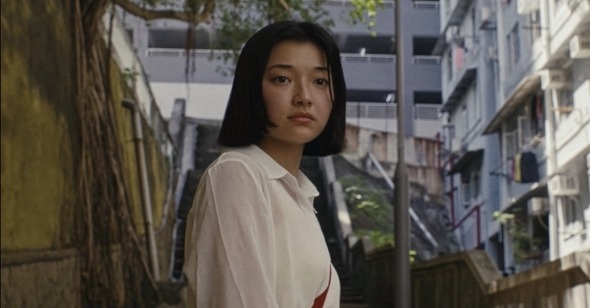
This disorientation mirrors that of our heroine, Zi (Michelle Mao), a young violinist whose peculiar condition causes her to see visions of her future self. In an early scene, she pays a visit to her late parents’ graves after learning she may have a brain tumor and canceling touring plans with her orchestra; the camera tracks her closely from behind as she navigates streets, overpasses, and up the stairs of a towering cemetery on a hillside dense with nearly identical tombstones. As Zi ascends to her destination, the camera slowly zooms in on her face, staring intensely offscreen. We then see a reverse shot where the profile of a small figure looking exactly like Zi already stands amidst the gray structures, placing the bouquet onher parents’ graves. The next shot assumes the POV of this Zi from slightly ahead of time, as she lays the flowers and stares back to where she just was, now empty. This technique recurs throughout the film, playing with perspective like a game of catch, the tight framing as destabilizing as the wide shots, which are not always clear in terms of whose perspective it is channeling and from which point in time.
During an emotional breakdown on a neighborhood staircase, Zi meets Elle (Haley Lu Richardson), a wandering American who takes an interest in Zi, and the two begin roaming through the city together. They are later joined by Min (Jin Ha), Elle’s ex-fiancé, who works at a local neurology center and whose knowledge of Zi’s condition is gradually revealed. Elle initially appears to be the sort of manic pixie dream girl whose sole narrative purpose is to guide a troubled protagonist out of her stupor, or at least accompany her through it, yet Kogonada makes effort to complicate her. Almost everything she does—from following Zi and offering unsolicited help, to collecting the sounds of Hong Kong for an unspecified art project—seems like an elaborate coping mechanism against her thwarted ambitions as a dancer back in New York. She confesses that she moved to Hong Kong to escape the weight of that shadow, hoping for an anonymity that her gauche blond wig and hipster cowgirl outfit scream against. Min, by contrast, offers a more grounded counterweight, though his own history with Elle and his ambivalence about returning to Hong Kong are similarly dispensed in fragments. Each of these characters’ frustrations and their particular relationships to Hong Kong are slowly unveiled over the film’s 99 minutes, though the filmmaker’s own self-imposed constraints often lead to a psychological opacity.
Perhaps this emotional remove is reflective of Hong Kong, whose identity has always seemed to elude grasp, its future repeatedly deferred and its self-determination interrupted by colonial powers and larger geopolitical forces competing to claim it. Kogonada's Hong Kong is at once familiar and estranged. The city's instantly recognizable skyline and dense urban expanse appear in sweeping, high-angle compositions, recalling the image of Hong Kong as it circulates in the popular imagination. More evocative are the quieter views: pedestrian walkways, narrow alleys, residential blocks, and the overlooked urban pockets where ordinary life goes on, largely undisturbed by the city's spectacular verticality. Often held in still, contemplative frames against the ghostly, piano-led compositions of the late Ryuichi Sakamoto, these buildings acquire a life of their own, their windows and facades bearing the accumulated traces of lives we can only imagine. As dusk settles and the city gradually lights up, Kogonada's camera lingers on its surfaces with an almost documentary attentiveness, as if trying to apprehend something that a panoramic view can never quite contain.
There is, perhaps then, a political resonance in the film’s portrait of Zi, played by Mao with an affecting mixture of confusion, alienation, and helplessness. She is the only local among the protagonists, yet she's also the one with the least agency: orphaned, neurologically disordered, and increasingly dependent on dubious strangers to explain her own experiences to her. Even her relationship to Hong Kong remains elusive, as she refuses to answer when Elle asks whether she was born and raised there, despite acknowledging it as her home. But we can infer from the clues: at her parents’ graves, she speaks to them in fluent Mandarin, while her inner monologues and conversations elsewhere move between Cantonese and English. She may have been born in Hong Kong to mainland migrant parents, or perhaps she arrived from the mainland as a child—either way, her linguistic life suggests an identity assembled across borders, just like her two companions. Min, too, spent formative years of his early life in Hong Kong despite being born in Korea. Having once left for what we can assume is the United States, he is reluctant to come back and ultimately chooses to leave again. Zi has no such exit. In the opening montage, a crimson necklace bearing the inscription 自由—freedom—rests against her chest, an almost cruelly ironic emblem for someone so thoroughly dispossessed of agency. As she moves between competing versions of the present and future, she seems trapped not only in time but also in a place whose own future remains difficult to imagine.
If Zi never quite grants its characters full interiority, it nevertheless captures the alienation of living in a city suspended between histories and futures, between the desire to belong and the inability to determine what belonging might mean. Its images are often more eloquent than its people, and its atmosphere more fully realized than its drama. Perhaps it is in this lingering over what resists resolution that Kogonada gives form to his existential attachment to cinema. Zi is a frustratingly incomplete portrait, but its scattered glimpses of a city—and of the lives unfolding within it—attain a fragile, haunting beauty.