Trust in Me
by Michael Koresky
You Can See Everything
Dir. Nathan Fielder and Lance Oppenheim, U.S., A24
In her 1960 essay “Cinematography: The Creative Use of Reality,” Maya Deren argued for the very concept of realism in film as an “absurd redundancy.” Sixty-six years later, we’re still trying to deny this absurdity. One can understand why Deren, whose films so radically denied any adherence to verisimilitude in favor of pure psychological nonmateriality, would believe that, at the tail end of the 1950s—with its preponderance of serious-minded middle-brow stage adaptations starring method-trained actors plumbing their depths of their lived experience—“the invasion of the motion-picture medium by modern playwrights and actors introduced the concept of realism” and that this has “served merely to deprive the motion-picture medium of its creative dimension.” Furthermore, according to the filmmaker and scholar, “As a reality, the photographic image confronts us with the innocent arrogance of an objective fact,” and this image “exercises an authority comparable in weight only to the authority of reality itself.” She continues, “It is upon this authority that the entire school of the social documentary film is based.”
One might argue that Deren’s words carry less weight in our moment, when the documentary has taken many disparate forms and can hardly be categorized as a phenomenon with a single-minded social function. But from the heights of prestige nonfiction to the corners of hybrid experiments to the documentary’s more disreputable corners, such skepticism remains central. The question of what is real—and therefore what, and who, is to be trusted—forms the gut of Nathan Fielder’s works, most of which have been documentary in basic form, and completely, insistently untrustworthy as such.
The Canadian writer-director-performer’s Nathan for You, which ran on Comedy Central from 2013 to 2018, was what we call a “reality series,” which of course has come to mean and be widely understood as a series with very little basis in reality. The show gave Fielder the chance to flaunt both his Bachelor of Commerce business degree and his singularly unsettling screen presence, alleging to assist actual small-business owners in revamping their struggling companies with bizarre and frequently beyond-the-pale marketing schemes. Making his own performative maladaptation the center of the joke, Fielder was not only satirizing the anything-for-a-buck competition at the heart of capitalist “strategic thinking”—and those who might submit to its worst tendencies in front of a camera—but also his own authority and untrustworthiness.
The first episode of the second season centralizes the question of honesty, as Fielder partners with car mechanic Greg Boodaghian, whose profession is frequently stereotyped as the province of liars. Fielder pitches the idea that Boodaghian hook himself up to a polygraph machine for his customers, proving he’s telling the truth about his prices, and thereby touting himself as the only honest mechanic in town. (Boodaghian semi-failed Fielder’s earlier honesty test when he claimed to sort of like a batch of terrible cookies Fielder had baked.) Such well-laid plans derail when Fielder submits to a polygraph himself, denying to multiple exam givers that he watches internet pornography and blaming old Windows operating systems for the needle going haywire. The segment climaxes with Fielder asking Boodaghian if he would want to hang out socially; the honest mechanic says no.
The human capacity and tendency for lying, along with the social fascination and anxiety it breeds, continue to be central concerns of Fielder’s work. His HBO series The Rehearsal, a remarkable and riotous fantasia of neurotic self-incrimination, is initiated by the fear of being caught in a lie. In the pilot episode, Brooklyn bar trivia guy Kor Skeet tells Fielder that he lied to his teammates that he had an advanced degree and is nervous to tell the truth, fearing their disappointment and ostracization. So, Fielder will help Skeet deal with his apprehensions by building a perfect simulacrum of his local bar, where he can rehearse coming clean and thus practice for—and try to cut off at the head—any contingencies and emotional difficulties he might face. (During a practice run, paid actors playing bar patrons overhear Skeet confessing his lie and murmur in earshot, “This guy is such a fraud.”)
No matter how many simulations you construct, of course, or how many flow charts and decision trees you design to avoid pitfalls and skirt misunderstandings, you can’t really alter the unknown path. The self-defeating convolutions inherent in trying to control reality become a central point of The Rehearsal. Fielder loses sight of himself—as we all do—in the hall of mirrors. As in Nathan for You, his rarefied, obsessive-compulsive methods and pronounced social awkwardness always end up thwarting his attempts—or, rather, those of his character, Nathan Fielder, we think—to make friends and get his own fears and phobias in order. Whether Fielder is to be trusted—by the guests who have agreed to appear on his “reality series” or by us as the viewers who might wonder who this guy really is—has long been his work’s implicit side premise.
*****
You Can See Everything, which Fielder has been constructing in secret for the past three years with co-director Lance Oppenheim, extends his concerns into even more richly ontological territory, building upon Fielder’s interventions on televisual reality and evoking Maya Deren’s exquisite suspicion about the possibility of cinematic realism at all. Fielder and Oppenheim complicate their endeavor by making what might appear to be Fielder’s most straightforward “documentary” yet. Philosophical and thematic resemblances to Fielder’s previous work aside, the film isn’t comically tricked-out; the faux-maudlin music cues and self-conscious “teaching moments” of his television series, which satirized the format of reality TV, are entirely missing, and there is more intimacy and restraint here, as well as a reliance on extended scenes and camera takes. This is in keeping with the work of Oppenheim, whose nonfiction films have seemed to question the notion of the “observational” documentary as they follow people on society’s margins, whether unregulated sperm donors, retirement community denizens, or Renaissance faire re-enactors. However, this time, Oppenheim and Fielder are not setting their sights on unknown, everyday folks who aren’t well-versed in how to behave or position themselves in front of a camera.
Because of her notoriety—and because she has already been the subject of documentaries, news program episodes, fictionalized series, and podcasts—Elizabeth Holmes may seem like a surprising choice of subject for these filmmakers, but she fits squarely, even epically, in the Fielder mold. Business fraud was an underlying theme to much of Nathan for You, as Fielder’s suggestions and schemes often flirted with illegality, intentionally putting himself in harm’s way and others in the role of the mark. A scammer on a considerably vaster scale, Holmes is primarily known for inventing Theranos, a supposed miracle medical technology that would allow consumers to home-diagnose a variety of medical ailments with just one drop of blood. The fanciful device was a pipe dream, yet Holmes’s Silicon Valley startup, founded in 2003 when she was just 19 years old and run with partner and company president Sunny Balwani, raised hundreds of millions of dollars from investors, resulting in one of the most widespread instances of defraudation in modern history. Years of allegations, investigations, and lawsuits resulted in Holmes’s net worth dropping from an estimated $4.5 billion to practically zero. In 2022, she was convicted of fraud and sentenced to eleven years in a federal prison camp.
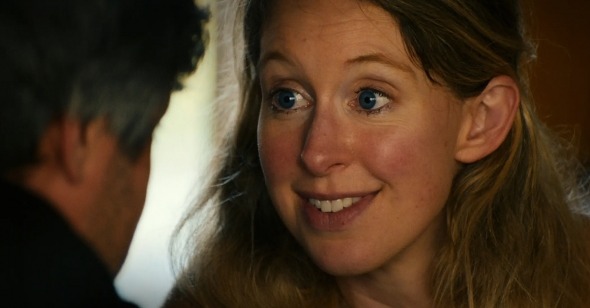
You Can See Everything begins in early 2023, 34 days before Holmes’s prison sentence will commence. Unlike other reportage-heavy, animation-laden, faux-ruminative documentaries that have been made about her, Fielder and Oppenheim’s film avoids explicitly sensationalistic broadsides and images, favoring an approach we might still term “vérité” until a better one comes along. The filmmakers burrowed in at home with Holmes and Billy Evans, her unsettlingly loyal partner and the father of her two children, with Fielder appearing on-screen as interlocutor and conduit to Holmes and Evans. More than in his past projects, he is also a sort of audience surrogate: like Fielder, we’re scrutinizing the scene, analyzing and interpreting her cadences, mannerisms, and wide eyes (soulful, pleading, or frozen?) for signs of distortion or chicanery. Holmes, unflaggingly cheer-led by Evans, insists she never lied about Theranos, never knowingly defrauded anyone, and that her intentions were always pure; she goes so far as to refuse to admit that she has ever lied, and that her most consistent core quality is her honesty. “I’m always being real,” she maintains. Fielder occasionally pokes and prods with incredulity, but, throughout the first half of the film, set within the confines of Holmes’s gloomy beachside house, he mostly inhabits the role of intrusive, needling pal.
Fielder’s presence also becomes rather curious: what exactly is he doing here? Is he lying to Holmes and Evans to get closer to them? What does he want out of this situation? A confession of guilt? If not, then is it something more personal? Equally vexing and central to the experience of the film is the question of why these two people, so obsessively preoccupied with how she’s perceived in the media and on screen, would allow this comedian—known for television programs that are often described for their “cringe” humor and proclivity to put people in somewhat mortifying situations—to film their family at all, let alone at such an emotionally loaded, fragile moment. Fielder explains the provenance of the project, but it’s fascinatingly, suspiciously perfunctory—they claimed to have enjoyed some of Fielder’s bits they saw on YouTube—leaving the basic conceit of the film as surreal as the winding, zigzag narrative will prove to be. By inviting Fielder and crew into their home, they’re not only encouraging a close-quarters discomfort (befitting their evident narcissism) but also subordinating themselves to his fixed, unsparing camera, agreeing to be players in Fielder’s ongoing anthropology project.
Fielder is fascinated by the performance of truth and what arises from awkward situations enabled by the camera, which can either expose or conceal people’s dubious instincts or blind spots. In an instant-classic scene, Fielder sits Holmes down to watch Abbott and Costello’s paradigmatic “Who’s on First?” comedy routine, which she claims to never have heard of. Her professed inability to conceptually follow the joke becomes yet another Rorschach: does she lack a basic logic function? Does she just not have a sense of humor? Or maybe she’s just not generationally keyed into vaudevillian wordplay? Or perhaps she’s playing dumb, one more way to erode her previously well-honed media image as a high-tech, cutting-edge businesswoman?
Holmes is a compelling figure for many reasons, especially for having created an invention that, never actually having been invented, exists solely in the collective mind. Even less intellectually or aesthetically exploratory films about her saw the self-evident metaphorical value in her persona. Alex Gibney’s HBO documentary The Inventor: Out for Blood in Silicon Valley, made in 2019, three years before her trial conviction, featured pensive voiceover narration asking things like: “Was Elizabeth lost in a landscape between what she could make real and the world of make-believe?” You Can See Everything leaves such ponderousness to the imagination. Fielder is interested in Holmes’s credibility as a matter of human expression rather than legality. He doesn’t appear to think that she owes us anything, even the truth; it’s not a film about debt-paying—her imminent jail sentence, the structuring principle of the first half of the movie, takes care of that. Instead, he talks to her, intently, up-close, something between a predator and a bosom buddy, his line of questioning betraying his curiosity about her romantic partnership with Billy, her motherhood, her relationship to the camera.
What does he want—what does he need—to know? Fielder’s works thus far have alighted upon many topics, but there’s a distinct monomania to them; they’re usually as much about him and his preoccupations as the subjects at hand. This is borne out in You Can See Everything: Fielder is the stealth protagonist, his seeming search for authenticity in Holmes’s life doubling as a search for meaning in his own. Because of this redirect, Holmes, a woman who had been so often called a “disruptor” (for being the country’s most powerful woman entrepreneur, for questioning the basic premises of the medical establishment in advocating for a revolution), is brought closer to earth than previous films about her have allowed. That doesn’t mean this eye-to-eye portrait is “sympathetic,” but it is undeniably humane. Just as Holmes resists any overtures to inquisition, the film resists capitulating to her pleas of innocence, content to swim in the sea of the unknowable.
With Fielder as our guide through these choppy waters, this extraordinary film challenges the notion of objectivity in documentary—but it also dismantles common notions of subjectivity, confronting us, per Deren, with the innocent arrogance of an objective fact. As the film proceeds, You Can See Everything equally engages with the limitations of nonfiction and the shaky morality of fiction, typified here by the 2022 Hulu miniseries The Dropout, a dramatization of Holmes’s life starring a plummy-voiced Amanda Seyfried that often veered into social satire and behavioral extremity. At one point, Fielder has Holmes and Evans watch scenes from the series, which won Seyfried an Emmy, in bed. A teary Holmes finally has to close her laptop while Evans asks Fielder and the cameras to leave the room so he can comfort her. We may wonder if her tears are “genuine,” but there’s no question that the cultural exploitation is real.
In rather surprising fashion, The Dropout will prove to be an essential element to Fielder and Oppenheim’s film, which feels like it’s being invented on the spot as it goes along, but in the best, richest way possible. Fielder and Oppenheim agreed to enter this arrangement in 2023, not knowing what rabbit holes it would take them down. Holmes herself remains the central figure, but as the film drifts into a duck-and-weave second half that’s best left unspoiled for the viewer, she becomes more of a haunting presence. The focus shifts to others, including one person very close to her who maintains control over her image and keeps her avatar alive as a kind of social media warrior. These developments deepen a film that, for all its metacinematic curls and coils, ultimately is about the inscrutability of human relationships: between husband and wife, between director and subject, between viewer and screen. Is the Holmes we’re watching a character that Fielder and Oppenheim have created? Or have their cameras simply captured her?
Fielder and Oppenheim know that the pursuit of the real never allows for such easy answers. They also surely know, as Maya Deren did so many decades ago, that documentaries are still, and always will be, only as effective, interrogatory, or meaningful as our individual perceptions allow. We may all know, on some level, that realism in cinema is an “absurd redundancy,” yet this doesn’t stop us from scanning the screen for evidence of truth. Even the most skeptical among us wants to “believe” something. Otherwise, why are we dupes still watching?