Judgment Day
By Matthew Eng
Fjord
Dir. Cristian Mungiu, Romania/France/Norway/Denmark/Finland/Sweden, NEON
As a woman is coolly told that her five children are to be removed from their home and placed in state custody, the viewer’s eye wanders, as intended, to the windblown Norwegian flag hanging prominently outside the living room window. This clumsy, hectoring image is emblematic of Cristian Mungiu’s Fjord, a dour dramatization of a real-life incident from the mid-2010s in which the Bodnarius, an Evangelical Christian family of mixed nationality, were torn apart by allegations of child abuse upon moving from Romania to a hamlet in the mother’s native Norway. A court case ensued, during which representatives of the Barnevernet, the controversial public agency that oversees child welfare, claimed that there was a pattern of abuse in the family; the Bodnarius insisted that they were being persecuted on religious grounds.
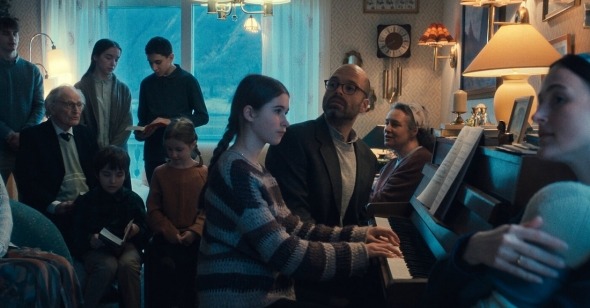
Mungiu’s second Palme d’Or–winning feature transforms this clan into the Gheorghius, led by Sebastian Stan’s bald and brooding Mihai and Renate Reinsve’s demure and bespectacled Lisbet, recently relocated to a placid, snowcapped village to be closer to the latter’s parents. They preside over progeny who shun new technology and popular media in favor of daily prayer and religious education. When two teachers at their new school notice a bruise creeping from cheek to shoulder on the Gheorghius’ eldest daughter Elia (Vanessa Ceban) and contact the authorities, the family’s children—including an infant son—are removed from the home and placed in foster care within days. Over the course of the film, the couple’s disciplinary methods and general parenting come under intense scrutiny. Are the slaps on the hand and rear that the Gheorghius abashedly admit to meting out to their children examples of harmless reproof or antiquated abuse? We are made to speculate whether Elia’s contusion came as punishment from Lisbet for an instance of roughhousing that nearly resulted in calamity; the precise nature of Reinsve’s physical reaction is carefully blocked out of the frame. Or perhaps the mark came from the exceedingly aggressive wrestling exercises that transpire in the girl’s gym classes, which we repeatedly witness. Mungiu desperately tips his hand with these vaporous choices, ensuring that the question of abuse is never so much an enigma as a blatant misunderstanding.
Jammed with minor characters and patchily connected incidents, Fjord induces a state of vague bewilderment that never entirely subsides. This shoddiness comes as a shock since Mungiu, a former journalist-turned-torchbearer of the New Romanian Cinema movement of the 2000s, has created some of this century’s toughest-minded and most transfixing socially engaged dramas, tackling hot-button issues such as abortion, xenophobia, and religious hysteria with a shiver-inducing sense of moral responsibility and a deceptively fluid directorial approach. It can be tempting to generalize his eye as artlessly clinical or his narratives as unequivocally straightforward for the sake of critical expediency, but there is always a caveat to these neat, totalizing descriptors. His previous film, the underrated R.M.N., memorably culminated in a mystifying, form-shredding sequence that recast its forthright portrayal of a small Transylvanian town divided by the presence of Sri Lankan migrants.
But Mungiu’s latest effort, his first made outside his native Romania, is a resounding misjudgment, one that unfolds with the subtlety of the avalanche that portentously plummets down a mountainside not once but twice in the film. It is challenging to disentangle Fjord itself from the critical debate that it has stirred since its Cannes debut, with its defenders alleging that critics betray their own biases by refusing to sympathize with the plight of religious conservatives or admit that left-leaning governments are as capable of discriminatory overreach as their right-wing counterparts. The loudest defenders have tended to be its makers, particularly Mungiu, who has decried the so-called “violence” of certain critics. He has maintained that his film has been misunderstood by bad-faith actors so beholden to political correctness that they are unwilling to engage with viewpoints other than their own and thus incapable of appreciating a film that is nothing but a “plea against all forms of fundamentalism.” At this year’s New York Film Festival, Stan warned audiences who run the risk of disliking the movie that they “have to remember that there’s more […] than just simply being right, and that doubt still serves a purpose and nuance is inherent to who we are.” But Fjord is not a disappointment for refusing to clarify its political allegiances; it is a disappointment because it is a limp and unconvincing oversimplification of a complex subject, a 146-minute finger-wagging that lacks the courage of its ostensible convictions.
Mungiu asserts that he has made an essentially ambiguous film, which the New York Times has characterized with predictable pomposity as an act of courage in our literal-minded age. In truth, he has stacked the deck overwhelmingly in favor of the family at its center. From Ellen Dorrit Petersen’s icily tactless social worker to Christian Rubeck’s glowering, self-satisfied prosecutor, the Norwegian antagonists are not so much characters as hastily assembled strawmen for a kind of fascistic progressivism that gladly infringes upon the rights of Mihai and Lisbet. Mungiu bifurcates the couple’s experiences in the aftermath of the family’s separation, blithely acknowledging Mihai’s embrace of the religious far-right in a handful of cursory scenes. We spend far too much time in the safe zone of Lisbet’s benevolent relations with a neighboring family, one of whose members, Mia (Lisa Carlehed), conveniently agrees to represent the couple in court. (It is a boon to the film that Carlehed is by far the ensemble’s most persuasive performer since she is also the one burdened with Mungiu’s fussiest speechifying.) In spite of Mihai, Mia forms a genuine bond with Lisbet; it is to Mungiu and Stan’s credit that they refuse to soften this patriarch’s repellent chauvinism.
Glancing, secondhand mention is made of Mihai’s homophobia via the one-man/one-woman definition of marriage that one of the children is alleged to have brought up in class. But ultimately Mungiu doesn’t care to interrogate or delineate these beliefs, lest it detract from his ardent defense of religious freedom, one predicated on a case of persecution so slanted as to render the opposition cartoonish from the start. Mungiu’s humanist impulses fail him here, as do, more troublingly, his directorial facilities. He has excelled at long takes of unbearable length in which sustained conversations between his characters reveal tensions that come to feel downright tangible, as if suspended in the increasingly stifling air they inhabit. These dialogues occur in Fjord but they are depicted with a bloodless competence that reduces Mungiu’s style to vapid self-parody.
There is more stomach-turning strain in the pauses that puncture the prosaic encounters of Mungiu’s totemic 4 Months, 3 Weeks and 2 Days than in any of Fjord’s leaden English-language scenes, particularly among the adolescent performers who flounder under Mungiu’s inability to credibly conjure their generation’s voices. There is a richer sense of history in the relatively brief quarrels between Graduation’s duplicitous doctor and his betrayed wife and conspiratorial mistress than in the solemn, edgeless anonymity of Stan and Reinsve’s interactions, their characters’ marriage emerging as the film’s most undernourished relationship. (It is especially strange that there is not a whiff of shared experience between these characters when one considers that this is Stan and Reinsve’s second time acting together, after Aaron Schimberg’s A Different Man.)
Just as Mungiu’s and Stan’s rebuttals to the press suggest artists intent on dictating the terms of their work’s interpretation, these narrative choices bespeak a filmmaker unwilling to trust his viewers to arrive at their own conclusions. Artists across mediums love to implore audiences not to place them on pedestals, but the defensiveness of Fjord’s makers clarifies that plenty of artists are quite pleased to talk down to us from these perches, to be regarded as emissaries of elevated consciousness. They are gratified to collect Palme d’Ors from international juries keen to cosign the idea of tolerance, content to bask in the commendation for their “passionate interest in society,” as one NYFF programmer summed up the thematic thrust of Mungiu’s career. Such platitudes befit Fjord, a film that makes an aggressive posture rather than a rigorous practice of achieving nuance.
Mungiu ends the film on a risible bid for pathos in which a dash of magical realism converts the character of Noora (Henrikke Lund Olsen), a wayward girl next door straight out of Degrassi: The Next Generation, into the family’s keenest disciple. Here, too, is a failure of dramatic vision but also of artistic nerve, a misplacement of the principle that has guided the most questioning and haunting of Mungiu’s works. This principle is not ambiguity per se, but the gut-level recognition that we are made to spend our lives tiptoeing across the constantly moving line that separates right from wrong. The only line that Mungiu cares to draw in Fjord is the one separating Us from Them.