Everything and Nothing
by Jeff Reichert
New York Film Festival 2026:
Life of Jorge Luis Borges
Dir. Mariano Llinás, Argentina, no distributor
Across the five and half hours of Mariano Llinás’s new triptych, Life of Jorge Luis Borges, we are given the opportunity to learn a great deal about the Argentine writer—major moments in his life, the places he once lived, the friendships he kept. Yet I’m struggling now, just a short time on from finishing the film, to remember much about Borges at all. In the same way that James Boswell has usurped in the collective imaginary the subject of the hefty biographical tome which made the Scottish writer famous, Samuel Johnson, Llinás’s documentary of the life of a writer he’s considered a lodestar since his teens is most notable for how it centers Llinás himself and his rangy, expansive artistic methods. (The end of Part One climaxes with Llinás cheekily pondering whether he’s following too closely in Boswell’s footsteps.) Could it have been any other way? The filmmaker’s last gargantuan offering, The Triptych of Mondongo, hinges, in part, on an aesthetic challenge—a duel—posed by the filmmaker to his titular protagonists, a notable Argentine art collective. Mondongo, fully exhausted after years of subjecting themselves to Llinás’s digressive process, flatly turn him down; the filmmaker went ahead and filmed his half of the duel anyway, making it the feature-length third chapter of an already distended work of nonfiction essaying. Where no one is asking, Llinás provides.
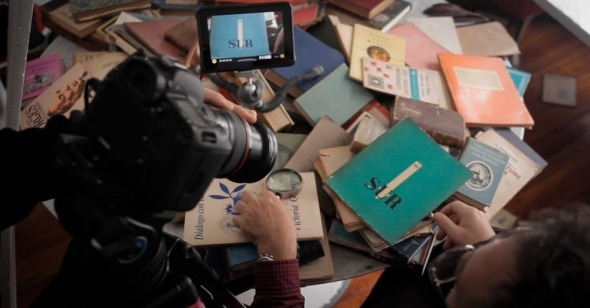
As with Mondongo, and to a lesser degree, La Flor, Llinás is the most important presence here, occupying space in the Venn overlap of ringleader, conductor and court jester. His is the voice we hear in the close mic’d, breathless, obsessive voiceover. Sometimes—often—his speaking is paired with images of the voiceover text itself filmed off computer screens, blocks of words streaming unbroken from one margin to the next, line after line, like a crackpot Laszlo Krasznahorkai. He appears regularly in frame, approaching-disheveled and hulking, as one of the film’s protagonists: hired by New York’s Institute for Studies on Latin American Art to create a film around a recently acquired trove of Borges related documents, the filmmaker character he plays, who, like his creator, pathologically cannot help himself, spins this brief into a globe-spanning investigation full of intrigues real and imagined. It’s also his hands, I’m quite sure, that rifle through the piles of faded and dusty physical texts by Borges and others, in images that, along with the continual return to text on screens, form one of the film’s most durable visual motifs. This kind of singularly focused, oppressive monomania should be terribly annoying, unwatchable even. If in the end, Life of Jorges Luis Borges scans as a quite lovable, occasionally frustrating, oddity/odyssey, this is due to Llinás’s ever-present wit, his adeptness at deflating pretension and the open-armed invitation he gives his viewers to peek into the conditions of the film’s making.
Llínas’s delightfully shoddy and ramshackle formal tactics place us on more than a few occasions in the small edit room of the film we are watching, a cluttered Premiere timeline occupying much of the frame, the editor Ignacio Cordino bemused, tucked in a corner. At one point, a musical motif we’ve become familiar with over the course of several hours is revealed, via a cut, to be the issuance of the director himself, banging out a handful of notes on a colorful toy xylophone. Late in the film, Llinás re-enacts his own memory of encountering an imposing statue in a town square, casting himself as the hair-slicked-back hero of a low-rent thriller—his mock seriousness is hilarious. But, maybe, we wonder as the sequence wears on, he isn’t fully joking? As with the other major works bearing the insignia of Llinás’s production company El Pampero Cine we find here that particular twinning of a winking conceptual audacity and grand ambition with an approachability of practice. These gargantuan works (which include the aforementioned films along with the wonders Historias extraordinarias and Trenque Lauquen) aren’t the result of massive budgets and huge teams. They seem to be a group of smart, cinema-besotted people who enjoy making movies with each other, and pushing limits collectively. “Handmade” is so overused in this moment to be near evacuated of meaning, but these films all feel, wonderfully, like things made by people, together in community.
As Llinás’s investigation continues, a twinge of dissatisfaction with his findings lances the film: Borges’s late-life flirtations with racism towards Argentina’s indigenous populations and Pinochet’s military fascism have been well-publicized, and are dutifully related here, but Llinás seems as troubled by the banality of the language employed in Borges’s love letters, or the discovery of records relating to his difficult divorce from first wife Elsa Helena Astete Millán, which document the writer’s attempts to punish her in the legal proceedings. He proposes his subject as essentially unknowable at the film’s outset, but he seems to arc by the film’s end towards the possibility that Borges, the man who conjured worlds within worlds, a miraculous library’s-worth of imagined texts that feel as tangible as those we might pick off a bookstore shelf, contained within just a few hundred pages of extant short stories, was perhaps just not all that interesting himself. This doesn’t upset Llinás’s project, which foregrounds the search above all. But for any viewers left disinclined towards Borges as the film reaches its conclusion, Life of Jorge Luis Borges ends with a moving eulogy for another artist entirely—the Argentine filmmaker Edgardo Cozarinsky who passed during the film’s production. Llinás always finds a way to have his cake, then gleefully reach for another.
Unlike The Triptych of Mondongo, where each new installment broke formally from the prior, inviting reflections on earlier events and introducing new strategies to chew on, Life of Jorges Luis Borges begins, establishes its world, and then avoids much deviation throughout. Sure, Laura Paredes (Llinás’s wife and a star of La Flor and Trenque Lauquen) shows up late to cheekily play Borges in a combative twilight years interview with a tabloid, but this clever scene is merely one of many variations on the central motifs, as opposed to a signal of a wholesale reshuffling of elements. The only real critique I might level at the film is that it’s doing so many of the same kinds of things, and quite well at that, so why not do more of different ones? It feels churlish to offer this in the face of a charming entertainment that, as it winds and wends, gives so much, and ultimately does land itself near the brand of labyrinthine fabrications that populate Borges’s texts. But it does leave a question: Will there come a moment when Llinás’s extravagant cinema of more than enough, will, finally, feel like it’s just too much? I certainly hope not.