You Got the Touch
by Michael Koresky
New York Film Festival 2026:
All of a Sudden
Dir. Ryusuke Hamaguchi, France/Japan, NEON
No one of moral conscience could argue with this: capitalism, which by definition runs societies on market competition and wage labor, destroys the ability of those societies, fueled by and preoccupied with the success of privately funded, profit-motivated institutions, to adequately care for their citizens. Another irrefutable idea: in caring for the elderly and those with severe memory loss, one should treat the patient like an individual, with care, directness, respect, and gentleness of touch, which is preferable to handling human beings as little more than bodies. Unfortunately, the major costs associated—namely, time and money—make it often unimaginable for such tender, loving care to exist outside of the plushest, most expensive facilities (and even rarely there), leaving its benefits, as with so many of life’s comforts, to those with means.
Ryusuke Hamaguchi’s new film All of a Sudden, unwieldy and aggressively humane, swirls around a lot of ideas and images for its 196 minutes—eldercare, the power of friendship, dubious experimental theater, end-of-life acceptance, spiritual transcendence, foot massages—but the central one it engages with, as expressed above in this review and often in the film, is the virtuous imperative for adequate emotional and physical medical care and the systemic impossibility of capitalist societies to realize it. As a moral fulcrum it’s strong, as a dramatic one it’s fragile.
In materializing these concerns, Hamaguchi’s film mostly tells rather than shows, putting its ideological and ethical commitments into the dialogue of its two main characters: Marie-Lou (Virginie Efira), the head administrator of a Paris nursing home devoted to treating patients with dignity and proselytizing to her staff about it, and Mari (Tao Okamoto), a theater director from Kyoto whose current production Marie-Lou attends one evening. The play centers on a monologue concerning psychiatric care reform in Japan written by a late-middle-aged actor, Goro (Kyôzô Nagatsuka), whose grandson, Tomoki (Kodai Kurosaki), a nonverbal teenager with severe autism, plays a crucial role, his unpredictable reactions and responses creating variable encounters with the otherwise staid theater audience. Marie-Lou is profoundly moved by Mari’s show, and afterwards, the two women embark on an extended walk-and-talk that reveals their spiritual commune and ease of connection: Marie-Lou had studied anthropology in Tokyo and speaks Japanese fluently, while Mari, a philosophy major from the Sorbonne, is proficient in French. The sudden and intensely felt friendship between these similarly named women becomes an intellectual and emotional balm for both. Also, as she reveals, Mari is dying of terminal cancer, making their evolving bond even more urgent, both for the lack of time they have to explore their budding friendship and for their circumscribed ability to provide mutual solace.
Hamaguchi’s film is primarily inspired by an existing methodology of care called “Humanitude,” which was invented in France in the late 1970s specifically for dementia patients. For those of us who have had to endure the pain of a loved one with memory loss languishing in a nursing home and being given the bare minimum attention by nominally paid hospital workers, the tenets of “Humanitude” are refreshing and aspirational: using the principles of gaze, touch, speech, and verticality, one can aim to preserve human dignity in the face of a tragically undignified disease. The human connection between patient and caregiver should ideally improve the ability to perform more basic functions in the former and help mitigate burnout in the latter. By focusing on overall emotional structure rather than the medical symptoms—holistic rather than specific, if you will—behavioral symptoms will ideally have less of effect on those suffering from the disease and those treating it.
All of a Sudden proceeds to narrativize its communiqué for Humanitude in unusually direct ways. Most memorably, in the already beloved/infamous “whiteboard scene,” set in a nursing home break room, Mari diagrams for Marie-Lou, her audience of one, the deleterious effects of late capitalism on society in general, circling around the argument that political systems based on the pursuit of profit create intractable boundaries between inside and outside, institution and nature, caregiver and patient, life and death. The increasingly convoluted diagram is both a gesture of affinity for Marie-Lou and an explication of the difficulty of realizing Humanitude’s positive effects within such political structures. At the same time, Mari’s professed belief in the power and comfort of art produced within late capitalist societies functions as a tacit justification for her own art and, by extension, a defense of the film we’re watching. Well performed by Okamoto, who convincingly plays the lecture as though making it up on the spot and even surprising herself in the process, the scene skirts the line between a rather artless Brechtian direct address and a humane plea couched in behavioral realism—it’s both scattershot and efficient, a bit ridiculous as a scripted dramatic moment, more moving and effective when considered as the film’s clearest realization of Mari’s desire to dissolve boundaries though performance, in this case between audience and character (this lecture is clearly not really for in-the-tank Marie-Lou).
In a more dramatically integrated but no less didactic manner, the film also creates a situation in which Marie-Lou finds herself at odds with members of her staff in promoting this philosophy of care, most specifically Sophie (Marie Bunel), a highly skeptical nurse whose objections represent the burdensome toll Humanitude’s hours and attention would take on labor. Sophie is positioned as Marie-Lou’s primary antagonist, and though Bunel tries to inject the role with nuance and subtle gradations that speak more to a pragmatic weariness than mere obstructionism, Marie-Lou—and Efira’s performance of her—is so beatific and undeniably righteous that Sophie comes off like a straw man for Marie-Lou’s efforts for reform than a genuine figure of debate. (In these scenes, the most conventional in the film, I was reminded of nothing less than Patch Adams.) Rather than provide Marie-Lou with an intellectual sparring partner, as Sophie may have been, the film gives her a kindred spirit with whom she can help refine and build her argument for Humanitude and its real-world application. In short order (things happen all of a sudden here because time is of the essence), Mari becomes Marie-Lou’s support and shadow as she aims to transform the facility, which means also taking inspiration from Mari’s play.
Humanitude is not the only motivation for Hamaguchi’s film, which was also inspired by a 2019 Japanese book consisting of letters between an anthropologist and a philosopher dying of cancer, the title of which roughly translates to “The Illness Suddenly Gets Worse,” also the Japanese title for the film. And indeed Marie-Lou and Mari’s tête-à-têtes, reflecting their mutual growing admiration, are Hamaguchi’s most persuasive element: the women’s therapeutic, teasingly homoerotic bond, an unforeseen human connection between two needy souls, becomes an ethereal expression of pure kinship wholly devoid of conflict that allows the film’s general lack of dramatic tension to feel more like a feature than a bug. The film breathes easiest during an idyll in Kyoto, when Mari takes Marie-Lou back to her hometown, overlooking a hilly expanse of countryside that finally brings us to Mari’s “outside,” a privileged, momentary repose.
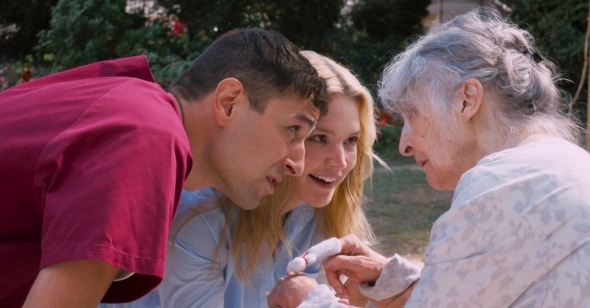
At other times, the film’s absence of moral complication (or self-critique) can be perplexing, especially in scenes involving Mari’s play. Tomoki (played by a non-autistic actor, it must be noted) is unquestioningly exploited as an agent of chaos, a known unknown unleashed to interrupt his grandfather’s monologue, his disability deployed as a confrontational theater device and his body a site of rupture. Subsequently, when Marie-Lou later brings Mari’s play to the nursing home, with Goro and Tomoki performing in the courtyard for an audience of dementia patients, Tomoki is again a crucial, interrogatory part of the show. Overall, the film—like Marie-Lou, like Mari, like Goro—feels so confident in its philosophical aims that when the play devolves into a spontaneous, orgiastic foot massage that sees patients and caregivers splayed over the lawn in an extreme expression of Humanitude’s belief in the healing power of touch, this climax, however compellingly absurd, comes across as little more than one final teachable moment. Recalling Mari’s lecture, boundaries have dissolved between patient/caregiver, inside/outside, and audience/performer, yet here the barrier between the screen and this viewer, at least, felt re-fortified by impenetrable conviction.
Hamaguchi’s past films have tended to see identity as mutable and even metaphysical. From Asako I & II to Drive My Car to Wheel of Fortune and Fantasy, what characters do and how they manifest are contingent on environment and experience, and personalities shift as easily as the weather; Evil Does Not Exist was the outermost expression of Hamaguchi’s rejection of a socially defined version of selfhood, as its initial realism gave way to a spiritual abstraction that dispersed its characters, hampered by the evils of profit and capital, back to the winds of nature. That film left some viewers scratching their heads (I rewound the end of the film three times to try and fully understand what was happening spatially and narratively); his latest, however, leaves little room for confusion or ambiguity. The film’s various satellite characters exist to reinforce the film’s advocacy and to bolster Marie-Lou and Mari’s certitude: from scowling Sophie, to Goro and Tomoki, to the generalized, nonspecific patients at the nursing home (who might have been given more screen time and context to better elucidate the effects of Humanitude), no one serves to complicate the debates around treatment, which might have made for a more dialectical, dramatic experience.
All of a Sudden is a highly prescriptive movie, in both form and feeling, and the ecstatic response to it leads me to believe that its political directness and its occasionally saccharine emotionality (safely couched in an art-film package) are precisely what many people believe they need at this moment of world collapse and generalized inhumanity. All of a Sudden’s primary aesthetic conceit seems to be its cumbersome, sloping nature—its duration is maddening but also its saving grace: a film about the benefits of Humanitude running half its length might have felt like mere advert, after all. There’s undeniable beauty here, yet it’s the film’s undeniability—its assurance of intent and meaning—that makes it at once powerful and inert. Its final attempts at spiritual transcendence can only remind one of the nagging realities of the bodies—and the entrenched capitalist systems—that keep us all weighted down to earth.