Tales from the Golden Age
by Jawni Han
New York Film Festival 2026:
The Dreamed Adventure
Dir. Valeska Grisebach, Germany/France/Bulgaria/Austria, Janus Films
Valeska Grisebach’s The Dreamed Adventure (2026) opens with the image of Syuleyman Alilov Letifov’s engrossing visage, which one might remember fondly from the director’s previous film, Western. Here, he plays Saïd, headed to Svilengrad, his old stomping ground bordering Greece and Turkey, on a job that we soon learn involves shady diesel trading. Although there are no horses in sight, the borderlands setting suggests that the director is once again returning to a genre best suited for telling frontier stories. What draws her to the western is the mercurial state of being on the edge, where national borders, conflicting allegiances, and distinct ethical codes converge and confront one another. What gradually materializes throughout Grisebach’s new film is less a revisionist take on the western than a consideration of the genre as an epistemic framework applied to the post-Communist economic desperation and social instability that have invariably shaped the lives of Svilengrad residents.
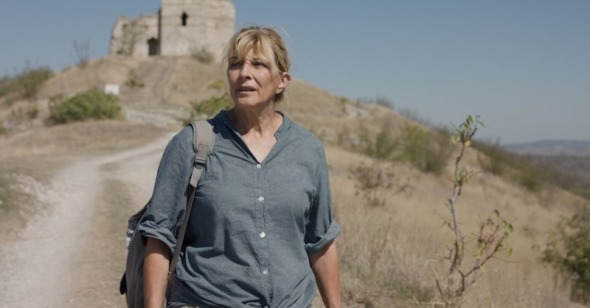
The morning after his arrival in Svilengrad, Saïd wakes up to the rude discovery that his barely functioning sedan has been stolen overnight. Contemplating the next course of action over vending-machine coffee, he runs into old fling Veska (Yana Radeva), an archaeologist back in town to supervise an excavation project at the nearby Matochina Fortress, a relic from the medieval period. The unexpected reunion leads him to the excavation site, where an eclectic group of townspeople has gathered to lend a helping hand. After a lovely dinner with Veska, he abruptly vanishes for a good chunk of the film. Right before this L'Avventura-like exit, a man at a bar confronts Saïd about some sinister affairs he was embroiled in years ago. From there, Veska takes over as the film’s de facto protagonist, and her private investigation into Saïd’s disappearance pulls her back into the criminal network headed by Iliya (Stoicho Kostadinov), with whom she once had a romantic history. In that process, she comes face to face with the unsavory remnants of what Iliya calls “the Golden Age of men”—the decade following the dissolution of the Soviet Union when organized crime became lucrative, and men violated women with total impunity—and a local community still stuck in a social contract with the oppressive kingpin for its survival.
Like its predecessor, The Dreamed Adventure emerged from years of extensive field research and collaborations with the locals, who contributed not only their knowledge and personal histories that shaped the film’s narrative but also their indelible screen presence. Grisebach’s gift for working with nonprofessional actors derives in part from her discerning eye for fascinating faces. Meinhard and Letifov were mesmerizing in Western, and in her latest, we encounter dozens of such characters, with or without spoken lines, whose facial features alone communicate the sheer breadth of their life experiences. Radeva’s is, rather like Letifov’s, engraved with the traces of moral ambiguity, street smarts, and deep kindness that she must have acquired while living through “the Golden Age of men.” In The Dreamed Adventure, the human faces become another frontier at which the battles of wills are fought and the densely layered plot unfolds.
Although there are gunshots and scuffles in this film, its most intense and memorable moments are those of characters in conversations. Spoken words become cinematic gestures, and their often impenetrable countenances make it nearly impossible to predict their next moves. Midway through, Veska is half-pressured into joining a group of small-time crooks for an outdoor booze-up, and they could convincingly be characters in a spaghetti western if dressed in the right attire. As if provoked by the sudden presence of a woman with an unreadable expression, they hurl brazenly misogynistic phrases and probe into her relationship to Iliya. The only action happening in the scene is speech, yet Veska’s stone face and all the guessing games buried underneath the men’s salacious looks render this sequence unpredictable and suspenseful, with the possibility of violent eruptions kept at bay but always palpable. Later in the film, upon Saïd’s unexpected return, we come across a similar moment between him and Iliya as they hash out their dark past. Neither says anything in concrete terms aside from the mob boss’s job proposal involving crossing the Turkish border, but the oppressively tense atmosphere fills the frame due to the absence of clearly defined emotions on their faces. All we can infer from Saïd’s deadpan look is the act of thinking itself.
Curiously, each time we see Saïd drinking coffee, he is deliberating on what choices to make: about the stolen car, the offer from his former partner in crime, and the second reunion with his old flame. More precisely, it is the act of drinking itself—and the duration it takes to complete that act—that embodies the state of suspended potentiality in which Saïd finds himself, pondering the next steps in a place where geographical, temporal, and moral boundaries remain fuzzy. In Grisebach’s hands, this quotidian gesture becomes utterly consequential in a manner reminiscent of John Ford’s oeuvre. In “John Ford, or The Eloquence of Gesture,” a fascinating study on the ubiquity of the act of throwing in the director’s filmography, Japanese critic Shiguéhiko Hasumi points out that this gesture, regardless of the object thrown, often precedes a decisive moment in narrative. A stone thrown into a river in Young Mr. Lincoln (1939), for instance, announces the death of the woman Henry Fonda’s character loves. Whenever Saïd drinks something—and let’s not forget that he is seen consuming alcohol right before leaving town—he comes face to face with the ghosts from his sinister past, leaving him with the option to either get sucked right back in or change his ways.
This also holds true of Veska. In addition to the raucous run-in with the group of drunkards, we see her chatting over coffee with a woman associated with Saïd’s previous life. She, too, has to contend with the inglorious history of the town she once left behind. But she realizes it is possible to refuse, as she does when Iliya offers a liquor at a lavish house party. Determined to stop teenaged Maria (Denislava Yordanova) from being taken advantage of by the gangsters like she and countless other women in the town were in the’90s, Veska instead picks up her pistol and escorts the young girl home. Her act of rebellion soon leads her back to Saïd, who says he’s been waiting for her with a cup of coffee in his hand. Grisebach concludes the film with the serene image of the two characters walking to the excavation site. They are still stuck in the ruins of both distant and recent pasts, but all possibilities stay open—after all, they are at the frontier. What awaits them up on that hill may as well turn out to resemble a half-constructed church ground from My Darling Clementine, where, according to Gilberto Perez, “Wyatt Earp will forever dance with Clementine.”