Crossing the Line
by Lawrence Garcia
New York Film Festival 2026:
La Libertad Doble
Dir. Lisandro Alonso, Chile/Argentina/Luxembourg/Germany/U.K., no distributor
In 2001, a 25-year-old Lisandro Alonso established himself as one of the most audacious and uncompromising directors of his generation with the premiere of his debut feature La Libertad. Chronicling a day in the life of a woodcutter living alone in the Argentine Pampas, the film opens with a bare-chested Misael (Misael Saavedra) sitting by the fire eating an armadillo, the darkness behind him punctuated by flashes of lightning. The remainder of the film follows as he goes about his daily routine—chopping trees, selling the poles for cash, buying supplies—eventually circling back to that opening image. With La Libertad Doble (Double Freedom), Alonso’s unexpected follow-up to La Libertad, the director returns to that same composition, again opening his film with Misael, bare-chested, by the fire, carving off armadillo meat as lightning flashes in the background. To even speak of the “same” composition, of course, is to raise a whole host of questions. Can Misael really have sustained the same routine over the intervening 9,000 or so days? What has and has not changed in the intervening years? And what then does it mean to re-present, or indeed to recreate, Misael’s routine a quarter-century later?
For a time, La Libertad Doble creates the impression less of a remake than of a sequel—something along the lines of Gus Van Sant’s Psycho (1998), where one’s attention falls on deviations, large and small, from the original. As before, Misael goes about chopping wood, but when he returns home to wash, for instance, he doesn’t rinse out the basin before filling it with water. Likewise, instead of being shown Misael pausing work to defecate, as in La Libertad, we see him urinate into the brush. Although he still wears a blue New York Yankees cap and interacts with a large white dog, we notice that this could not possibly be the same cap and dog from 25 years ago. As the film unfolds, however, we are gradually confronted with a possibility that La Libertad raised but did not explore—that is, of a dramatic rupture, a decisive break in routine. After being told that he must go and see his sister, Micaela, Misael makes his way to the local asylum, where a doctor informs him that due to budget cuts, the facility is being shut down. Misael must take his sister with him, incorporating her presence into his routine. And after spending the evening on one of the institution’s beds, he does. Unlike La Libertad’s looped structure, La Libertad Doble thus confronts the viewer with the vertiginous prospect of a second day.
Since the appearance of La Libertad, Alonso has been routinely tagged as a “slow cinema” filmmaker. Six features and umpteen cycles of debate later, it has become clear that even if the term correctly encompasses a set of shared techniques (sparse narratives, minimal dialogue, an emphasis on duration and long takes), it does not do much to capture a director’s style, and is unable to distinguish, say, a Tsai Ming-liang from a Béla Tarr, an Apichatpong Weerasethakul from a Lav Diaz. In Alonso’s case, simply naming the cinematic techniques employed in La Libertad and La Libertad Doble fails to convey what makes the paired films so uniquely discombobulating, which is the way they manage not merely to blur the lines between documentary and fiction, as is commonly held, but to interrogate the very grounds of that distinction.
Although filmed on Alonso’s family ranch rather than the Argentine hinterlands, La Libertad was largely based upon the real-life routine of Misael Saavedra, whom the filmmaker observed over several weeks. Described in this way, the film seems hardly distinguishable from Robert Flaherty’s Nanook of the North (1922), which likewise confronts the problem of how to portray an action as typical, habitual, or recurrent. What was and remains unique about Alonso’s experiment, however, is how it continually activates this formal dilemma through canny decisions of framing, cutting, and duration. Early on in La Libertad, Alonso shows Misael stripping the bark from a tree trunk, the sequence filmed in long shot, without a cut, the continuity of the sequence not just attesting to Misael’s expertise at wielding an axe but also allowing us to grasp the spatiotemporal boundaries of the activity and how it fits into his day-to-day. But later, when the film cuts from Misael walking through the brush to a shot of him catching an armadillo, the action taking up only roughly five seconds of screen time, we are confronted with something other than a straightforward documentation of the quotidian. The animal, which we later see killed and prepared in some detail, is real enough. But the truncated presentation of the hunt makes it difficult to grasp how the action slots into his diurnal routine: Does he hunt and eat armadillos every day? How long does the hunt take? And what does Misael do if he comes up empty? Unable as we are to answer these questions, a fictional thread precipitates out of the documentary material—not as absolutely opposed to it, but as differentiated by contrasting demands of presentation.
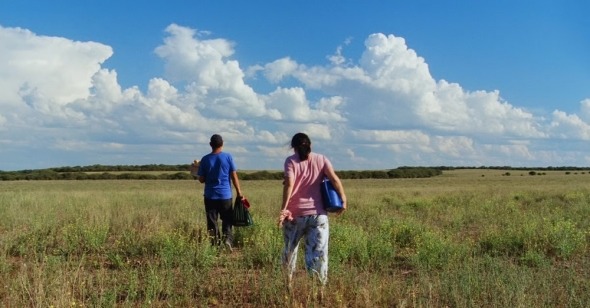
La Libertad Doble returns to, and in effect reverses, this approach. Whereas La Libertad allows a fictional line to crystallize out of its rigorous documentation of routine, La Libertad Doble begins by establishing a fictional frame that nonetheless allows for the presentation of various recurrent realities. (The most proximate point of reference here may be Jean Eustache’s 1977 mid-length masterpiece Une sale histoire, which follows a “fictional” rendering of an event with a “documentary” recording of it.) Now housed some 800 kilometers away from the filming location, Misael Saavedra was in effect asked to recreate a regimen that no longer exists. Yet despite this fictional foundation, it remains possible to discern those habits and regularities which remain—such as Misael’s know-how with an axe and chainsaw, or the region’s climate and weather and vegetation. Similarly, although Micaela is played by Chilean actress Catalina Saavedra (no relation to Misael Saavedra), her performance as a person with mental illness does not prevent the documentation of various other stabilities—principally those of the natural world. Soon after arriving at Misael’s home in the woods, Micaela wanders off as her brother prepares dinner. And, in one of the film’s most striking moments, a cut takes us from a medium shot of Micaela standing below a tree to a close-up of her hand running across the bark of its trunk, her fingers then reaching up into its leaves as the afternoon light filters through. Here, as elsewhere, Alonso highlights how even the simplest changes in framing can emphasize or suppress the film’s fictional demands.
On the morning of the third day—the last the film presents us with—Micaela wanders from Misael’s home once more. When he awakes, Misael goes in search of her. Unable to find her, he returns to the hut and looks despondently through a plastic bag full of medications that Micaela was meant to take. The image is a sign of the times, indexing not just the closure of the fictional local asylum and its effect on the siblings’ respective lives but also the collapse of various real-life systems of social support in Argentina over the past few decades. The political force of the moment, which accentuates the burden placed on the most vulnerable, is unmistakable. But beyond this, what Alonso shows us here is that to traverse the boundaries of fiction and documentary is not, in the end, to leap over an unbridgeable gulf but simply to exploit the most elemental fact of the cinema—its capacity to modulate our perception of what things change and what stays the same.