Sister Act
By Keva York
Bucking Fastard
Dir. Werner Herzog, U.S./Ireland, no distributor
In the history of cinema twins, the image of the Grady sisters standing side-by-side in The Shining is perhaps the most indelible, and so, the most frequently imitated. With their prissy, baby blue frocks and faces of pallid porcelain, they look just like haunted dolls brought to life. “Come and play with us, Danny,” the pair exhort the film’s frightened young protagonist, their plea issued in ominous stereo.
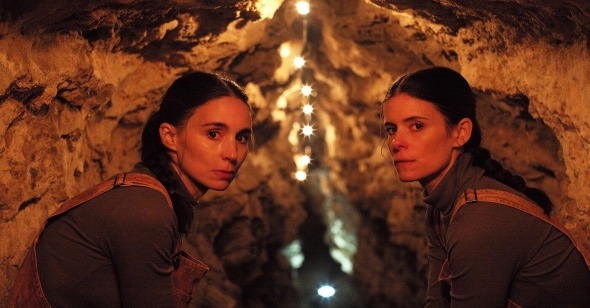
Even Werner Herzog is not above a nod to these sweet little victims of the Overlook Hotel. His quixotically plotted double portrait Bucking Fastard opens on the visages of Kate and Rooney Mara, which come into focus as they murmur, also in unison, about a dream of chirping birds. The characters gazing into the camera are Joan and Jean Holbrooke, mirror images of one another but, like the actresses who play them, “sisters, not twins,” as they later correct a gawker. Like the unfortunate Grady girls, Joan and Jean exhibit a manner of dress that belongs to a prior generation, appearing throughout the film in beautifully layered ensembles that incorporate high necklines, cinched waists, and long, full skirts; Gunne Sax by way of Grey Gardens. The film offers no clear-cut reason for their anachronistic dress—they are not ghosts frozen in the fashion of their day, as in the Kubrick film—but the implication is clear: these are women out of time, out of place. And yet, though there is a spectral air about them, a whiff of something witchy, they are also the film’s heroines: as always in Herzog’s fables, the aberrant occupy the bleakly charmed center.
Uncannily synchronized in speech, movement, and dress, Joan and Jean are no unheimlich fabulation. Rather, they are modeled on Freda and Greta Chaplin, real-life twins, not (just) sisters. The Chaplins were briefly thrust into the public eye in the early ’80s when their neighbor and—as Herzog asserts in the section concerning his own encounters with them in his 2022 autobiography, Every Man for Himself and God Against All—former lover, a truck driver named Ken Iveson, sought a restraining order against them. Iveson had cut off their dalliance after getting married; the Chaplin women had allegedly responded with a colorful campaign of harassment, peaking with them throwing themselves in front of his vehicle. Permitted to take the witness stand together in court, they vehemently and despite considerable evidence refuted Iveson’s claims, in one especially heated moment spitting out the indelible spoonerism that Herzog, decades later, would crib for his film’s title. But first, after the Chaplins lost the case (they were given a suspended jail sentence of one month), the director persuaded them to let him take them out for fish and chips.
There were other symbiotic twins being dissected in the tabloids of the era: in San Diego, there was little Grace and Virginia Kennedy, aka Poto and Cabengo, the subjects of a 1980 documentary by Jean-Pierre Gorin, and in the U.K., sequestered in Broadmoor Hospital, June and Jennifer Gibbons. As fueled by isolation and unhappy circumstances, these girls developed cryptoglossic modes of communication to the point of becoming unintelligible to third parties. But the Chaplins’ double act is uniquely bizarre (if not uniquely unhappy in its origins—Herzog speculates in his book that their father was sexually abusive), suggesting less a pair’s construction of a private world than an attempt to share a single identity between two people.
“You haven’t had any experience until I’ve had it too,” one Jeremy Irons tells another in Dead Ringers, David Cronenberg’s tale of twinned gynecologists with a habit of swapping identities—their duplicitous means of sidestepping unappealing duties and sharing oblivious women. The modus vivendi cultivated by the Chaplins, whose own portion of guile, as showcased in court, is probably best understood as a measure of their naiveté, was not so elegantly conceived. Certain moments in Bucking Fastard—Joan and Jean adjusting their headscarves by gazing at each other instead of a mirror, for instance, or wielding a vacuum between them and becoming distressed when the gap between two armchairs proves too narrow for both to pass through—strike as inspired bits of Herzogian whimsy, but are in fact borrowed directly from the Chaplins; these behaviors are “true” to them in the literal as well as the ecstatic sense.
Human duplicates are wont to stimulate a sort of glitch-in-the-matrix fascination, underlining as they do the material realities of our genetic coding. In Bucking Fastard, Herzog and his long-time cinematographer Peter Zeitlinger consistently balance Joan and Jean in the frame, in effect an extension of Herzog’s description of the Chaplins as “a Rorschach test ready to be folded in two at any moment.” Even scenes concerned with the most banal of actions are thus infused with a lightly surreal quality—but it is a testament to the skill of Kate and Rooney Mara, acting together for the first time, that Joan and Jean don’t come off as just a pantomime act drawn out to the length of a feature film. With an unexpected break in line delivery or a shared conspiratorial smile, they are able to gracefully, synchronously tilt the mood melancholic, then comedic, balancing the inherent contrivance of their roles with a prickly, beguiling dynamism.
Shifting the story from 1980s England to present-day Ireland, Bucking Fastard at first presents itself as a procedural. Speaking to their former lover in court—here, he’s a limo driver by the name of Gareth Mulroney, embodied by a suitably louche and loutish Orlando Bloom—Joan and Jean affirm, girlishly sincere, “You are the love of our lives.” To those gathered in the snug, dark-wood-paneled amphitheater, they entreat, “Is it a crime to love?”
In his six decades of filmmaking, throughout which he has moved fluidly between narrative and non-fiction, Herzog has almost always centered stories of men, and he remains most closely associated with those possessed of a singular, ill-conceived but all-consuming vision. His Joanie and Jeanie prove something like mad dreamers in the mold of Aguirre, Fitzcarraldo, or Timothy Treadwell, but the great and impossible thing they are driven to pursue (their El Dorado, their Amazonian opera house) is the love of a man—specifically, Bloom’s drunken and obviously meritless limo driver. This feels a little retrograde, even in an era that has found an aspirational figure in the trad-wife.
At least their pursuit of love is allowed to take on an increasingly subversive and grandiose form, eventually manifesting in an obsessive quest to bore through a mountain by hand. (Never do Joan and Jean sound more like a mouthpiece for Herzog than when they declare that “Everybody should dig a tunnel through a mountain.”) What begins with the sisters enacting vengeful acts of petty arson around the neighborhood culminates in them cavorting in an ancient Slovenian cave garbed in wedding gowns and veils. If that transition—from grounded courtroom dramedy to metaphysical reverie—sounds difficult to pull off, actually watching the film will not convince you otherwise; unfolding in more or less discrete chunks, Bucking Fastard plays like a kind of exquisite corpse, its genus uncertain.
In literal terms, it is by the intercession of a CGI fox—whom Joan and Jean dub Cupid after he falls into their care, by way of a clunky environmental side plot involving a rabies outbreak and toxic gas—that the narrative makes its final swerve. In part because it’s also screening as part of New York Film Festival, the fox’s appearance for me called to mind Gone to Earth, Powell and Pressburger’s gorgeously tragic 1950 melodrama. In that film, Jennifer Jones plays Hazel Woodus, a ravishing but rough-hewn country girl caught between two awful men, her only faithful companion an adopted fox she calls Foxy. Hazel’s primal innocence causes her to chafe against the rules of courtship and matrimony, and the narrative duly punishes her for it. Neither can Joan and Jean flourish in society, where men are capable only of lust and armchairs are always positioned too close together. Herzog spares his heroines the cruel fate dealt Hazel—not to mention so many of his own flawed heroes—but the crystalline idyll he offers in its place feels more purgatorial than transcendent. While Herzog may have softened over the decades, become more tender in the stewarding of his characters, the world itself has not.