Between Two Worlds
by Michael Koresky
New York Film Festival 2026:
Clarissa
Dir. Arie Esiri and Chuko Esiri, Nigeria/U.S., NEON
Virginia Woolf had an immense, perhaps unequaled gift for summoning into being concrete worlds that she then dissolved, right there, before the mind’s eye. Her characters, using memories as conveyances to glide through the stubborn folds of time, give the reader everything and nothing—a wealth of minute, richly sculpted details whose ephemerality only increases the mystery of their being. Literature’s great unknowable extrovert, Mrs. Dalloway makes for a plum movie character, a buzzing queen of hustle-bustle who seems to want to tell us—and everyone around her—everything but betrays little of her heart’s desire, caught up in the regrets of a private, distant past even as she tends to the fancies of a hectic present. In their marvelous new screen adaptation of Woolf’s 1925 novel, Arie and Chuko Esiri allow Clarissa Dalloway to remain an enigma even as they update the sociohistorical context that gives her life.
In setting their story in contemporary Lagos, the Esiri brothers don’t transform so much as enhance and extract from Woolf’s class parable, creating a rich dialogue between post–WWI England and twenty-first-century Nigeria, both countries still rocked by war, which means death-wracked and hollow for those who saw bloodshed, blinkered and safe for anyone sheltered by privilege. Woolf critiqued and satirized her nation’s empire, but it’s still a charged gambit to reapply the themes, characters, and concerns of a cornerstone work of English literature to a country that had been under Great Britain’s colonialist thumb for more than a hundred years, until 1960. Taking place over one day, Woolf’s book, a crisscrossing network of many characters’ internal monologues rich with parallels and echoes, is set amidst the growing chaos of modernity, predominantly toggling between twinned protagonists marked by separate forms of ambivalence: Clarissa, the wealthy party-thrower preparing for an evening shindig at her home, and Septimus, the working-class former soldier, shell-shocked and unable to reintegrate into civilian life. The Esiris’ Clarissa, edited by Blair McClendon (Aftersun) with an astonishing spatial and temporal clarity, exists in its own specific emotional and social maelstrom, moving back and forth between the unsettled mindscapes of its particular incarnations of Dalloway and Septimus, each an emissary of a very different part of a rapidly changing city: Sophie Okonedo’s tightly coiled upper-class wife and mother, and Fortune Nwafor’s traumatized veteran of the Nigerian Army.
Mrs. Dalloway wears the author’s comfortable contempt of British empire as easily as a springtime shawl; early on, Woolf has Clarissa’s eyes scan over a table at an outdoor bazaar to notice “Mrs. Asquith’s Memoirs and Big Game Shooting in Nigeria, all spread open”—the former referring to a series of autobiographical books popular in the twenties, the latter apparently a satirical invention of Woolf’s. Yet when put side by side, both seem intended to poke fun at the named author, the former prime minister’s wife and outspoken opponent of women’s suffrage. By putting Mrs. Asquith next to a book on big game hunting in Nigeria (she was unlikely to ever set foot there, during or after her husband’s reign), Woolf summons a coupled image that feels key to her feelings on the way British aristocracy treated its colonies as sport and leisure. Precisely, one hundred years later, Arie and Chuko Esiri have made independent Nigeria the central concern of a faithful reimagination and reconsideration of Woolf’s book, which Chuko first read and was enraptured by as a teenager in, aptly, a British boarding school.
At the outset, Woolf has Clarissa wander the class-dissolved crossings of Piccadilly in Westminster; the Esiris’ opening credit sequence, set to a cover of the plaintive American folk classic “Who Knows Where the Time Goes,” gives a kaleidoscopic view of the streets of contemporary Lagos, teeming with vendors, traffic, and construction. Living on the periphery of the city in a fortress of privileged solitude that’s flanked by both calming bushels of pink blossoms and the rattling skeletons of rising buildings, Okonedo’s Clarissa, a child of generational wealth, starts her long day’s journey into the past before 6 a.m. We gradually get just enough detail about her domestic life to understand the entrenched family dynamics: strained relations with her ramrod, analyst husband Richard (Jude Akuwudike), detachment from her largely invisible grown daughter. Her here-and-now becomes secondary to her long-ago—as the day wears on and she puts the finishing touches on her elaborate party, we come to realize it will be less a normal reunion of friends than an assemblage of ghosts: the potential lover she rejected, Peter (David Oyelowo in the present, Toheeb Jimoh in the past); the one-time lover who was perhaps never meant to be, Sally (Nikki Amuka-Bird and Ayo Edebiri); the sweet-natured boor who provided an essential glue in her long-lost group of friends, Ugo (Danny Sapani and Kehinde Cardoso). Hovering even more ominously amidst all these interwoven characters is Septimus, whose severe post-war social alienation and relationship with his long-suffering wife, the tailor Aisha (Modesinuola Ogundiwin), form a counterposed narrative that is also the film’s spine. As in Woolf’s original vision, these figures drift in and out of the past, each of them somehow central and incidental at once, the narrative genuflecting to the characters’ subjective, timeless experiences, so that the word “flashback” all but loses its meaning in the stew of unbound experience.
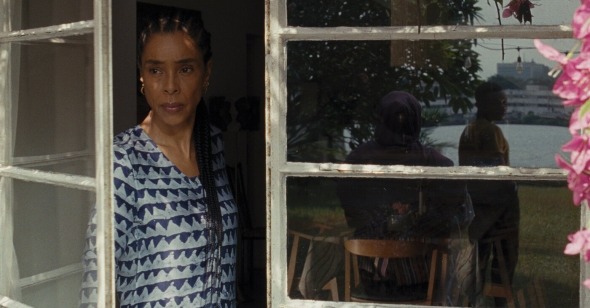
Clarissa’s initial obsessive fixation on minutiae—reprimanding a servant for setting out the wrong dishes, arguing with a worker on the placement of a decorative wall mosaic—gives an early impression of imperiousness. Yet Okonedo’s miracle of a performance will short-circuit any easy reading of Clarissa, whose fixation on control is not given any simplistic psychological or even class-bred framework. With her symphony of exquisite pauses, further suspended in time by the muted, single tones of her flowing house dresses and tight, swept-back cornrows, Okonendo is at once meditative and anxious, self-contained and ready to pounce. Her entire bearing gathers up the ghosts, the youthful events we see on screen already playing out on her unsettled face and anticipatory bearing. Refuge and prison, her lovingly appointed home, with its perfectly placed objects captured in hushed cutaways, is itself a family heirloom, an indication of her geographical and emotional remoteness. And it’s here, in this home, both enchanting and stultifying, with its capacious, waterfront backyard and expressive reflective surfaces, that the Esiri brothers, working with cinematographer Jonathan Bloom, are at their most compositionally striking, placing Okonedo in the frame as an ambivalent, swanning spirit.
It’s almost 9:00 a.m. when we meet Septimus, scraping his fingernails with the trusty straight razor he seems to always carry as both warning and comfort. Living in tight quarters with Aisha in a more teeming, working-class, predominantly Muslim section of Lagos, Septimus is, like Clarissa, haunted, yet his apparitions are more recent, violent, and permeable to the fabric of life. Evans, a former Army friend who, as we come to realize, was killed in a terrifying moment of mental breakdown, makes regular visitations. Unable to socially reintegrate from his bouts of depression and PTSD—afflictions he claims not to have to the psychiatrist his increasingly concerned wife escorts him to—Septimus exists in a constant time loop. His experiences with the Nigerian Army in their attempts to “engage and neutralize” the jihadist Islamist extremist group Boko Haram, and the resultant horrors he has seen, have left him a shell. Knowing the sad fate of Woolf’s Septimus, an afflicted World War I veteran, helps ground these parallel sequences, which may seem out of place or disjointed from Clarissa’s “main” narrative (in the most provocative way). Yet the Esiris give these scenes a jolt of contemporary horror, a reminder that Woolf never wrote a simple story about a rich lady throwing a party. Mrs. Dalloway and Clarissa, perhaps the greatest screen adaptation of any Woolf novel, both tell us that modern life is always a constant negotiation of social composure and simmering brutality.
The best kinds of literary adaptations forgo emulative faithfulness in favor of regeneration, drawing on the artist’s own endemic experience and detail. The specificity of the Esiris’ vision comes into focus incrementally, breathing fresh life and giving new shape to the timeless qualities that have made Woolf’s writing transcendent. In reimagining Clarissa, the filmmakers ensure that her relationships to the erstwhile friends and lovers of her past do not exist in a sociohistorical vacuum. One initial fracture in the bond between Clarissa and Peter (played with wonderful youthful anxiety in flashback by India Amarteifio and Jimoh) is that she was critical of his poetry, which takes as its theme the discord that results from colonialism; Clarissa implores Peter not to use the word “primal” in his writing because it’s a loaded term for Black representation and, she says, “words have meaning.” Clarissa’s world is substantially one of young Nigerian artists and intellectuals, spanning the end of the twentieth century into the twenty-first, reckoning with art and politics (Chinua Achebe’s 1958 novel Things Fall Apart is heralded as still being a central national text by Clarissa and Peter at one point) and the legacies of British rule. Throughout the film, Nigeria is referred to as a country defined by dualities—North and South, quiet and noisy, Christian and Muslim, wealthy and poor—a splintered nation that, as Richard’s patron, the rich politician’s wife Lady Maryam insists, “is better as one.” (A political debate over whether Nigeria should split into two religious and geographical factions has been taking place in the country for a good part of this century.) Clarissa is itself too defined by contradictions to plead for simple reconciliation.
These divided worlds bump against each other only once, very briefly. Aisha, accompanied by her loyal Septimus, turns up at Clarissa’s doorstep. In this fleeting moment, we learn that Aisha is Clarissa’s tailor, here to adjust her client’s outfit for the evening. Clarissa and Aisha walk off to her bedroom, leaving Septimus alone in the foyer. Notably incongruous in Clarissa’s cloistered, tranquil world of privilege, Septimus drifts out of frame, leaving the room momentarily uninhabited, a ghost house waiting to be. He wanders back, and against billowing white curtains, retreats into the backyard, a phantomlike window reflection. Waiting for his wife’s return, he takes in the alien environment, which is still being prepared for the night’s elaborate gathering. The Esiris never show us Clarissa and Aisha interacting within the house, kept entirely off-screen as if to underline that theirs isn’t a true moment of connection but a customary, monetary transaction. Instead, we stay on Septimus, the lost soul, always neither here nor there. Later, in the film’s final moments, Clarissa will dance to Sir Victor Uwaifo’s seventies Nigerian pop tune “Happy Day.” The music is upbeat, joyous, but poignant—we will be unable to forget Septimus, the kindred spirit Clarissa will never know.