A Man of Her Time
by Matthew Eng
New York Film Festival 2026:
Rose
Dir. Markus Schleinzer, Austria/Germany, MUBI
Some screen actors thrive on boundless transparency, while others excel at a reticence so abstruse that one might question whether their approach rightfully counts as acting. (For every Juliette Binoche, a Catherine Deneuve, if you will.) But what of the actor who uses clarity to conceal, who seems to lay it all bare in role after role, but whose directness is itself a smokescreen, a welcome mat leading to a home whose every door is locked? Behind each of Sandra Hüller’s most entrancing and indelible performances is a shadow performance, an inner sanctum of thought and feeling that belies her straight-shooting accessibility.
The brilliance of Hüller’s work in Anatomy of a Fall lies in her deliberate eschewal of mystery, a decision that troubles the film’s central question of whether a garrulous, open-faced, and temperamentally unmysterious protagonist might be hiding nothing save for mariticide. Entire dialogues play out in Toni Erdmann wherein Hüller’s corporate invader speaks as much as her scene partner yet all the while impishly weighing a vague idea, left unspoken. Since her breakthrough role as a pious and possibly possessed woman in Requiem, a devastating tour de force that suggested Carrie White as played by Harriet Andersson, Hüller has earned her place on a singlehanded shortlist of our greatest working actors. But she has primarily done this by foregrounding a legibility of fathomless, often isolated depths. One never loses the sense that each of her characters is the bearer and nurturer of a secret that belongs to Hüller and Hüller alone.
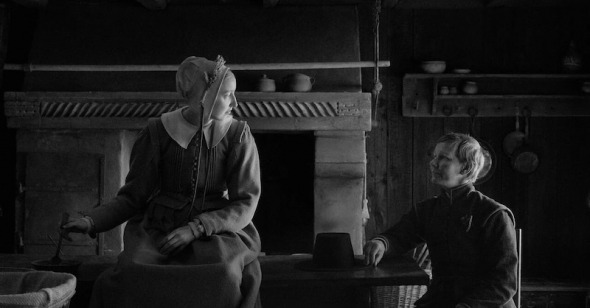
This makes the actress an exceedingly apt choice for the starring role in Markus Schleinzer’s historical drama Rose. Hüller plays the title character, a woman living as a man in 17th-century Germany at the tail-end of the Thirty Years’ War. At the film’s outset, Rose staggers off the battlefield where she fought alongside her countrymen and wanders into a sleepy protestant village, curiously possessing the deed to a long-unoccupied farmstead of which she quickly assumes ownership. Combat has made her a sight to behold: the right side of her face appears to be partially paralyzed and bears a crudely mended scar along the cheek, the result of a bullet taken on the frontlines. Rose wears the bullet on a chain around her neck, habitually chewing on this token of valor that serves as irrefutable proof of her masculine bona fides to her farmhands and neighbors. One of these neighbors, a forbidding elder patriarch (Godehard Giese), shakes up Rose’s solitary domesticity by giving her Suzanna (Caro Braun), his credulous adult daughter, as a wife in exchange for use of his land. Rose forges an awkward yet peaceable existence with Suzanna, even fulfilling his breeding obligations with a homemade strap-on that, to no one’s surprise but Rose’s, produces a son. But Rose buries her bafflement. Her work on the farm and in the community is fulfilling, her reputation unblemished, and her deception entirely unsuspected—until, at last, it isn’t.
Rose marks its writer-director’s first film in eight years following Angelo, a biographical drama about the Nigerian-born Angelo Soliman, who was carried off to Austria as an enslaved child and ascended the ranks of Viennese high society as both a Freemason and a kind of human pet. (The film never obtained stateside distribution.) Schleinzer started as a casting director, most notably for Michael Haneke, who put him in charge of selecting the child actors in The White Ribbon and directing their performances once on set. Two years later, his debut feature, Michael, premiered in competition at Cannes and set off a short-lived firestorm for its depiction of a pedophile’s abduction and abuse of a 10-year-old boy, a premise that even Lars Von Trier might deem beyond the pale. His latest work is the culmination of an extensive research project that began when a historian friend told him about a 1721 German court case in which a woman was executed for committing the crime of sodomy while living as a man. In collaboration with his Angelo cowriter Alexander Brom, Schleinzer immersed himself in hundreds of known instances across centuries in which women became men for any number of reasons. The character of Rose is thus a composite figure, borne of this exploratory process but not beholden to the facts and figures of a single history.
From this foundation, Hüller crafts one of her most expressively fine-tuned and fully realized characters, a Teutonic cowboy of square shoulders, low-pitched voice, and steady, sharpshooting gaze. Although she has cited the inane Glenn Close vehicle Albert Nobbs as part of her preparation for the part, Hüller refrains from parody or mimicry, refusing to put too much stock in appearances. Maintaining the mischievous ease that is one of her trademarks, the actress does not undergo a radical physical transformation but instead submerges herself so deeply into the character that she seems to create a new soul entirely. She gives her performance and, in turn, the character the space to breathe and blossom, even when the film itself could stand to focus more intently on the flesh-and-blood being at its center.
Rather than let Rose speak for herself, Schleinzer and Brom insist on relaying her backstory and contemplating her successive exploits through intrusive, rococo narration recited with witchy relish by the actress Marisa Growaldt. The overindulgent recourse to voiceover certifies the film’s folkloric charm, but it also suggests a filmmaker who does not consistently trust his actors or his austere, elemental images (elegantly shot in black-and-white by his longtime DP Gerald Kerkletz) to speak for themselves. At a critical point in Rose and Suzanna’s marriage, Schleinzer opts to have Growaldt hazily describe the former’s confession and the catharsis that follows as the pair strolls in the countryside. There is a richer, churning realm of interiority too conveniently elided here, an occasional settling for surfaces that makes its earliest passages feel less dramatic than wispily expositional.
The film finds its footing in the wry, tragic union of Rose and Suzanna. In swift strokes, Schleinzer and his actresses delineate an astute and unsentimental portrait of a marriage between eventual co-conspirators, joined by circumstance but bonded by dawning respect, a hint of affection, and the mutual recognition that they are each other’s lone hope of leading autonomous, mobile lives then unattainable to others of their sex. “You don’t belong to yourself,” Rose tells her newly haughty wife in the sole scene where female subjugation is frankly acknowledged, drawing her attention to a deceiving sense of agency that stretches no farther than the farm they inhabit. As Suzanna comes to understand, belonging to Rose might at least allow her a measured independence in the guise of wedded orthodoxy. Hüller’s performance, which earned her a Silver Bear at this year’s Berlin Film Festival, is undoubtedly the main show, but Braun proves every bit the capable partner. In her first feature-length role, the actress traces Suzanna’s abbreviated arc with the lightest of comic touches, moving from docile meekness to frisky, forthright maturity.
There is to be no happy ending for Rose and Suzanna. The film’s final act is a formidable chamber piece unto itself, transpiring primarily in a courtroom and a penitentiary and mounted with clear, calm conviction. Rose’s history comes into full view, but so, too, does a more nuanced examination of gender roles, as we learn that Rose has not only endured but committed sexual violence, the latter inflicted as a spoil of war. Hüller’s pure, direct approach reaches its apotheosis in these scenes, endowing the film with a quaking power that refocuses our attention fixedly, reverently in her direction. She lunges not for pathos but imperturbability. Her piercing, determined gaze, stripped of romance or preciousness, will surely conjure Renée Maria Falconetti in the minds of some viewers, but it is through the composed tones of speech that the actress makes her most commanding impression. As Rose anxiously awaits the executioner’s blow, she reasserts an authority over her short existence of which no country, creed, or god can dispossess her. In death as in life, she shall remain her own maker.