Back to Life
by A.G. Sims
Once Upon a Time in Harlem
Dir. William Greaves and David Greaves, U.S., NEON
In spring 2024, the Metropolitan Museum of Art curated an exhibition dedicated to the Harlem Renaissance, bringing artworks on loan from historically Black institutions around the country into its cavernous halls, amounting to what was the largest exhibition of its kind in 40 years. I hurried uptown to see it. Titled “The Harlem Renaissance and Transatlantic Modernism,” it featured the photography of James Van Der Zee, work by sculptor Augusta Savage, Jacob Lawrence’s paintings, and much more. After winding through the rooms and reaching the end of the exhibition, I was awed by Romare Bearden’s monumental six-panel collage “The Block” (1971). I first heard some of these names in grade school, during a short lesson on this landmark period in Black visual art, music, and literature. I don’t remember what I felt about these artists back then, beyond a hazy personal pride. Seeing the exhibition at the age of 30, the works stirred deeper, murkier feelings in me, while also transporting me right back to that childlike wonder. There was a certain romance about it, too, and not only because I was at the museum on a promising date. I saw myself reflected in these works, especially Samuel Joseph Brown Jr.’s “Self Portrait” (1941), a deep-blue watercolor of Brown gazing into a mirror. Looking at this painting, I wondered about the artist’s interiority. What did he see when he looked in the mirror? How did he comprehend his place in the world around him?
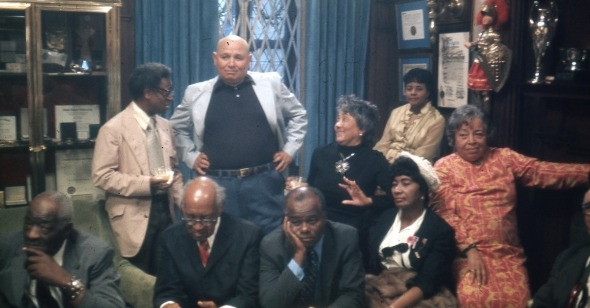
Once Upon a Time in Harlem brought me as close to answering those questions about the minds behind the Harlem Renaissance as one can possibly get to a movement that happened a century ago. The documentary emerges from the vision of late experimental and nonfiction filmmaker William Greaves (Symbiopsychotaxiplasm: Take One) and the cumulative effort of his family to shepherd his footage to screens after his death in 2014. Greaves had the idea to gather the living luminaries of the Harlem Renaissance to discuss and debate the legacy of the movement. In 1972, he threw and filmed a party at the home of legendary jazz musician Duke Ellington, with about two dozen of these important figures in attendance. Greaves was motivated by a desire to document the significance of an explosive intellectual boom that he felt had been underestimated. If the Met’s highly controversial 1969 exhibition “Harlem on My Mind: Cultural Capital of Black America 1900–1968,” which famously didn’t include any paintings or sculptures by Black artists, was any indication, Greaves was right to be concerned about the possibility of erasure. Embarking on this project, then, rhymed with the vision of the time Greaves was reflecting on, a vision of Black thinkers, writers, artists, and musicians, to ignore white society’s weak interpretations and embrace the social responsibility and creative opportunity as the true shapers, storytellers, and historians of modern Black life.
The film opens with the party’s invitation, typed out on letterhead, and then we arrive at the fete in Ellington’s high-ceilinged townhouse on Nicholas Ave. as the guests do. The camera, manned by a crew of four, including Greaves’s son David, moves through the rooms somewhat passively, as an observer, though sometimes directly engaging with its subjects. When the camera stops on someone recognizable, like the heavyset, dark-skinned Van Der Zee, captured earlier at the piano in the opening sequence, the feeling is surreal, as if walking around inside one of his famous black-and-white portraits. The film is alive with historical figures who have long passed on. The specter of death doesn’t hang over the movie so much as suffuse it with a sense of urgency. Names of those who had already died by the time this was shot, like Langston Hughes, Zora Neale Hurston, and Countee Cullen, are invoked and rhapsodized about, ensuring that their contributions wouldn’t be diminished, reflecting the seriousness with which the partygoers took Greaves’s mission to develop an oral history in real time.
So, what exactly do we mean when we talk about The Harlem Renaissance? It’s a fair question, considering that the term captures an idea more than represents what was happening in a literal sense; it only became known as the Harlem Renaissance after it was over. What it is, though, is an interdisciplinary creative movement spanning the 1920s to 1940s, in which Black modern art began to take shape. At the time, it was called the New Negro movement, coined by the writer and philosopher Alain Locke, who alongside W. E. B. Dubois was one of the most influential thinkers of the period. In 1925, Locke published the anthology The New Negro: An Interpretation, and in the title essay he wrote of a burgeoning “spiritual emancipation” occurring under the noses of those driving the conversations surrounding racial progress, as the Great Migration brought Black people from the South into cities like Chicago, Philadelphia, and New York City, creating Black neighborhoods and cultural centers like Harlem. This “New Negro,” as Locke put it, was no longer creating art with the burden of kowtowing to racial stereotypes or even refuting them. The modern Black artist was determined to find and define himself, as in Brown’s “Self Portrait” painting, which has been described as a reflection of Dubois’s theory of double consciousness, or the idea that undergirding Black consciousness is a maddening collision of the perception of self with the ever-present awareness of the white gaze. Something expansive was waking up in Black people, Locke argued, and the evidence was in the art being made at the time.
Greaves’s documentary might be richer for an audience coming to the film with a few of these historical details already in tow. For example, I am kind of stunned, in retrospect, at the presence of conservative Black journalist George Schuyler—who sat cooly on the couch during the party as much of the conversation flew around him—once I went home and read his 1926 essay “The Negro-Art Hokum,” wherein he challenges the entire concept of Black art. In his view, African Americans can only produce European-influenced American art, and there are no distinguishing characteristics of Black art that can’t be explained away by regional conditions and historical circumstances. “Any group under similar circumstances would have produced something similar,” he wrote. At the party, Schuyler dismisses Langston Hughes’s rebuttal, “The Racial Mountain.” Using the example of a Black poet who yearns to be described as simply a “poet,” Hughes argued that perspectives like Schuyler’s, which seek to undermine the existence of a Black experience, conceal a bleaker truth: an implicit desire to be white.
One could imagine that at a party among his contemporaries, artists whose very careers proved Schuyler wrong, there’d be some gloating or simmering resentment, but if there was, it doesn’t appear in the film. After learning of that potent debate between Schuyler and Hughes, I wished it had been addressed more directly in the doc, which is to say that one limiting product of Greaves’s fly-on-the-wall conceit is that context is at times absent where it would have enriched understanding. Relatedly, after I later learned that the painter Richard Bruce Nugent, a big personality in a red turtleneck who leaps off the screen, was one of the few openly gay artists of the Renaissance, his presence at the party carried even more meaning. His queerness doesn’t come up in the film, though, nor does the important queer history of the period (Locke himself was gay). In that way, the artists and thinkers represented, seemingly closer than ever, still remain at a remove. In trying to wrap their arms around an entire era, the filmmakers occasionally sublimate individual histories and experiences.
There’s a convivial home video-like quality to the film, but the visuals themselves are purely cinematic. Shot on color 16mm and seemingly layered with a warm sepia filter, the film is made even more beautiful by the elegant threads of the ’70s, cast against a backdrop of exquisite interior architecture and design afforded by Ellington’s home. Her face framed by her spiky grey hair, Ida Mae Cullen, widow of the poet Countee Cullen and one of the most energetic speakers, wore a silver bracelet with spikes and a kente cloth across her body. Magazine editor Gerri Major wore both pearls and gold around her neck, and bracelets up to her elbows, bulbous rocks on her fingers. The men wore impeccably tailored suits with ties of polka dots, stripes, and paisley. The actor Leigh Whipper, in his late nineties, treated by the group with a reverence befitting his status as an elder, wore an overly baggy light brown suit with drooping lapels and a long cowboy bowtie. They sat and stood in a collegiate-looking sitting room with teal velvet drapes and certificates crawling up the wall, surrounding a dark mahogany mantel. Arguing, shouting, talking over one another, clutching cocktails that threatened to spill over, they discussed and debated the impact of the Harlem Renaissance, returning again and again to the relationship of art development and political struggle, as if orbiting around the topic might pull them closer to a definitive truth hovering just out of reach, something they might all agree on.
Greaves invited some of the guests to return to the house the next day, wearing the same clothing, and conducted one-on-one interviews. These are edited into the flow of the film, along with photography stills often deployed with split-screens. Greaves sat on this footage for a long time, returning to it over the course of his life. After his death, his wife and creative partner, Louise, revived the project, securing restoration funding from the Ford Foundation, and bringing in editor and producer Anne de Mare and archival producer Matt Hoffman. Louise died in 2023, at which point she passed the torch down to their granddaughter, Liani, to be the custodian of the post-production process. In the end, the final product of the film was just as much about remembering the Renaissance as it was about remembering Greaves, a beloved husband, father, and grandfather—a labor of love in the truest sense.
The film ends when the party does, as guests file out of the door and spill onto the street, the camera following them a short way, before cutting to shots of children around the neighborhood, on their stoops or walking down the sidewalk. It’s these children Greaves had in mind when setting out to make this film—not only as the future of Harlem but also as the recipients of history. In these final images, I was reminded of my own childhood encounter with these luminaries, whom I found hard to imagine as real embodied people, inspiring though their accomplishments were. I also thought, of course, of my day at the museum, two years ago, seeing their art production in full relief for the first time. Now this film has put living, vibrant faces and humanity to the venerated names, keeping their legacy alive and offering a new generation an opportunity to connect with a time that deserves to be endlessly reckoned with.