Pompeii and Circumstance
By Dan Schindel
New York Film Festival 2026:
La Gradiva
Dir. Marine Atlan, France, 1-2 Special
Wilhelm Jensen’s 1903 novella Gradiva: A Pompeiian Fancy—or, more precisely, Freud’s 1907 psychoanalytic study of the text—helped establish the literary convention of ancient ruins as dreamscapes, with different fictional figures finding personal meaning in the eerily frozen remains. In the story, an archaeologist’s fixation on a woman depicted in an Ancient Roman relief, whom he names “Gradiva” (she who steps along), is quelled only when it leads him to recognize his love for his childhood friend. Giorgio Albertazzi and Alain Robbe-Grillet have previously adapted the novella into films. With La Gradiva, cinematographer-turned-feature-director Marine Atlan takes a looser approach, centering a troupe of high-schoolers who interface with Pompeii in vastly different ways.
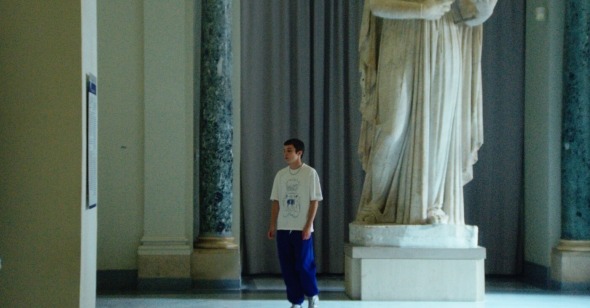
These kids, members of a Latin class on a weeklong school trip to Naples, are nearing graduation and will soon be notified about their college acceptances. That knowledge is in the back of their minds as they tour the city and its archaeological sites, one of many ways the film lays the weight of both history and the future on their shoulders. La Gradiva at first presents itself as unhurried and unstructured, putting different configurations of the teens in various situations to see what their conversations draw out about the issues facing today’s French youth. There are also multiple lectures about Pompeiian art and artifacts. One at the Villa of the Mysteries highlights how consent is front of mind for modern youth, as the kids are perturbed by the apparent distress of the women in the frescoes.
Before Atlan and Anne Brouillet’s script eventually settles into a more conventional narrative, its dialogue style is often at odds with the naturalistic tone. A discussion of teachers’ unions and school standards is particularly broad, and the actors seem stilted by having to work as talking-point delivery systems. (As is often the case with political dialogue, a big issue is that everyone is way more coherent and articulate than most are in reality.) The cast is much more at ease in everyday interactions. The episodic framework gives many of the young actors in the ensemble at least one scene’s spotlight. Atlan cast newcomers as the students, and she gets impressively natural, unpressured performances out of them. As distractingly writerly as the extended conversations may be, they are a convincing social organism—the way they speak, walk, or even just lounge together to take in a lesson as if they’ve all truly known each other for years.
The emphasis is not primarily on the collective, though; every permutation of characters includes at least one of four leads. There’s the teacher, Madame Mercier (Antonia Buresi); burnout troublemaker Toni (Colas Quignard); the quiet and studious Suzanne (Suzanne Gerin); and Toni’s best friend James (Mitia Capellier-Audat), equally marked by his political and restless sexual pursuits. Fictional representations of kids, and especially teenagers, tend to invoke “types.” This is understandable, as young people, still figuring out who they are, tend to sort themselves into different, sometimes overlapping crowds. The problem is that movies and TV shows can be overly broad and several steps behind what real-world students are like. Only in the last decade or so does it feel like American pop culture finally broke away from high school character tropes that had been calcified since the ’80s, for instance. With Toni, Suzanne, and James, Atlan and Brouillet imbue familiar types of teens with much more specificity.
My informal survey of fellow New York Film Festival attendees, with respondents ranging from Generations X through Z, found that many saw themselves as Suzannes in high school. She’s isolated by defensive prickliness as much as by her introversion. James is a darker spin on the golden boy, his popularity rendered via how many other characters are tormented by their desire to fuck him, and how carelessly he treats them. The opening scene is James having sex with Angela (Hadya Fofana), whom he then coldly ghosts for the rest of the story. Toni wants him, as does Suzanne. In an eye-roller of a sequence that comes perilously close to smashing the film’s realism (and tipping it from extremely French to cartoonishly French), he and Madame Mercier, who is otherwise characterized by her professional aloofness from the kids’ immaturity, consider a dalliance.
The film devotes most of its time to Toni, who provides its strongest throughline. He doesn’t act the class clown with any broad pranks, but with myriad snide comments that compound his classmates’ and teacher’s irritation over the course of any given lecture. The authenticity is bracing; we’ve all known kids like this. But the movie also complicates this dynamic, as Madame Mercier is liable to snap only at Toni when another student is equally to blame for an outburst, even outright calling him dumb and publicly announcing she’s giving up on him. A movie rarely depicts how “bad kids” can be made into sin eaters for their peers.
Many of the film’s conversations loop back onto the state of French education, so it makes sense for it to cohere around someone whom that system has failed. In its increasing emphasis on Toni, La Gradiva reveals itself as a tragedy. But when the tragedy arrives, it’s curiously weightless—inevitable and almost perfunctory. For all we get to know about him, he doesn’t feel memorably distinct. He cruises on Grindr, pines after James, and neglects his schoolwork. He’s marked mainly by his fixation on his family’s roots in the area, and the rumor that he comes from fallen wealth. But all these qualities manifest like checklist items to help turn our sympathies toward Toni despite his obnoxious tendencies, instead of making him feel like a fully dimensional person.
The movie excels at showing how kids in general bounce off each other without us getting to know these kids. Atlan, acting as her own cinematographer with Pierre Mazoyer, is adept at watching them, flitting and cutting to capture microexpressions and gestures as they ripple through a group. But dramaturgy proves more difficult. Lacking a way to tie its ideas together, in the end, the film resorts to another format break with an incongruous bit of voiceover narration, culminating in a final line that acts like it’s gained thematic heft from the story but is, in truth, generic in sentiment. Despite having so many genuine moments, the film rarely coheres into a portrait of believable characters. The figures in the Roman frescoes feel more alive.