Dead Pixels
By Sam Bodrojan
New York Film Festival 2026:
Everytime
Dir. Sandra Wollner, Germany/Austria, 1-2 Special
[Warning: Spoilers ahead.]
For children, Minecraft is real life. Over the past decade, the most popular games for kids have shifted from single-player and competitive-focused to multiplayer, online sandboxes which foreground social interaction. Winning is irrelevant; hanging out with friends after school without leaving the house is paramount. Minecraft is the biggest video game on the planet, with a large portion of its user base being under 18. It has held that same demographic for more than 15 years, and has been formative to multiple generations across the planet. It has become as universal an experience as playing soccer or using animal-shaped erasers or scraping your knee on concrete.
In Everytime, the children do not play Minecraft. They play Vintage Story, a more challenging, flexible game with a similar aesthetic. This feels honest; who didn’t, when they were younger, grow attached to some cheaper/weirder/DIY version of a popular activity or toy? There are many reasons that Wollner might’ve chosen to use Vintage Story over Minecraft, many of which are financially motivated rather than creatively. But the result is the same. It looks like a half-remembered playground, a private daydream. Sandra Wollner’s extraordinary new film is enamored of the roundabout ways that technology mediates our relationship to memory. Vintage Story is thus a perfect microcosm for Everytime’s fixation on familiar yet impenetrably personal experiences. Some have asserted that Wollner’s latest exists downstream of Aftersun, which is reasonable; the two share a DP, Gregory Oke, and both prominently feature a holiday resort captured on MiniDV. But whereas Charlotte Wells was focused on resurrecting the past, Wollner has a maniacal pursuit of the present moment. Everytime is not just a film that features vapes and drones and kids who text in emojis. It integrates these objects—often used for trite metaphor or novelty—into the dramatic crux of the text.
It is only clear in retrospect how tightly plotted the opening 20 minutes of Everytime are. Ella (Birgit Minichmayr) is a divorcée and mother of two: the teenage Jessie (Carla Hütterman) and the younger Melli (devastatingly understated breakout child actor Lotte Shirin Keillig). Jessie has a boyfriend, Lux (Tristán López). Seemingly inconsequential moments in these swiftly sketched early scenes will find mirrored images and dramatic payoffs later, a deft demonstration of how mundane experiences gain outsized importance in the wake of loss. The audience might not notice, at first, the poster that Jessie has put on her door, but they will notice when later on, it is unceremoniously taken down and replaced by nothing.
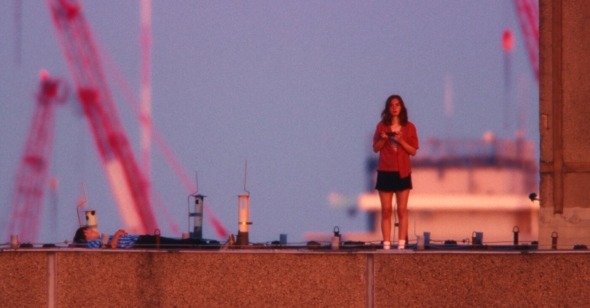
One night, Jessie and Lux go to a rave, and get high in the woods. They climb up onto the roof of an apartment building to watch the sun come up. The audience sees this through a long take shot on a telephoto lens from a nearby building, though the actors are mic’ed so we can hear them speaking to one another. The image flattens the rooftop into a two-dimensional plain. It’s unclear, when Jessie hops to her feet to take a picture of the sunrise, whether she has stepped forward or backward. In Jessie’s last moments, she catches the camera’s eye just as the lens becomes distracted by a bird. Suddenly, the audience is cut off from the couple upon the revelation that the camera is meant to mimic a pair of binoculars. An adult woman and a younger boy whisper off-screen as they peer through buildings. This distraction is interrupted by Jessie’s body—falling, blurred, only recognizable by the shade of her oversized red shirt. The camera does not cut here but instead pans over to a green forest.
Suddenly, Vintage Story takes over the screen accompanied by David Schweighart’s minimalist synth score. The camera flies between voxel trees, towards the clouds, and eventually “no-clipping” beneath the earth’s surface, down towards the lower bounds of the world. Then, in a single match-cut, the bright squares of the video game are replaced by the reflections from a moonlit skylight, Ella and Melli asleep in bed where there was nothing but digital dirt only a moment prior. The veil between three worlds—life, death, and digital—is suddenly so thin one might pass through it without knowing.
Everytime does not pick up immediately after Jessie’s passing. By the time Wollner returns to her subjects, Jessie has been buried. Ella is back at work. Lux is graduating, and he has a new girlfriend. Melli has rearranged her sister’s room. The three have remained close, but the relationship is strained; Ella resents Lux’s recklessness at the same time as she wants to offer him the support to heal and carry on her daughter’s memory vicariously through him. Melli clings to him, openly talking about her sister in a way she doesn’t feel comfortable articulating with her mother alone. Jessie’s absence from the film is startling to the audience, but these people have already grown accustomed to it, even as their grief refuses to subside.
Perhaps Everytime feels so elusive because it is most vividly recalled as a collection of details. There are about a half-dozen Big Images; they are formally audacious, given ample lead-up and thematic weight. But it is the smaller moments that take up residence in memory—like, for example, Lux’s new relationship. He and his new girlfriend appear together for a maximum of five minutes on-screen, yet Wollner is so attentive to how they flirt, how she handles his guilt over his ex’s death, how excited they are to practice being adults together. For a film that establishes its creative aims beyond simple realism throughout (and especially in the last third), it is striking how effectively Wollner conjures a world that feels like it extends beyond the limits of the frame.
Wollner’s previous film, 2020’s The Trouble with Being Born, garnered controversy for implying an incestuous relationship between a father and an android meant to resemble his missing daughter. That level of depravity is not on display in Everytime, but Wollner continues to explore the non-traditional bonds formed under extraordinary circumstances and the ways children are instrumentalized by the adults around them. Ella and Lux’s closeness is at once liberatory and suffocating; by enabling one another to stay suspended in the past, they give themselves permission to grieve irrationally. Though it is immediately clear why Ella might latch onto this boy, Lux’s motivations for spending so much time with them are more opaque; after all, he seems to have a full life outside of them. But Lux harbors an immense guilt over his future, and at times his seeking refuge in Ella resembles a self-imposed penance. Wollner is never prescriptive or judgmental, instead allowing the emotional exploitation to exist alongside any sincere (and unexpectedly effective) efforts to heal.
Everytime harbors real mysteries. Wollner does not let five minutes go by without something happening that goes unexplained. Though most (not all) of these things have explicable causes, often implied by the edit, these answers are rarely definitive or even satisfying. There is a montage of photos that are eventually revealed to have come from Jessie’s phone, including images from the day she died. The slideshow is preceded by Lux scrolling through his phone, surrounded by photos of Jessie crying. The audience is free to make several contradictory logical leaps: that Lux was sent these photos, or that he logged into Jessie’s phone or iCloud and took them after the fact. But there are no real answers, and every possibility only prompts further speculation. It does not meaningfully alter the audience’s relationship to these images to know who or how they see them. No matter what, the audience is complicit in this kind of omniscient voyeurism, this artistic surveillance of a family’s grief (which is made clear even before Ella and Melli are followed by a literal drone).
This mode is not so rigidly conspiratorial or blunt. Everytime predisposes the audience to believe impossibilities for the sake of capturing emotions so fragile that they would break down into gross approximations if put into words. Ella asks Lux to retrace his steps with her from her daughter’s final night, going so far as to do drugs from the exact same baggie. That night, Jessie had stopped at some overgrown train track and looked right, towards something out of frame. Now, Ella in the same spot, looks left, over her shoulder, a delayed reverse shot. There is nothing that suggests that the two women are literally seeing one another across time. But it feels like they do, which is what matters.
The last third of the film finds the three taking an impromptu trip to Tenerife, Spain, for Jessie’s birthday. Melli recognizes these spaces from home videos taken when Jessie was a toddler. On the day itself, a host of inexplicable events occur in rapid succession, blurring the line between reality and the digital spaces which have thus far only existed in parallel. The first is that Melli, who has developed a habit of texting Jessie’s number even after her passing, witnesses a speech bubble appear in response to one of her messages. Before Melli can receive a reply, however, her mother accidentally throws the phone down a mountain, bricking the device. At that same mountain’s summit, the three witness a shaft of light move across the trees opposite where they sit, in the exact same pattern seen on those camcorder tapes.
Back at the pool, Melli accidentally ingests some of Lux’s drugs from her mother’s purse. Shortly after, she discovers Jessie, once again a toddler, in the same clothes she wore in the home movies, with the same loud toy truck, in the same nondescript hallway. What follows could easily be dismissed as the hallucination of a child unknowingly on drugs; events follow the free-associative logic of a dream. The film’s climax, specifically, involves a group of children recreating Vintage Story–esque tasks on the beach, culminating in a flare-gun shot at the horizon to extend Jessie’s birthday past 24 hours, turning the sun into a square. Melli’s subconscious extends out into the world around her, an urge to protect and rescue her sister resulting in the overlap between spaces they once shared and this new place where Jessie had existed before her. All evidence of the evening seems to evaporate overnight, with the exception of baby Jessie. The next day, the toddler is still there, still in that oversized Tenerife sleep shirt. In voice-over, Melli says that Lux eventually falls out of touch with the family, that this new version of Jessie’s earliest memories seems to be contextless descriptions of the home videos.
This ending is unsettling, neither wish fulfillment nor the beginning of some cursed cycle. Everytime is more than a mere fable, or domestic drama, or lightly surreal exploration of grief. It is an unbearable tragedy wherein a young girl becomes her older sister’s older sister. Wollner is bold enough to assert that this divine intervention might nevertheless bring someone closure. Everytime is about the fragments of people that remain after their death, how these digital and geographic remnants constitute a life of their own.