Against the Music
By Alexander Mooney
New York Film Festival 2026:
Everything Else Is Noise
Dir. Nicolás Pereda, Mexico, Pragda
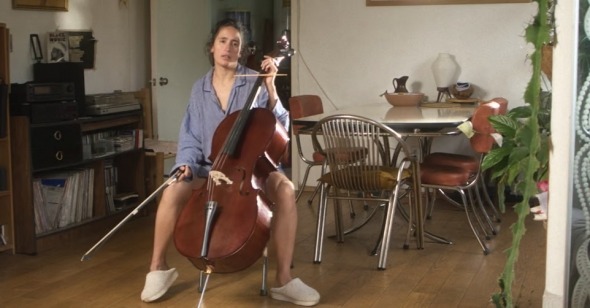
As you might have guessed from its title, Everything Else Is Noise places hefty significance on the auditory. What constitutes “noise,” however, is in the ear of the beholder. We are drowned in cacophony in the film’s opening, as a long jumble of cars fail to arrange themselves along a Mexico City thoroughfare. All of the subsequent action is confined to an apartment, but the racket rising from the street rarely abates. Indoors, environed by a healthy assortment of houseplants, Tere (Teresita Sanchez), a cellist and composer, is accosted by her neighbor, whose newborn is reportedly disturbed by the sounds of her practicing but not by the incessant barking from the dog across the hall or the jackhammers below. To a captive audience, it seems, high art can sound like nails on a chalkboard.
Clashes between culture, craft, perception, and ego are the film’s droll MO, part and parcel of writer-director Nicolás Pereda’s deadpan and desiccated style. The Mexican Canadian filmmaker favors sparse scenarios of confinement and confabulation, his characters––played by a loyal company of regular performers––possessing a knack for saying much but expressing little; for talking to, and through, each other; for role-playing impending encounters and having their performances proven prophetic. Again, Pereda frames a fleeting farce, and its cramped locale, in widescreen, his figures spread through horizontal space and left with a dearth of literal and figurative headroom. Within this narrow aperture, they have little room to think or breathe. Far less conceptually and tonally constricted than his previous efforts, however, Everything Else Is Noise flits through its 71 minutes with ease, insight, and low-key humor.
Fellow composer Rosa (Rosa Estela Juarez Vargas), in need of a picturesque backdrop, borrows Tere’s apartment for a television interview with the conceited culture reporter Lazaro (Gabino Rodriguez). On the periphery are cameraman Paco (Francisco Barrero), moonlighting as an independent filmmaker, and Tere’s daughter, Luisa (Luisa Pardo), who has followed in her mother’s footsteps despite an apparent rebellious streak. As they attempt to shoot, the quintet is constantly beset by interruptions beyond their control, and the incompetence and incuriosity of the two-man crew, which proves to be well within their control.
These points of friction fracture the film along gendered lines. The three women––all seasoned pros of different generations––are united by knowing glances and dry demurrals as the two men, eventually complemented by a third, variously engorge and belittle each other’s inflated senses of importance. The interview itself, conducted by Lazaro with blundering pomp, commences with a patronizing prompt about trailblazing to overcome patriarchy, which Rosa, deferring almost immediately to her older peer, gently dismisses by reminding him of the many women composers before her who led the way. Lazaro continues, not inquiring but provoking, disguising his own observations as invitations to his subject to comment; even his most innocuous queries (“We’d like you to tell us how you got started in composition...”) sound foolish because, prior to their arrival, Tere had predicted them nearly word-for-word. The through line from Lazaro’s comments is a need to impose a narrative on every dangling thread of method or technique, which collides repeatedly with Rosa’s affable frankness; in trying earnestly to play along, she winds up dressing him down.
When she deflects attention toward Tere, however––both Pereda and Paco’s camera panning to accommodate––the film shifts slightly on its axis. She recalls embarking into composition at 30, when her daughter was 13; asked by Rosa about teen motherhood, Tere divulges that Luisa’s father, the renowned Maestro Estevez (Jose Rodriguez Lopez), was her teacher in music school, and jumped ship shortly after her daughter’s birth in favor of “his own family.” Lazaro, heretofore too cool for school, perks up like a fanboy at the mention of the maestro. Later, after grilling Rosa more about “chromaticism” and “feminine vulnerability,” he turns to Tere to ask what he’s been itching to, claiming that he wouldn’t want to pry about her relationship to Estevez but wants to hear how he “influenced her development.” Tere proceeds to reenact the piece she wrote about their relationship, emitting a cartoonishly long, low, tuneless moan. Impatient and mortified, Lazaro finally says, “fantástico.”
In the following scene, Luisa stages a similar endurance test. Preparing to play the cello for the camera, she requests that everyone close their eyes, so the visual does not interfere with the aural. At this point, Pereda cuts to the reverse shot, training the lens on the living room of onlookers who, one after another, obey. Lazaro, after laughing and rolling his eyes, eventually complies as well. Her performance is, at first, similarly risible to Tere’s prior outburst, its discordancy blending in with the car horns outside. As the shot continues over several minutes, the sounds of her harsh, experimental technique sound increasingly impressive. As with Tere, it is hard to parse the level of seriousness with which the “music,” which might more accurately be called noise, is delivered; are they avant-gardists, practical jokers, or both? The only clear answer is: like mother, like daughter.
In these moments of synchrony between the women, the stiff air of stilted sarcasm––Pereda’s greatest strength and limitation––is briefly punctured, allowing clearer access to otherwise translucent figures and giving Everything Else is Noise its emotional thrust. In a standout sequence, the group waits for the power to come back on: Lazaro and Paco head to the cafe down the street while Tere, Luisa, and Rosa kick back for a gab sesh. Lazaro and Paco’s inane exchanges fill the soundtrack, and the women’s convening is muted, told through performance and behavior, their gestural warmth undermining the dubious dialogue. It’s not only a successful gag but also genuinely sweet. This is the sort of sororal respite that the film returns to in its extended coda, when Tere and Luisa host Estevez for dinner. Having already mapped out the course of their scant conversation with the man via Pereda’s calling card play-acting, the two women enter a bitter, disheartening evening––which could only dredge up longstanding disappointments––with the upper hand. The film ends, wisely and ruefully, with their laughter.