A Temple of Texts
by Jeff Reichert
Chronovisor
Dir. Kevin Walker and Jack Auen, U.S., Grasshopper Film
Have you ever experienced a pleasurable, tingling sensation at the thought that somewhere out there, perhaps locked in a vault, stashed in a shoebox, or hidden in plain sight on the dusty shelves of an unassuming bookseller, lies a secret, suppressed, or once lost text that could change the course of humanity, unlock portals to other worlds, or reveal secret histories? This is the stuff of Umberto Eco’s The Name of the Rose, recently departed John Crowley’s Aegypt cycle, numerous works of M. R. James and H. P. Lovecraft and, well, of course, The DaVinci Code. A besottedness with apocryphal, occult-adjacent texts runs through moving image arts: a few that immediately to mind come are Mariano Llínas’s epic La Flor (especially the Arthur Machenalia of Chapter 4), Carpenter’s In the Mouth of Madness, and Polanski’s The Ninth Gate. Any recovering fans of the quite awful, terribly watchable, three-season Fox supernatural-American-history-cum-modern-policier Sleepy Hollow reading this? Don’t be shy.
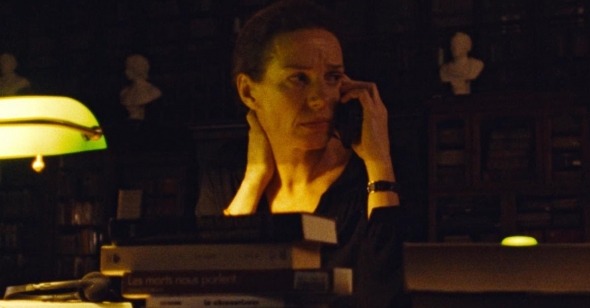
Chronovisor, the first feature by American directing duo Kevin Walker and Jack Auen, takes on-screen textual curiosity to a perverse extreme. It is a movie largely comprised of lingering 16mm shots of a woman reading, often taken from a distance, often facing away from the camera, intercut with close-ups of the texts she is examining—obscure books, magazine articles, correspondences. (To help the viewer parse frame after frame filled with words, the filmmakers cleverly deploy white overlays on the portions of text they want us to absorb.) Ever so occasionally we’re gifted an ambiguous reaction shot. Sometimes the woman walks through a ghostly nocturnal New York City, most likely headed off to another cavernous space to scan more texts. Sometimes she makes a phone call. There’s not much more to the list of material elements in Chronovisor, yet from these, the filmmakers have crafted one of the most intellectually expansive and legitimately thrilling movie mysteries in recent memory.
Chronovisor’s protagonist is Béatrice (Anne-Laure Sellier, an actual academic and professor)
who, while in the midst of finishing a research project—perhaps her dissertation—on the concept of memory palaces, or, the method of loci, makes an unexpected find. One night, while listening to a series of cassette recordings in a deserted library space lit only by a handful of scattered banker’s lamps, she sits up a little straighter in her chair. She’s hearing the voice of Father Pellegrino Ernetti, an Italian Benedictine Monk who argues that he, with the help of prominent physicists and researchers like Enrico Fermi, had developed a device called the Chronovisor, which would allow them to tune into the past, capturing lingering audiovisual traces of events long distant on a small television screen. She quickly removes her headphones and strides out of frame to collect more texts on this new subject, but the filmmakers cleverly let the Ernetti recording continue.
She begins to obsessively research the Chronovisor—the film is “set” in New York City, but the grand library interiors she inhabits were cobbled together from a few locations across the mid-Atlantic. As she continues, a hidden history of the device, and its creator, begins to emerge. Ernetti claimed to have used the device to witness the Crucifixion and watch premieres of classic Greek tragedies. As the texts accumulate, there’s a suggestion that Pope Pius XII was made aware of these experiments and ultimately ordered the monk to cease his activities. One night while watching a related videotape, her face pressed close to the screen, she hears a screech from the darkness—has her search placed her under scrutiny? Coming into Chronovisor for a first time, with little knowledge of the narrative, I found the filmmakers’ archival components so convincing I assumed they must be skillfully done forgeries. It was something of a backwards delight to learn that their narrative scaffolding hung on an exhaustively researched and sourced true story.
Throughout, Béatrice remains, appropriately, a cipher. Even in the moment she determines to turn her focus toward the Chronovisor, we only see her from behind, standing stock still, the camera moving closer and closer to her tight chignon. And yet, if we consider more deeply what the filmmakers do give us of her, a clearer picture emerges, as if via tuning of the titular device. She’s almost never without a book in hand—she doesn’t even undress fully for bed without reaching for another tome. She’s obviously a night owl—often up late making calls to minor European publishing houses as they open for business and speaking to them fluently across four or five languages. She’s not just smart, she’s canny and cunning—as she runs into blocks with publisher after publisher in search of connections to Ernetti, she invents a new strategy: she abandons her identity as a researcher and recasts herself as the head of, variably, a parapsychology or polyphonic music organization hoping to bestow a lifetime achievement award on the monk. Béatrice is also clearly, like so many of us, susceptible to a good rabbit hole, though notably we never see her conducting her research via the internet. The film’s limited palette but seemingly limitless control over it invites its viewers to be textual detectives sussing out clues as the narrative rolls forward.
And the film really does move ahead at a rapid clip for a work of largely static compositions and text on-screen. The filmmakers’ tightness of form extends to a similar elegance of its metaphors—the memory palace was a Greek mnemonic device, revived to more extensive use in the Renaissance (notably by Italian hermetic scholar Giordano Bruno, one of the major dramatis personae of Crowley’s Aegypt books) in which the practitioner would conjure a familiar environment and then methodically “place” pieces of information in certain locations there to be more easily recalled later. What if the world itself was a memory palace that contained everything that had ever happened and we just needed to right tools to see it? It’s completely legible why Béatrice, who displays flickers of disdain for the dead-end insularity of academia across the film, would be drawn to the Chronovisor (so drawn that she repeatedly flubs her dissertation defense)—here is a course of research that, were it followed to the end, could provide humanity with actual answers to long-running queries, not just fodder for more debates.
A challenge with texts built around the existence of a long-hidden or scrutinized works (real or apocryphal) surrounds sticking the landing—how disappointed was the world to finally hear Mr. Holland’s “Opus”? There is no proof the Chronovisor device ever existed, no documentation of the images Ernetti purported to have captured, and his collaborators have long vanished from the Earth. That leaves a film like Chronovisor with essentially two choices. One would be that Béatrice hits a wall in her searching, abandons the quest and returns to her daily life, perhaps to pick up and complete her bungled dissertation. In such a scenario we might read her Chronovisor diversion as the result of some bruised bit of psychology. The other available path would require imagining the Chronovisor, where it now sits in the world, what it looks like, what its captured images would look like, and how Béatrice interacts with the machine—what historical moments would she want to see? I won’t go much further into unpacking the details of Chronovisor’s quite excellent conclusion other than to note that Walker and Auen seem remarkably unafraid to take a final leap of faith into the unknown, which is in keeping with the constant riskiness of this strange and singular debut.