Pledge of Loyalty
By Ryan Swen
The Samurai and the Prisoner
Dir. Kiyoshi Kurosawa, Japan, Janus Films
While it would be foolish to downplay the influence or the achievement of the films that made Kiyoshi Kurosawa a de facto figurehead of the late ’90s and early ’00s wave of Japanese horror, using his facility with the genre to set expectations for all his work does a disservice to the breadth of his abilities. The key to Kurosawa's cinema is his multifaceted approach to various forms, each storytelling configuration providing its own archetypes and stylistic markers that can be freely mixed even as he maintains control over tone and aesthetic style. Accordingly, films like his exquisite domestic drama Tokyo Sonata (2008), the introspective travelogue To the Ends of the Earth (2019), and the pitch-black Internet thriller satire Cloud (2024) refuse to belong cleanly to a single genre, and even a more easily classifiable horror film like Pulse (2001) gradually morphs into a mournful, apocalyptic death march.
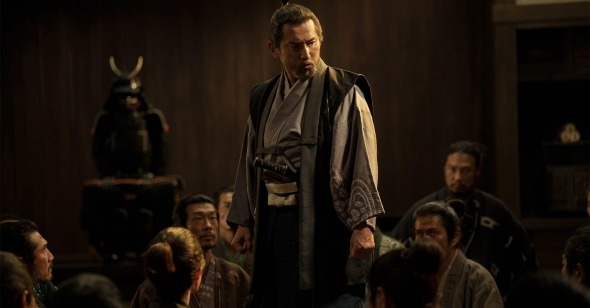
With this in mind, his 40-plus-year career reaches a kind of apotheosis in The Samurai and the Prisoner. Adapted from Kokurōjō—also the film's Japanese title, which translates to “Black Prison Castle”—Honobu Yonezawa's collection of short mystery novels, it represents only Kurosawa's second period film, after his World War II–set Wife of a Spy (2020), and his first far removed from the present day. As the opening titles speedily establish, it concerns the mysterious 1578 rebellion of the daimyo Araki Murashige (Masahiro Motoki), a former retainer of the mighty Oda Nobunaga, who resists his former master’s aims to rule all of Japan. While carefully planning his actions in Arioka Castle, he kidnaps Nobunaga's envoy, the wily Kuroda Kanbei (Masaki Suda, the lead of Cloud, adroitly playing a significantly more expressive character), only to forge an unexpected bond with him as he attempts to uncover the truth behind several bizarre events, beginning in winter and continuing over the course of four seasons. After Wife of a Spy, a film made for Japanese television that even in its theatrical version thrums with an uncannily digital, high-frame look that creates a no-man’s-land of bright environs in purposeful contrast with its characters' hazy intentions, it can be something of a shock to see how straight The Samurai and the Prisoner seems to play its setting and attendant genre conventions.
Handsomely mounted on elaborate castle sets and utilizing Kurosawa's steadier-than-ever compositional mastery to capture long walkways, imposing towers, and the shadowy basement dungeon in which Kanbei is perpetually confined, the film conforms at first to the appealing logline of a murder mystery that happens to take place in 16th-century Japan: the son of a lord who broke his allegiance with Murashige is held captive, despite his plea to be killed as per samurai custom, only to die inside the castle from a mysterious wound to the back. Through both Murashige's investigations (involving arrow trajectories and interviews with his servants and soldiers) and Kanbei's intellect, which is cloaked in diffident inquiries and poetic riddles, the men uncover the ingenious and tidy solution.
This first mystery is by far the shortest and most concrete that The Samurai and the Prisoner will unfurl over its measured two-and-a-half hours, and by the end the panoply of names and competing allegiances stretching across Arioka Castle dwarfs the plot convolutions of any of Kurosawa's previous films. While it is possible to view the accumulation of details as mere busywork, it feels more in line with Kurosawa's interests to regard them as a slow, increasingly nightmarish downward spiral, each breach in security another step into an illogical realm perceived by many of Murashige's retainers as divine punishment. In that sense, The Samurai and the Prisoner is strikingly reminiscent of Kurosawa's masterpiece Cure (1997), the ultimate cop movie as all-consuming horror, where the temporary cessation of mounting bodies only demonstrates the impossibility of halting evil itself.
Kurosawa is not after such frightening aims this time around, but his ultimate destination is equally ambitious: a moral exploration of an entire epoch. For the first time in his filmography, the Sengoku period allows him to depict codes of honor that are not the nebulous concept only sometimes obeyed in modern society—the abstruse yakuza loyalties of Serpent's Path or the settlement money reluctantly paid to a car accident survivor in License to Live (both 1998)—but instead the rigid backbone of this era's behavior. Despite the many underlings who urge Murashige to show no mercy towards his captives or enemies, he demurs, instead forging his own path. Through lengthy tea ceremonies as tests of character, confrontations that begin rancorous and end with attempted reconciliation, and roundabout negotiations using the least likely of collateral, Murashige's approach—in tandem with the intense dignity of Motoki's performance—never quite adheres to the prescribed actions demanded of him by the weight of tradition, proceeding in odd, even ungainly feints and changes of heart that resemble the film's unpredictable rhythms. His attempts to spare his hostages often only result in further bloodshed, and yet his unyielding nature becomes a fully formed ethos, one yearning to be understood by lionhearted vassal and shrewd tactician alike.
In the end, a choice on Murashige's part—the most significant deviation from Yonezawa's text, which instead ends from Kanbei's perspective—thrusts the daimyo into newfound territory, exiting the center stage of history to pursue a different way of life. This rejection of the expected, easily definable forms of behavior in favor of a more unconventional, indefinite existence, pushes The Samurai and the Prisoner closest to Kurosawa's past works. Like his quietly enigmatic protagonist, the modern master offers no easy answers for how even a lord can reckon with the crushing forces of conquest that he helped set in motion, but the patient eloquence with which he poses these questions builds a film as labyrinthine and monumental as Arioka Castle itself.